
Copa América Centenario – The Groups
FSPortal
- posted on
Last updated: 21 August 2026
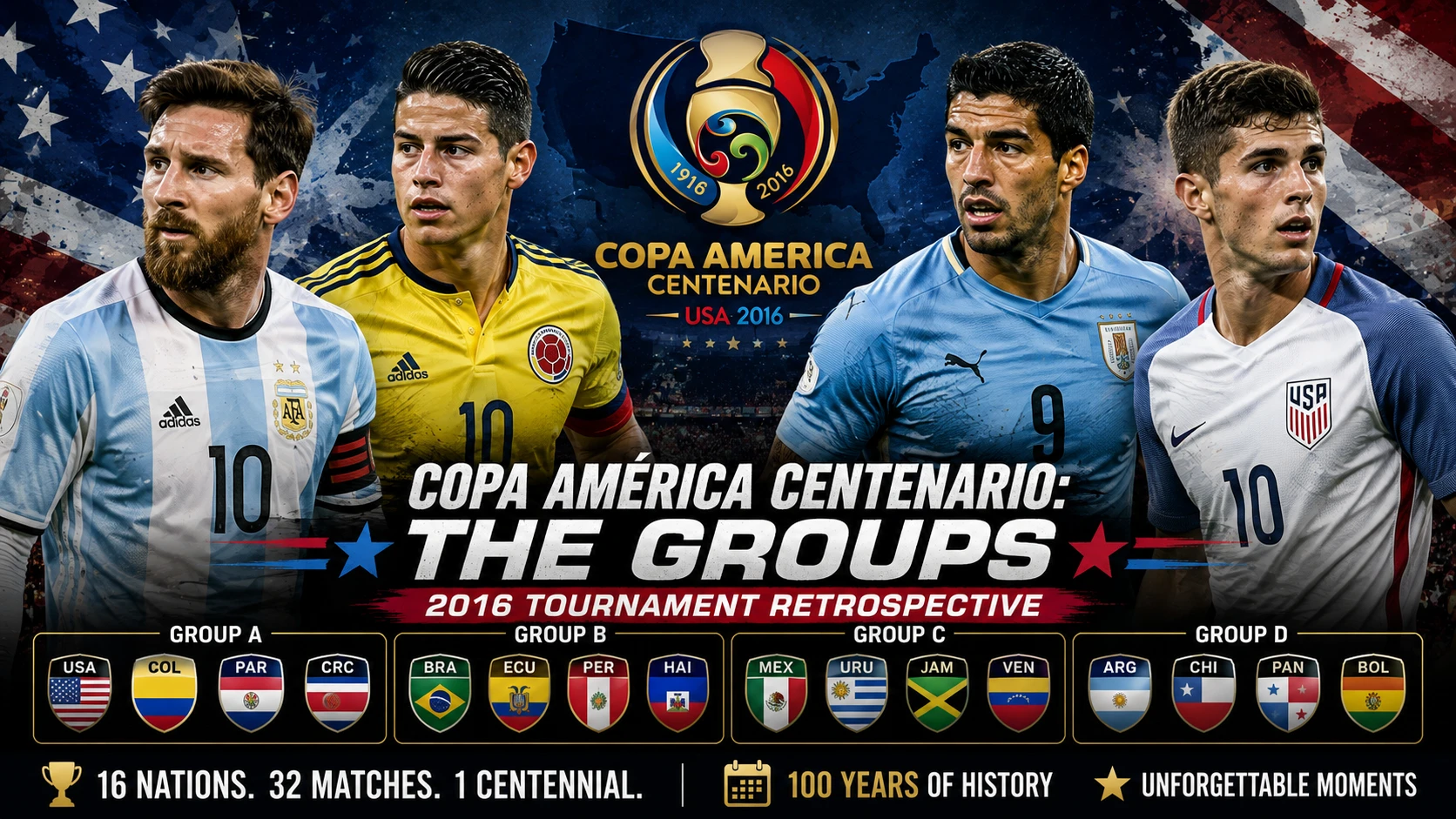
The Copa América Centenario was a special edition of South America’s international championship, staged in the United States in June 2016 to celebrate 100 years of the competition.
Sixteen nations took part, with Argentina, Brazil and Uruguay among the pre-tournament favourites and the United States competing as hosts. The expanded tournament also brought CONCACAF nations including Mexico, Costa Rica, Jamaica, Haiti and Panama into a fascinating month of international football.
Originally published immediately before the tournament, this Fantasy Sports Portal preview preserves our assessment of the four groups and the players we expected to make an impact from a football and fantasy perspective.
Group A: United States, Colombia, Paraguay and Costa Rica
Hosts United States entered Group A with a realistic chance of progressing. One particularly interesting member of the squad was Borussia Dortmund midfielder Christian Pulisic, who arrived at the tournament aged just 17 and was already regarded as one of the country’s most exciting prospects.
Colombia were the major force in the group. Carlos Bacca offered a significant goalscoring threat, while James Rodríguez remained the team’s outstanding creative talent after becoming one of the stars of the 2014 World Cup in Brazil.
Paraguay had reached the semi-finals of the previous Copa América and were not to be underestimated. Their organisation and defensive resilience made them potentially difficult opponents, while Juan Iturbe provided pace in attacking areas.
Costa Rica completed Group A. Their remarkable run to the quarter-finals of the 2014 World Cup remained fresh in the memory, although this appeared to be a difficult group from which to qualify.
Group B: Brazil, Ecuador, Peru and Haiti
Brazil were the headline team in Group B, although Dunga travelled to the United States without Neymar, who was instead scheduled to represent his country at the Olympic Games in Rio later that summer.
That absence raised questions about where Brazil’s goals and creativity would come from. The Seleção had also failed to progress beyond the quarter-finals in the previous two editions of the Copa América.
Ecuador represented a potentially difficult opponent. Enner Valencia, Antonio Valencia, Juan Carlos Paredes and Jefferson Montero were familiar names to Premier League followers, while Ecuador had also been performing strongly in South American World Cup qualifying.
Peru had finished third at the 2015 Copa América after narrowly losing to Chile in the semi-finals. Paolo Guerrero remained their major attacking threat after scoring four goals at the previous tournament and finishing as joint-top scorer.
Haiti completed the group and were making their Copa América debut after reaching the quarter-finals of the 2015 CONCACAF Gold Cup.
Group C: Mexico, Uruguay, Jamaica and Venezuela
Mexico and Uruguay appeared to be the strongest teams in Group C and met each other in their opening match.
Mexico arrived as reigning CONCACAF Gold Cup champions. Javier Hernández provided a proven goalscoring threat, while Andrés Guardado brought considerable international experience and creativity.
Uruguay entered the tournament as the most successful nation in Copa América history at the time, having won the competition 15 times.
Their major concern surrounded Luis Suárez. The Barcelona striker had suffered a hamstring injury in the Copa del Rey final against Sevilla shortly before the tournament and his availability became one of the major stories surrounding Uruguay’s campaign.
Suárez was also returning to a major international tournament after the suspension that followed his infamous incident with Italy defender Giorgio Chiellini at the 2014 World Cup.
Jamaica had reached the final of the previous Gold Cup and therefore could not be dismissed completely, while Venezuela entered the competition during a difficult World Cup qualifying campaign.
Group D: Argentina, Chile, Panama and Bolivia
Argentina entered the Copa América Centenario as favourites after losing the 2015 final to Chile on penalties.
The 14-time champions were seeking their first Copa América title since 1993 and possessed arguably the strongest attacking squad in the tournament.
Lionel Messi was joined by Gonzalo Higuaín, Sergio Agüero and Ángel Di María, giving Argentina an extraordinary collection of attacking options.
Their principal competition in Group D appeared to be Chile, with the teams meeting in a rematch of the previous year’s final.
Arturo Vidal provided power and aggression in midfield, while Alexis Sánchez was one of Chile’s most dangerous attacking players.
Panama were making their Copa América debut after finishing third at the 2015 Gold Cup, while Bolivia completed a challenging group.
What Happened at the Copa América Centenario?
Looking back from 2026 makes the original preview particularly interesting because the tournament produced several major stories that were difficult to predict beforehand.
Colombia and the United States progressed from Group A, while Brazil suffered a shock group-stage elimination after finishing behind Peru and Ecuador. Mexico and Venezuela advanced from Group C, with Uruguay also eliminated before the knockout stage.
Argentina and Chile progressed from Group D and eventually met again in the final, exactly as they had in 2015.
Once again the match finished goalless and Chile defeated Argentina on penalties, successfully defending their Copa América title. The defeat was particularly painful for Argentina and Messi, who announced his international retirement immediately afterwards before later reversing the decision.
Players Viewed Differently a Decade Later
The original preview also captures several players at fascinating moments in their careers.
Christian Pulisic was only 17 and being discussed as a potential breakthrough player. James Rodríguez was still viewed through the extraordinary impact he had made at the 2014 World Cup, while Lionel Messi was still searching for the senior international trophy that would eventually arrive later in his career.
The tournament also demonstrates why international fantasy football can be difficult to predict. Brazil and Uruguay possessed enormous football pedigree but failed to escape their groups, while teams such as Venezuela and hosts United States exceeded many pre-tournament expectations.
Fantasy Football Analysis Before xG Became Mainstream
Reading the preview a decade later also highlights how closely fantasy football analysis was already connected to ideas that have since become standard in mainstream football coverage.
We were assessing likely starters, goalscoring potential, injuries, tactical roles, set-piece threats, group strength and expected progression through the tournament. Today those discussions are increasingly supported by expected goals (xG), expected assists (xA), shot data, possession models and other advanced metrics.
The terminology has evolved, but the underlying objective has not: estimate what is likely to happen next and identify the players most capable of influencing it.
That overlap between fantasy football and conventional football analysis is one reason the Fantasy Sports Portal archive remains relevant. These articles provide a contemporary record of how teams and players were evaluated before the results were known, rather than a history rewritten with the benefit of hindsight.

