
Euro 2016 Fantasy Preview: Turkey
Jamie Smith
- posted on
Last updated: 21 August 2026
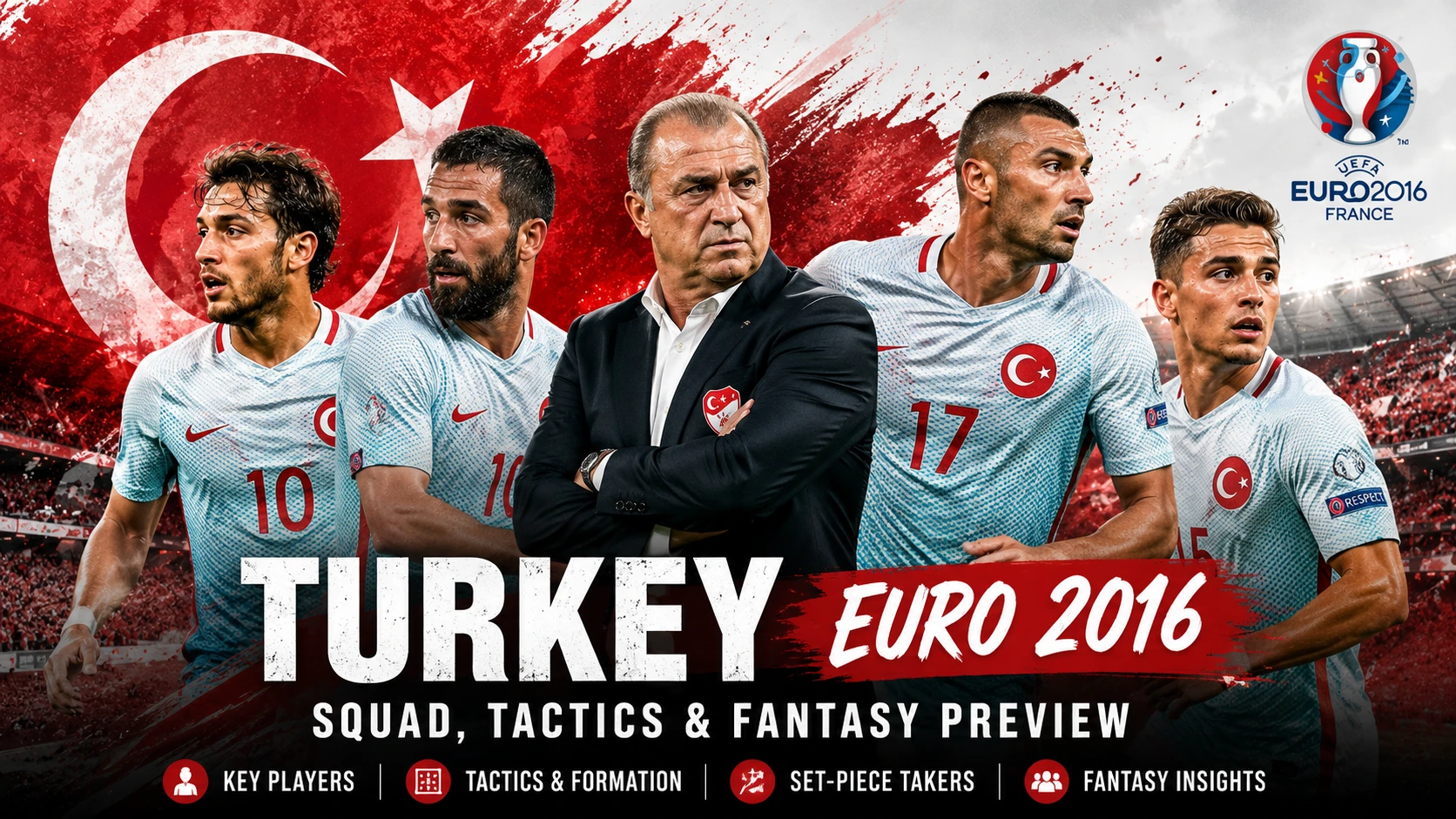
Turkey arrived at Euro 2016 as one of the tournament’s more intriguing teams and were considered potential dark horses if Fatih Terim could get the best from a talented squad.
A 13-match unbeaten run ended with a narrow defeat against England in a pre-tournament friendly, but Turkey travelled to France with confidence after a dramatic qualifying campaign.
Terim was in his third spell as Turkey manager, having previously led the country to the semi-finals of Euro 2008. Turkey qualified for Euro 2016 as the best third-placed team and were drawn alongside Croatia, Spain and the Czech Republic.
Originally published immediately before Euro 2016, this Fantasy Sports Portal preview preserves our assessment of Turkey’s squad, tactics and fantasy football prospects at the time, while providing an interesting snapshot of several players who would go on to have very different careers.
Turkey’s Likely Tactics and Formation
Turkey appeared likely to use a 4-2-3-1 formation, which was one of the dominant tactical systems in European football at the time.
Terim did not possess an abundance of elite centre-forward options, creating the possibility of using a more fluid attacker at the top of the formation. Hakan Çalhanoğlu was among the players capable of operating in several attacking positions.
An indication of Terim’s thinking could also be found in his decision to omit winger Gökhan Töre from the preliminary squad, although the Beşiktaş player was suspended for Turkey’s first two matches in any case.
Likely Starters
Çalhanoğlu was certain to play an important role, although exactly where Terim would deploy him remained uncertain.
Barcelona midfielder Arda Turan was also expected to start the opening match against Croatia in Paris despite having struggled for regular football following his move to the Spanish champions.
Mehmet Topal, Oğuzhan Özyakup and Nuri Şahin were among the other players expected to feature prominently.
Goalkeepers
Turkey’s first-choice goalkeeper was 27-year-old Volkan Babacan of İstanbul Başakşehir, who had established himself in the national team after making his senior international debut two years earlier.
Trabzonspor captain Onur Kıvrak provided the main competition, while Harun Tekin was selected as the third goalkeeper despite being uncapped at the time.
Tekin was preferred to alternatives including Tolga Zengin, Muammer Yıldırım and Mert Akyüz, while experienced goalkeeper Volkan Demirel was surprisingly absent.
Defenders
Fenerbahçe defensive midfielder Mehmet Topal was regularly used in Turkey’s back line and appeared likely to perform that role again at Euro 2016, particularly after Bursaspor centre-back Serdar Aziz was ruled out with a groin injury.
Topal’s Fenerbahçe team-mate Gökhan Gönül was expected to start at right-back, with Caner Erkin another likely starter on the opposite flank.
Galatasaray defender Hakan Balta was another experienced option. Along with Topal and Turan, Balta had been part of the Turkey squad that reached the Euro 2008 semi-finals.
Midfielders
Turkey possessed considerable technical quality in midfield.
Selçuk İnan offered control in deeper areas, with Nuri Şahin another possible central option, while the attacking midfield positions contained some of the squad’s most interesting players.
Oğuzhan Özyakup had made little impact during his time at Arsenal but subsequently developed into an influential player at Beşiktaş. Former Turkey international Rıdvan Dilmen had even compared the playmaker’s style to Zinedine Zidane.
Çalhanoğlu provided creativity and an exceptional set-piece threat, while captain Arda Turan brought experience at the highest level of European club football.
Ozan Tufan, then only 21, had also played in all ten of Turkey’s qualifying matches and provided another energetic midfield option.
Forwards
Burak Yılmaz remained Turkey’s established goalscorer despite having left Turkish football for Beijing Guoan in China.
His international record made him difficult to overlook, having scored 19 goals in 43 appearances for Turkey by the time of the tournament.
Beşiktaş forward Cenk Tosun was another striking option, although he was generally regarded as an impact player at this stage of his career.
Turkey’s abundance of attacking midfielders also created the possibility of playing without a conventional centre-forward, with Çalhanoğlu among the potential false-nine options discussed before the tournament.
Options from the Bench
Tosun provided the most obvious alternative to Yılmaz and had already scored three times in only nine senior international appearances.
Yunus Mallı offered considerable versatility and could fill several attacking roles. The Mainz player was attracting interest from larger European clubs and represented another possible option in a fluid forward line.
Volkan Şen and Olcay Şahan provided width, while one particularly interesting selection was 18-year-old Emre Mor.
Mor entered Euro 2016 regarded as one of Turkey’s most exciting young prospects. His inclusion illustrates how international tournaments can introduce emerging players to a much wider football audience.
Defensive cover was provided by players including Şener Özbayraklı, İsmail Köybaşı, Ahmet Çalık and Semih Kaya.
Set-Piece Takers
Hakan Çalhanoğlu was already regarded as one of Europe’s most dangerous free-kick specialists, making him particularly interesting from a fantasy football perspective.
However, Turkey possessed several accomplished set-piece takers.
Selçuk İnan’s dramatic 89th-minute free-kick against Iceland had secured Turkey’s place at the finals, while Özyakup also offered dangerous delivery from dead-ball situations.
Burak Yılmaz appeared the most likely penalty taker, although İnan also had an excellent career record from the spot.
Looking Back at Turkey at Euro 2016
The optimism surrounding Turkey before Euro 2016 ultimately proved greater than their results on the pitch. Terim’s side lost their opening two group matches against Croatia and Spain before defeating the Czech Republic 2-0, but three points were not enough to reach the knockout stage.
The preview nevertheless provides an interesting snapshot of Turkish football at the time. Several of the players discussed here remained prominent figures for years afterwards, while others followed very different career paths.
Çalhanoğlu is particularly notable in hindsight. Already recognised in 2016 for his technical ability and set-piece delivery, his career subsequently developed far beyond the role envisaged in this preview, demonstrating how a player’s tactical responsibilities can evolve with experience, coaching and changes in the wider game.
The article also illustrates how closely fantasy football analysis overlaps with conventional football analysis. Formation, expected minutes, set-piece responsibility, attacking defenders, positional flexibility and likely starters were important considerations for fantasy players in 2016 and remain fundamental parts of modern football discussion today.
That makes archive previews such as this useful for more than nostalgia. They provide a contemporary record of how teams and players were assessed before a major tournament — before hindsight changed the story.

