
Will Kurt’s absence hurt Chelsea ?
FSPortal
- posted on
Last updated: 25 August 2026
Kurt Zouma at Chelsea: The 2016 Injury That Changed Their Defence
Kurt Zouma had established himself as one of Chelsea’s most important young defenders when a serious knee injury abruptly ended his 2015/16 season.
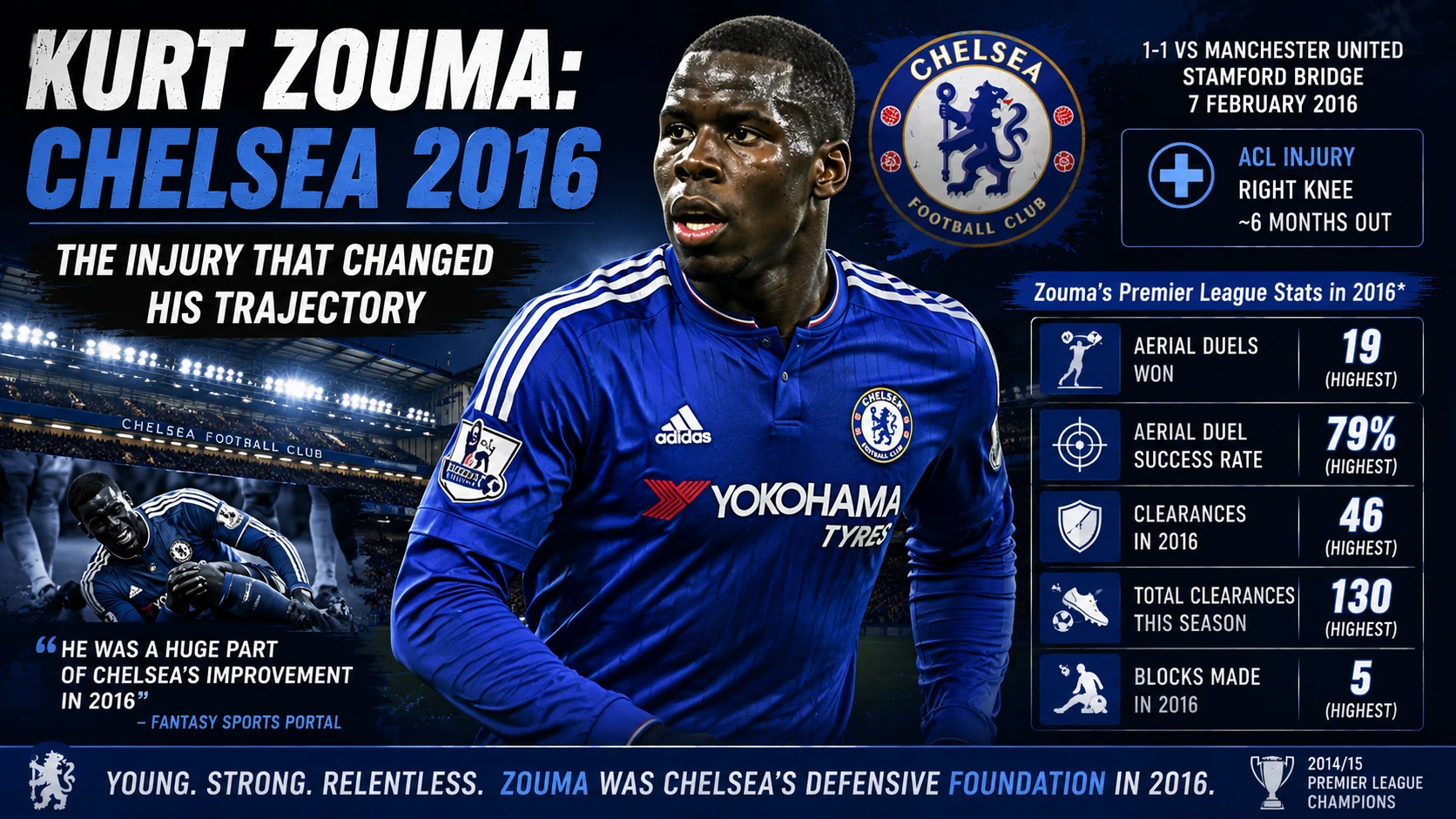
The French centre-back damaged the anterior cruciate ligament in his right knee during Chelsea’s 1-1 Premier League draw with Manchester United at Stamford Bridge in February 2016.
Zouma landed awkwardly after contesting a high ball and immediately required treatment. Chelsea subsequently confirmed the severity of the injury, beginning a lengthy rehabilitation that kept him out of competitive action for months.
At the time, Fantasy Sports Portal examined his defensive numbers to ask a simple question: how much would Chelsea miss Kurt Zouma?
Looking back, the statistics demonstrate why the injury represented such a significant setback for both the player and the club.
Zouma Had Become a Major Part of Chelsea’s Defence
Chelsea’s 2015/16 campaign had been extraordinarily turbulent.
José Mourinho departed in December after the defending Premier League champions suffered a dramatic collapse in form, with Guus Hiddink returning as interim manager.
Results began to stabilise under Hiddink.
Chelsea entered the Manchester United fixture unbeaten in the league during 2016 and had recorded three clean sheets across their opening six league matches of the calendar year.
Zouma had become an increasingly important part of that improvement.
Zouma’s Aerial Strength Stood Out
One of Zouma’s greatest assets was his ability in the air.
In the statistical sample used for our original analysis, Zouma had won 19 aerial duels, the highest total in the Chelsea squad during that period.
His aerial success rate was approximately 79%, again demonstrating how difficult he was for opposition attackers to beat in physical contests.
That ability was particularly valuable for a Premier League centre-back required to defend crosses, long passes and set pieces.
There was a cruel irony in the fact that the injury itself occurred as Zouma challenged for an aerial ball — precisely the type of situation in which he had become so effective.
His Clearance Numbers Were Equally Impressive
Zouma’s defensive contribution extended well beyond aerial duels.
During the opening part of 2016, he recorded 46 clearances.
John Terry was second among Chelsea defenders in the same period with 30.
Across the season at the point of Zouma’s injury, the French defender had accumulated approximately 130 clearances.
Those numbers reflected both his athleticism and his willingness to defend proactively when Chelsea came under pressure.
Blocks Added Another Dimension
Zouma had also produced five blocks since the beginning of 2016 in the original statistical sample.
Individual defensive statistics always require context. A high clearance total, for example, can sometimes indicate that a team is spending too much time defending.
But taken together, Zouma’s aerial success, clearances and blocks painted a consistent picture.
Chelsea had a young centre-back capable of dealing with a substantial amount of defensive pressure.
Why Zouma Had Moved Ahead of Gary Cahill
Perhaps the clearest indication of Zouma’s progress was the competition for places at Stamford Bridge.
Gary Cahill had been an important member of Chelsea’s title-winning side in 2014/15, but Zouma’s development increasingly challenged the England international’s position.
The younger defender offered pace and athleticism that could be particularly useful when Chelsea defended with space behind the back line.
By early 2016, Zouma was no longer simply a talented prospect waiting behind established defenders.
He had become a legitimate first-choice option.
The Injury Created an Immediate Chelsea Problem
Zouma’s absence pushed Cahill back towards a more prominent role alongside Chelsea captain John Terry.
That created uncertainty because Cahill had featured less regularly following Hiddink’s arrival.
The question facing Chelsea was therefore not simply whether Cahill was an accomplished defender.
He clearly was.
The issue was whether Chelsea could replace the particular attributes Zouma had been providing:
- pace across the defensive line;
- strength in aerial duels;
- high clearance volume;
- physical recovery ability;
- one-on-one defending; and
- athleticism against quick attackers.
A Serious Injury at a Crucial Stage of Development
The timing was particularly unfortunate for Zouma personally.
He was only 21 and appeared to be establishing himself at one of the biggest clubs in English football.
Young players often need an uninterrupted sequence of matches to turn potential into a permanent first-team position.
A serious ACL injury does the opposite.
Instead of continuing his development on the pitch, Zouma faced surgery, rehabilitation and the challenge of rebuilding confidence in the injured knee.
Chelsea Were About to Change Completely
There was another complication that nobody could fully appreciate when Zouma suffered the injury.
Chelsea were approaching another major tactical transformation.
Antonio Conte arrived ahead of the 2016/17 season and eventually switched Chelsea to the three-man defensive system that powered them to the Premier League title.
César Azpilicueta, David Luiz and Gary Cahill became Conte’s established back three.
By the time Zouma was available to compete regularly again, the structure of Chelsea’s defence had changed significantly.
His injury therefore cost him more than several months of football. It removed him from the team during a period when Chelsea’s next championship-winning defensive unit was being formed.
What Happened to Kurt Zouma After Chelsea?
Zouma eventually returned to competitive football and continued his Premier League career.
Loan spells with Stoke City and Everton gave him regular first-team minutes before he returned to Chelsea and again featured prominently.
He was part of the Chelsea squad that won the UEFA Champions League in 2020/21 before joining West Ham United later in 2021.
His subsequent career demonstrated that the ACL injury did not prevent him from returning to a high level of professional football.
But it remains reasonable to wonder how his Chelsea career might have developed without that interruption.
Why the 2016 Statistics Still Tell an Interesting Story
Football statistics are most useful when they provide context rather than simply numbers.
Zouma’s aerial duels, clearances and blocks help explain why his injury generated genuine concern at Chelsea.
He wasn’t merely a squad player being replaced.
He was a 21-year-old defender who had forced himself ahead of established internationals and was beginning to demonstrate the attributes required to become a long-term Chelsea centre-back.
Final Thought
When Fantasy Sports Portal originally asked whether Kurt Zouma’s absence would hurt Chelsea, the immediate answer was clearly yes.
Chelsea were losing one of their strongest aerial defenders and one of the most athletic centre-backs in their squad.
But the longer-term consequences were more interesting.
Football moved quickly. Chelsea changed manager, changed formation and assembled another title-winning defence while Zouma was working his way back.
He recovered and enjoyed a substantial Premier League career, but February 2016 remains one of those moments when an injury arrived just as a young player’s trajectory appeared to be accelerating.
Explore more: Football history, analysis and features from Fantasy Sports Portal.

