
Liverpool top another table
FSPortal
- posted on
Last updated: 21 August 2026
Liverpool entered the summer of 2016 in an unusual position. Jürgen Klopp had begun to transform the team’s attacking football, the Reds had reached two cup finals, and no Premier League club was sending more players to Euro 2016.
Originally published immediately before the tournament, this Fantasy Sports Portal article looked at another table Liverpool found themselves topping: the number of Premier League players representing their countries at the European Championship.
The article also captures an important moment in the club’s development under Klopp, several years before Liverpool would finally end their long wait for another English league title.
Liverpool’s Progress Under Jürgen Klopp
Earlier in 2016, we highlighted how Liverpool were leading the Premier League for goals scored during the calendar year, even though converting the same run of matches into league points would have left them considerably lower in the table.
That contrast summed up much of Klopp’s early Liverpool side. The attacking potential was obvious, but defensive weaknesses and inconsistency were still preventing the team from turning exciting performances into sustained results.
Liverpool also reached the Europa League final in Klopp’s first season, only to lose 3-1 to Sevilla in Basel. It was a disappointing end to the campaign, but the progress made during the season suggested something significant was beginning to develop at Anfield.
Liverpool Had 12 Players at Euro 2016
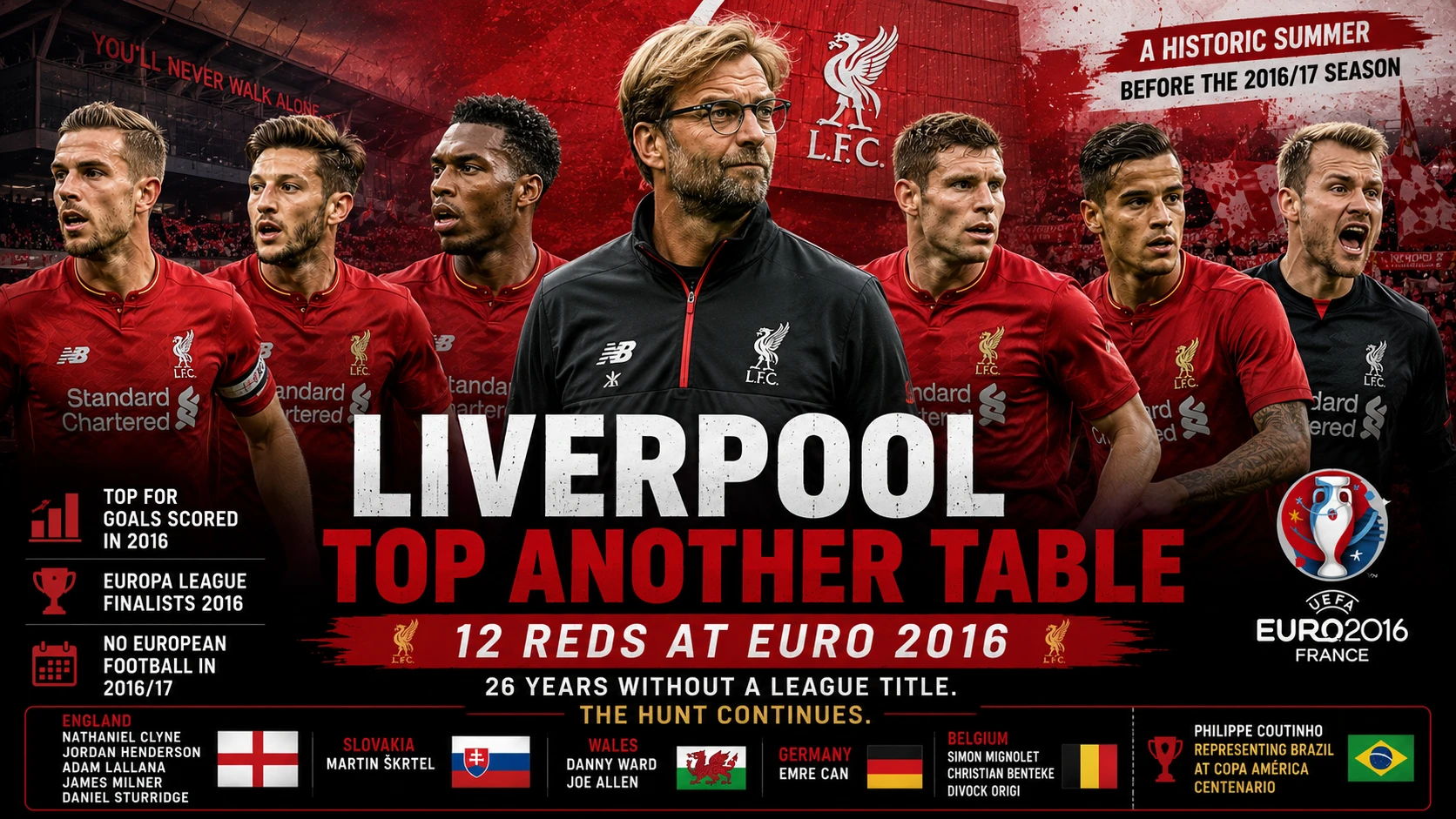
Liverpool sent 12 first-team players to Euro 2016 in France, more than any other Premier League club at the tournament.
Five represented England:
- Nathaniel Clyne
- Jordan Henderson
- Adam Lallana
- James Milner
- Daniel Sturridge
Martin Škrtel represented Slovakia, while Danny Ward and Joe Allen were selected by Wales.
Emre Can travelled with Germany, with Simon Mignolet, Christian Benteke and Divock Origi representing Belgium.
For Liverpool supporters, the size of that contingent was both a source of pride and a cause for concern. Klopp needed his players to return fit and ready for what promised to be an important 2016/17 season.
Coutinho at the Copa América Centenario
Liverpool’s international representation extended beyond Euro 2016.
Philippe Coutinho, who had been named Liverpool’s player of the year, travelled to the United States with Brazil for the Copa América Centenario.
Coutinho had become one of Liverpool’s most influential attacking players and was increasingly establishing himself on the international stage as well.
His presence at the Copa América meant that a significant proportion of Klopp’s squad would spend the summer involved in major international tournaments rather than enjoying a conventional pre-season break.
A Defining Summer for Liverpool
Liverpool had gone 26 years without winning the English league title when this article was first published.
The absence of European football in 2016/17 also created an intriguing opportunity. Klopp would have more time on the training ground and fewer midweek fixtures than many of Liverpool’s rivals.
Competition at the top of the Premier League was becoming particularly intense. Manchester City had appointed Pep Guardiola, Manchester United had turned to José Mourinho, while Arsenal, Chelsea and Tottenham also expected to challenge.
Liverpool nevertheless appeared capable of joining that group if Klopp could improve the team’s defensive organisation without sacrificing its attacking intensity.
Looking Back at Liverpool in 2016
Viewed a decade later, the summer of 2016 feels like an important stage in Liverpool’s transformation under Jürgen Klopp.
Many of the players travelling to Euro 2016 would play important roles in the team’s development, while others would gradually move on as Klopp reshaped the squad.
The following season provided evidence that Liverpool were moving in the right direction. They finished fourth in the Premier League and returned to the Champions League, beginning the progression that would eventually turn Klopp’s side into one of Europe’s strongest teams.
Liverpool ultimately ended their 30-year wait for another English league championship by winning the Premier League in 2019/20.
International Tournaments and Club Performance
The concern about Liverpool’s players returning safely from international duty also remains highly relevant to modern football.
Major tournaments create difficult decisions for club managers. Players can return with injuries, physical fatigue or reduced preparation time, while those who progress deep into a competition may have very little opportunity to recover before the domestic season begins.
Today those issues are discussed through concepts such as workload management, minutes played, recovery data and injury risk, but clubs and fantasy football managers were already considering the same fundamental problem in 2016: how much football is too much football?
That makes Liverpool’s unusually large Euro 2016 contingent more than a historical curiosity. It provides another example of how squad depth, player availability and international workload can influence an entire domestic campaign.

