
Cockerels up for title fight
FSPortal
- posted on
Last updated: 26 August 2026
Érik Lamela and Tottenham’s 2015/16 Title Challenge: The Premier League’s Dirtiest Player?
Tottenham Hotspur’s 2015/16 Premier League title challenge is remembered for Harry Kane’s goals, Dele Alli’s breakthrough and Mauricio Pochettino transforming Spurs into one of the most exciting young teams in England.
There was another side to that Tottenham team.
They were extremely aggressive without the ball.
Contemporary statistics examined by Fantasy Sports Portal revealed an unexpected leader of the Premier League’s fouls table: Érik Lamela.
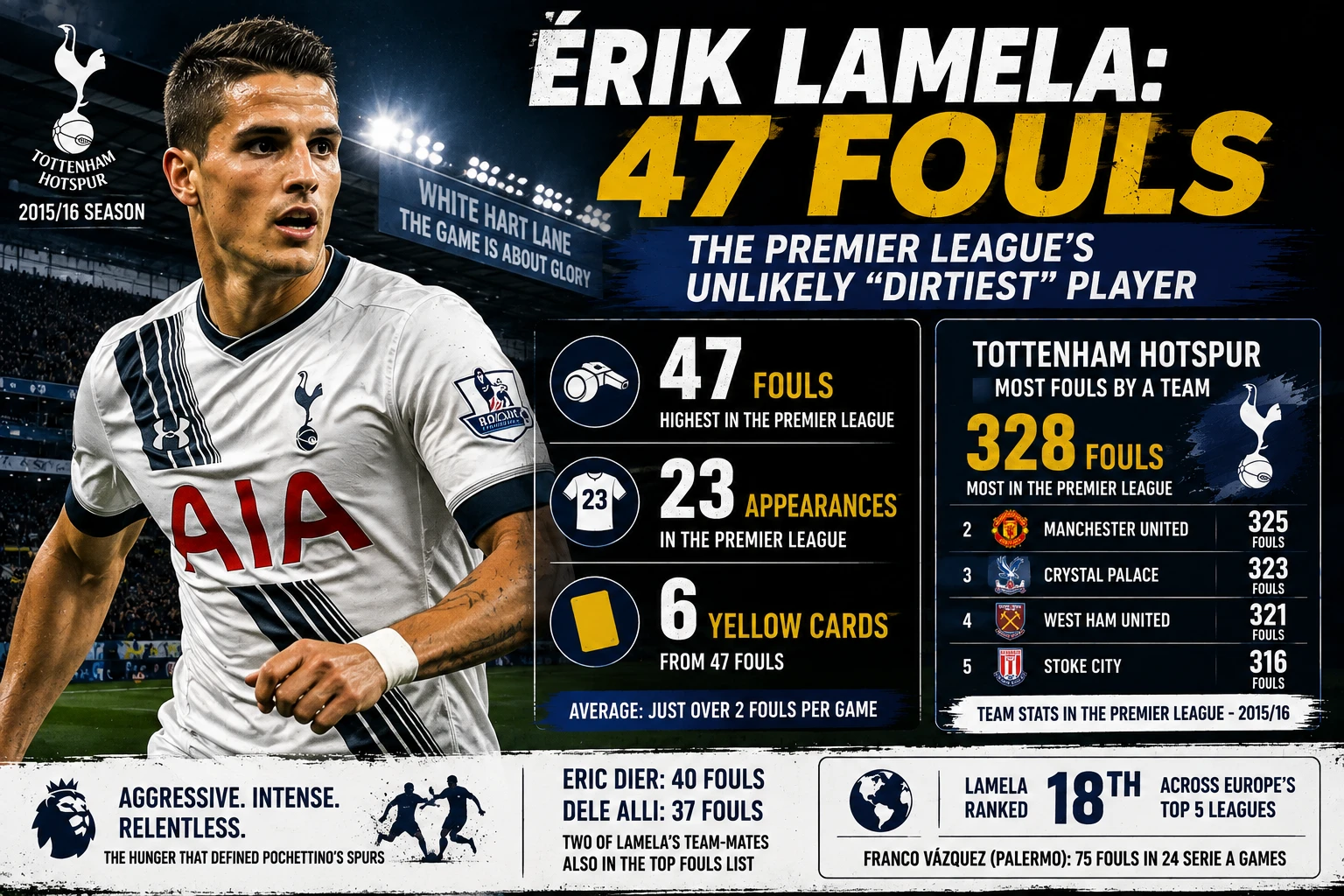
The Argentine attacker had committed 47 fouls in only 23 Premier League appearances when the original analysis was published.
Rather than simply making Lamela the league’s so-called “dirtiest player”, however, the numbers also told us something important about the emerging style of Pochettino’s Tottenham.
Érik Lamela Topped the Premier League Fouls Table
Defenders and defensive midfielders would ordinarily be expected to dominate a ranking of players committing the most fouls.
Lamela was different.
He was primarily an attacking player, yet had accumulated 47 fouls from 23 league appearances — slightly more than two per game.
That placed him above the Premier League’s more conventional ball-winning midfielders and defenders in the original dataset.
It was a surprising statistic, but one that made considerably more sense when viewed within Tottenham’s tactical system.
Tottenham’s Pressing Required Their Attackers to Defend
Pochettino wanted Tottenham to defend from the front.
Rather than allowing opponents to progress comfortably through midfield, Spurs attempted to regain possession quickly and high up the pitch.
That required attacking players to become active defenders whenever possession was lost.
Lamela was particularly suited to that approach.
He played with intensity, closed opponents aggressively and regularly attempted to disrupt transitions before they could develop.
The resulting fouls were therefore not necessarily evidence of an unusually reckless attacker.
Many were a consequence of his defensive responsibilities within an aggressive pressing system.
Lamela Wasn’t the Only Tottenham Player Committing Fouls
The wider Tottenham numbers strengthened that interpretation.
Two of Lamela’s teammates also featured prominently in the original ranking.
- Érik Lamela: 47 fouls
- Eric Dier: 40 fouls
- Dele Alli: 37 fouls
Those were three players performing very different roles.
Dier frequently operated as the defensive midfielder, Alli played as an attacking midfielder and Lamela generally occupied a wider attacking position.
Their presence in the same ranking suggested something broader than individual indiscipline.
Tottenham were playing with collective aggression.
Spurs Had Committed More Fouls Than Any Premier League Team
The team statistics made the pattern even clearer.
At the point of our original analysis, Tottenham had committed 328 Premier League fouls.
That was the highest total in the competition.
Manchester United were close behind with 325, while Crystal Palace had committed 323.
Tottenham’s position at the top of that table was particularly interesting because they were simultaneously competing near the top of the actual Premier League standings.
This was not a struggling team desperately attempting to disrupt technically superior opponents.
It was one of England’s best footballing sides deliberately combining technical quality with physical intensity.
Was Lamela Really a ‘Dirty’ Player?
Calling the player who commits the most fouls the “dirtiest” player makes for an eye-catching headline, but the statistic requires context.
Not all fouls are equal.
A tactical trip designed to stop a counterattack is recorded in the same basic foul column as a mistimed tackle, an aerial collision or a reckless challenge.
Lamela had received six yellow cards from his 47 fouls at the time.
That distinction matters.
High foul volume can indicate aggression and indiscipline, but it can also reveal how frequently a player engages opponents without the ball.
Yellow and Red Cards Told a Different Story
Other players accumulated significantly more disciplinary punishment without appearing at the very top of the foul rankings.
Norwich City’s Alexander Tettey, for example, had collected 10 yellow cards but did not feature among the top 12 players for total fouls in the original analysis.
Southampton midfielder Victor Wanyama had already received three red cards, despite ranking only tenth by fouls committed.
The contrast demonstrates why disciplinary statistics need to be interpreted together rather than in isolation.
Total fouls measure frequency.
Cards tell us more about how officials judged the seriousness or persistence of those offences.
Tottenham’s Intensity Was Central to Their Title Challenge
The 2015/16 Tottenham side became one of the defining teams of Pochettino’s managerial career.
Kane supplied the goals. Alli provided creativity and late runs into the penalty area. Mousa Dembélé gave Spurs extraordinary strength in midfield, while Dier provided defensive balance.
Behind them, Toby Alderweireld and Jan Vertonghen formed one of the Premier League’s strongest defensive partnerships.
But the system depended heavily on collective work without possession.
Attackers could not simply wait for the ball to return.
They were expected to press.
Lamela embodied that philosophy better than almost anyone.
The Rise of Pressing in the Premier League
The numbers are also interesting when viewed against the tactical development of English football during the mid-2010s.
Pressing was becoming increasingly central to the Premier League.
Pochettino had already demonstrated his methods at Southampton, while Jürgen Klopp arrived at Liverpool in October 2015 with his own aggressive approach to winning the ball back.
Pep Guardiola would arrive at Manchester City the following summer.
Premier League football was becoming increasingly focused on what teams did immediately after losing possession.
Forwards and attacking midfielders consequently had greater defensive responsibilities.
Why Tactical Fouls Matter
Modern pressing inevitably creates moments when the press fails.
When an opponent escapes the first line of pressure, space can suddenly appear behind it.
Stopping that transition before it develops can be extremely valuable.
This is where the tactical foul enters the equation.
A relatively harmless foul near the halfway line may prevent an opponent from attacking an exposed defence at speed.
Managers do not necessarily instruct players simply to foul opponents, but intelligent teams understand the importance of controlling transitions.
Players such as Lamela were frequently operating in exactly those areas.
How Did the Premier League Compare With Europe?
The original comparison also produced an interesting European perspective.
Despite leading the Premier League ranking with 47 fouls, Lamela was only around 18th when compared with players across Europe’s major domestic leagues in the dataset used at the time.
Palermo midfielder Franco Vázquez had committed 75 fouls in 24 Serie A appearances, substantially more than Lamela.
That raised an interesting question in 2016: was English football becoming less physically distinctive than its reputation suggested?
The answer was probably more complicated.
Different refereeing cultures, tactical systems, possession patterns and interpretations of contact all affect foul statistics across leagues.
Fantasy Football Managers Could Use Foul Data Too
Foul statistics may appear less useful to fantasy football managers than goals, assists or clean sheets, but they can reveal important information.
A player regularly committing fouls carries increased disciplinary risk.
That can mean:
- lost fantasy points through bookings;
- greater risk of suspension;
- reduced bonus-point potential in some scoring systems;
- increased substitution risk after an early booking; and
- possible changes to playing style when one card away from suspension.
Context remains essential, however.
A high foul count for an attacking player can also indicate a high-intensity role that keeps him heavily involved in the match.
What Happened to Tottenham’s 2015/16 Title Challenge?
Tottenham remained Leicester City’s closest challengers for much of the closing stages of the season.
Ultimately, Leicester completed one of football’s greatest title triumphs.
Spurs then lost second place to Arsenal after a dramatic collapse over the final matches of the campaign.
But the final table does not diminish the importance of that Tottenham side.
It established a young core that would continue competing near the top of English football and eventually reach the 2019 Champions League final under Pochettino.
Érik Lamela Was a Perfect Pochettino Player
Lamela’s Tottenham career was frequently interrupted by injuries, but his intensity made him particularly valuable to Pochettino.
He was technically gifted enough to contribute in possession while possessing the aggression and work rate required to execute the manager’s pressing system.
That combination helps explain the surprising statistic Fantasy Sports Portal identified in 2016.
The Premier League player committing the most fouls wasn’t a rugged centre-back or destructive holding midfielder.
He was an Argentine attacker playing for a team challenging for the title.
Final Thought
Calling Érik Lamela the Premier League’s “dirtiest player” told only part of the story.
His 47 fouls certainly demonstrated aggression, but Tottenham’s league-leading team total suggested something more interesting was happening.
Pochettino was building a side that wanted to attack when it had the ball and immediately hunt it down when possession was lost.
Lamela’s foul statistics were partly a by-product of that philosophy.
A decade later, aggressive pressing and transition control are fundamental parts of elite football.
Seen through that lens, Tottenham’s “dirty dozen” statistics were not merely about indiscipline.
They were also evidence of where Premier League football was heading.
Explore more: Football history, tactics and analysis from Fantasy Sports Portal.

