
Liverpool v Man City Refereeing Row: When Decisions Become a Question of Trust
Admin
- posted on
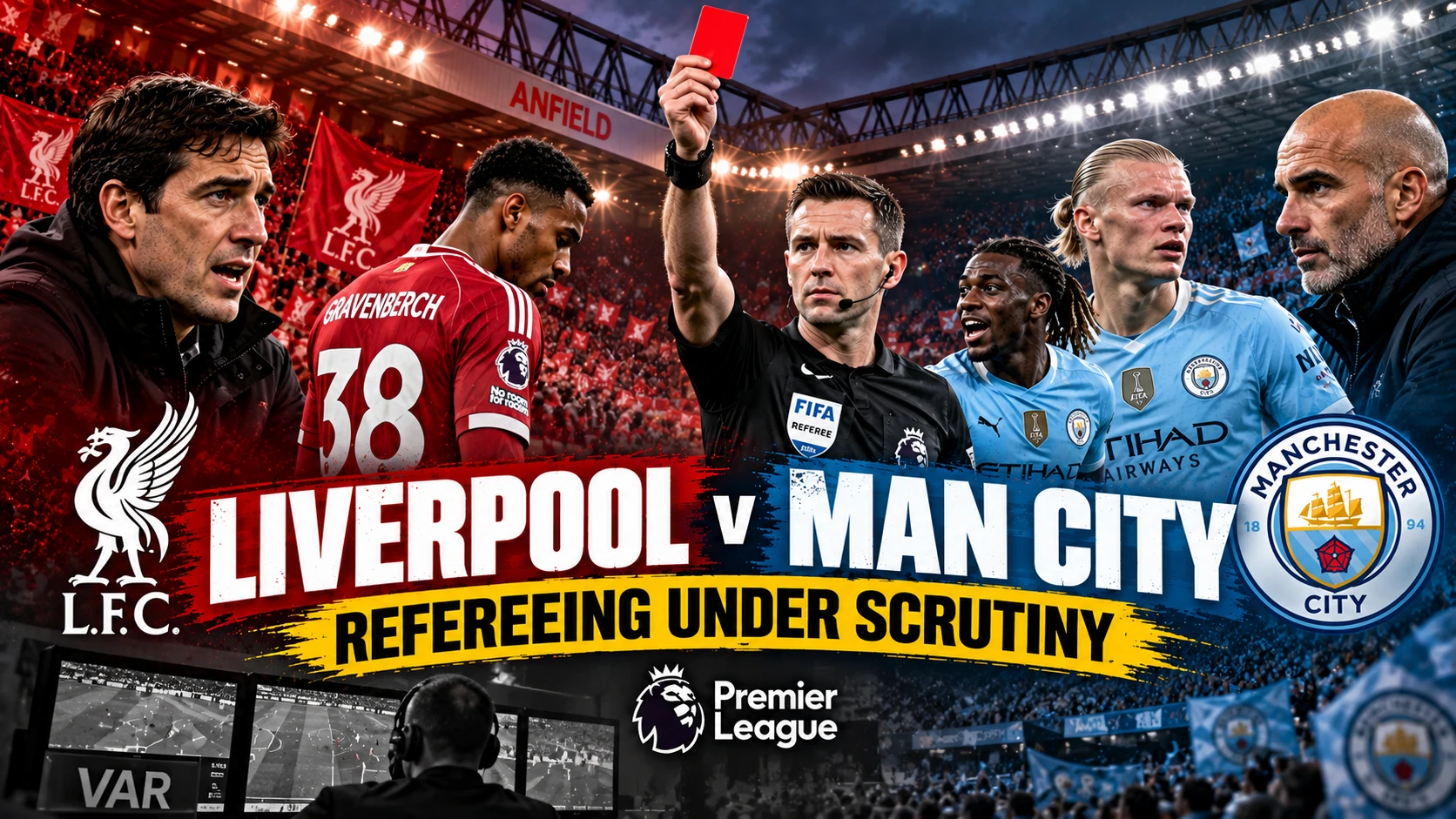
Manchester City’s 3-0 victory over Liverpool at Anfield should have been remembered as another significant result in the Premier League title race. Instead, much of the conversation has centred on referee Chris Kavanagh, Ryan Gravenberch’s dismissal and a familiar question: are football’s rules being applied consistently?
Sunday’s match was goalless when Gravenberch received his second yellow card in the 62nd minute. Three minutes later, Erling Haaland put Manchester City ahead. Jérémy Doku and Rayan Cherki subsequently completed a convincing-looking victory.
City deserve credit for exploiting their numerical advantage. They did not make the refereeing decisions, and their players still had to score the goals.
But that does not mean the decisions themselves should escape scrutiny.
The controversy extends beyond one red card. Ronald Araújo was cautioned early in the match for gesturing that an opponent should receive a yellow card. Liverpool manager Andoni Iraola subsequently questioned whether similar standards were applied to Manchester City’s players.
Meanwhile, Kavanagh’s appointment has prompted a separate debate about geographical connections, referee neutrality and the transparency of Premier League appointments.
These are different issues, and they deserve to be examined separately. Together, however, they raise a larger question about public confidence in English football’s officiating system.
Ryan Gravenberch’s Red Card Changed the Match
There can be little dispute about the significance of the dismissal.
With the score at 0-0, Gravenberch was shown a second yellow card for pulling back Jérémy Doku. His first caution had come earlier in the second half following a challenge on City’s Elliot Anderson.
Two cautions meant Liverpool were reduced to ten players with almost half an hour remaining.
The consequences were immediate.
Haaland scored in the 65th minute, Doku extended the advantage shortly afterwards, and Cherki added a third.
It would be simplistic to claim that Liverpool would otherwise have won. City were always capable of producing decisive attacking moments.
However, the dismissal fundamentally changed the tactical contest.
Before the red card, Liverpool could maintain their midfield structure, challenge City’s possession and press with greater numbers.
Afterwards, they had to cover the same areas with one fewer player against an opponent particularly skilled at exploiting space.
That is why the standard required for a second caution matters.
A yellow card is not merely a warning when a player has already been booked. It can become the decision that removes a player from the match and alters the competitive balance.
Was Gravenberch’s First Yellow Card Justified?
Iraola’s strongest objection concerned the first booking.
The Liverpool manager argued that Gravenberch’s challenge on Anderson was not sufficiently serious to warrant a caution.
He also questioned the referee’s interpretation of the incident, suggesting that Anderson continued moving before going to ground.
Under the Laws of the Game, a challenge does not automatically become a yellow-card offence simply because contact occurs.
Referees must consider factors such as recklessness, the nature of the contact and whether a player has stopped or interfered with a promising attack.
These assessments inevitably involve judgement.
That does not mean every disputed booking is wrong. Nor does it mean the referee must allow physical challenges without consequences.
But where a decision is marginal, its consequences deserve particular attention.
Gravenberch’s second caution was for a different type of incident: pulling back an opponent. Such actions can warrant a yellow card depending on the circumstances, including whether a promising attack has been stopped.
The central argument, therefore, is not necessarily that both decisions were indefensible.
It is whether the first challenge met the threshold for a caution and whether the same threshold was maintained throughout the match.
Ronald Araújo’s Yellow Card Raises the Consistency Question
Another significant incident occurred in the eighth minute.
Liverpool defender Ronald Araújo was cautioned after making the familiar imaginary-yellow-card gesture towards the referee.
Gesturing for an opponent to be booked can constitute dissent or unsporting behaviour. Referees are entitled to take disciplinary action.
On that basis, Araújo’s caution is not inherently controversial.
Indeed, many supporters would welcome stricter enforcement of rules designed to prevent players from pressuring officials.
The problem arises when enforcement appears selective.
Following Gravenberch’s dismissal, Iraola questioned the consistency of Kavanagh’s decisions, pointing to Haaland’s reaction during the incident.
The Liverpool manager’s argument was straightforward: if a player receives an early booking for appealing for a yellow card, comparable behaviour should be judged against the same standard later in the match.
There may be differences between individual gestures, words and circumstances. Those differences matter, and not every appeal is necessarily a cautionable offence.
But supporters should not be left guessing why apparently similar behaviour produces different outcomes.
Consistency does not mean every incident must result in the same punishment. It means the same principles must be applied to comparable incidents, with meaningful differences capable of being explained.
That is the distinction the Premier League needs to communicate more effectively.
VAR Can Now Review Certain Second Yellow Cards — So What Happened?
The Gravenberch controversy also highlights an important change to the rules for the 2026/27 season.
Historically, VAR could review straight red cards but not dismissals resulting from two yellow cards.
That limitation attracted criticism because a player could be sent off following a questionable second caution without the same video-review protection available for a direct red card.
For 2026/27, the International Football Association Board approved an extension allowing reviews of red cards resulting from clearly incorrect second yellow cards.
However, the scope is deliberately narrow.
The system is not intended to re-referee every subjective caution or overturn every marginal disciplinary decision.
There must be a sufficiently clear error under the applicable protocol.
That distinction matters in Gravenberch’s case.
His first booking was the decision most strongly criticised by Iraola, but the new review provision focuses on clearly incorrect second cautions that produce a dismissal.
Consequently, the existence of VAR does not necessarily provide a remedy for a disputed first yellow card.
Nor does the absence of an overturned decision automatically prove the original judgement was correct.
The relevant question is whether the incident met the threshold for intervention.
That is something supporters deserve to understand.
The Premier League’s explanation of the 2026/27 law changes confirms the limited scope of second-yellow reviews.
Chris Kavanagh’s Appointment: Neutrality and the Appearance of Neutrality
There is a separate issue surrounding referee Chris Kavanagh’s appointment to the fixture.
Kavanagh comes from Ashton-under-Lyne in Greater Manchester.
That geographical connection has prompted questions about whether referees from the wider Manchester area should officiate high-profile matches involving Manchester City, particularly against Liverpool.
It is important to distinguish geographical background from actual allegiance.
Being born or raised near Manchester City does not establish that a referee supports the club, favours its players or cannot officiate impartially.
Claims circulating about the football allegiances of Kavanagh’s family should not be treated as established facts without reliable supporting evidence.
There is no basis for accusing Kavanagh of deliberately favouring Manchester City simply because of where he comes from.
But that does not make the wider question irrelevant.
Professional sport depends not only on impartial decision-making but also on public confidence that officials have been appointed through an appropriate and transparent process.
Referees inevitably have geographical backgrounds, personal histories and connections to football communities.
It would be unreasonable to assume that everyone from a particular city supports the same club.
Equally, it is reasonable to ask how PGMOL evaluates declared club allegiances, personal connections and potential conflicts of interest when making appointments.
What information is considered?
What circumstances would prevent an official from taking charge of a particular club?
And how much of that process should be explained publicly?
Those are legitimate governance questions. They do not require an allegation of corruption or personal misconduct.
Why Liverpool Against Manchester City Is Particularly Sensitive
The rivalry between Liverpool and Manchester extends well beyond football.
The two cities have a long history of economic competition, regional identity and sporting rivalry.
Matches between Liverpool and Manchester City also carry the legacy of repeated Premier League title battles.
That background does not make a referee from Greater Manchester automatically unsuitable.
But it does mean perceptions can become especially sensitive when major decisions go against one side.
Sunday’s match was already being played in a charged atmosphere because of the independent commission’s findings concerning Manchester City’s historical financial-rule breaches.
City have disputed those findings and lodged an appeal.
We have previously examined the Manchester City financial-rule verdict and the questions surrounding the club’s appeal and Abu Dhabi funding.
Those proceedings are separate from Sunday’s refereeing decisions and should not be used as evidence of officiating bias.
However, the broader atmosphere helps explain why supporters were particularly sensitive to decisions that appeared to influence the match.
When confidence in football’s institutions is already under pressure, transparency becomes more important, not less.
Refereeing Accountability Should Not Depend on the Final Score
One of football’s most unhelpful habits is judging refereeing controversies according to the eventual result.
If a team loses heavily, criticism of an earlier decision can be dismissed as an excuse.
If a team wins despite a disputed decision, the incident may quickly be forgotten.
Neither approach is satisfactory.
The correctness of a yellow card should not depend on whether the affected team subsequently concedes three goals.
Equally, Manchester City’s victory should not be discounted simply because Liverpool dispute the dismissal.
Two things can be true simultaneously.
City took full advantage of the circumstances and deserved credit for their attacking execution.
And the decisions that helped create those circumstances can still warrant independent examination.
That distinction is essential if refereeing debates are to become more constructive.
What Should PGMOL Explain?
Rather than demanding that every disputed decision be overturned, there are several reasonable questions PGMOL could address.
- Gravenberch’s first caution: What specific offence justified the yellow card, and which aspects of the challenge informed that judgement?
- The second caution: What made the pull on Doku cautionable, and did the incident fall within the 2026/27 VAR review provisions?
- Araújo’s booking: What behaviour triggered the caution, and how was comparable conduct assessed elsewhere in the match?
- Referee appointments: What safeguards and declarations are used when assigning officials to fixtures involving clubs from their wider home region?
- Public communication: How can supporters receive clearer explanations of consequential disciplinary decisions without undermining referees’ authority?
These questions are not demands for Liverpool to receive preferential treatment.
They concern standards that should apply to every Premier League club.
Arsenal, Manchester United, Chelsea, Newcastle, Liverpool and Manchester City should all be able to expect the same disciplinary principles and the same appointment safeguards.
That is what consistency means.
Football Needs Consistent Decisions, Not Untouchable Referees
Refereeing is difficult.
Officials must make rapid decisions under pressure, often with incomplete information and with players, managers and thousands of supporters demanding immediate answers.
Not every disputed decision is a mistake.
Not every mistake demonstrates bias.
And not every controversial match indicates a failure of the entire system.
But acknowledging those realities should not make refereeing decisions immune from criticism.
Football has invested heavily in video technology, professional officiating structures and detailed disciplinary rules.
Supporters are entitled to ask whether those systems deliver greater consistency and accountability.
We raised similar concerns in our earlier analysis of Premier League VAR, refereeing controversy and common sense.
The challenge is not simply to create more rules.
It is to ensure existing rules are interpreted coherently and explained convincingly.
Our Verdict: The Bigger Problem Is Trust
Liverpool lost 3-0. Manchester City won their sixth consecutive Premier League match.
Those results stand.
But the debate surrounding Sunday’s game will not disappear simply because the final score was emphatic.
Gravenberch’s dismissal altered the contest. Araújo’s early caution raised questions about consistent enforcement. Kavanagh’s geographical background has prompted debate about the transparency of referee appointments.
None of that establishes deliberate bias.
What it does establish is the importance of explaining decisions and maintaining confidence in the processes behind them.
The Premier League does not need referees who never make mistakes. It needs an officiating system capable of explaining its judgements, acknowledging errors where they occur and demonstrating that the same standards apply to everyone.
Because when supporters stop trusting the process, even correct decisions can become controversial.
And that is a much bigger problem than one afternoon at Anfield.
Fantasy Sports Portal | Analysis published 13 October 2026. This article distinguishes confirmed match incidents, managerial criticism and editorial questions about officiating governance. It does not allege misconduct or deliberate bias by any match official.

