
Manchester City’s Appeal Raises an Awkward Question: If the Money Wasn’t the Owner’s, Whose Was It?
Admin
- posted on
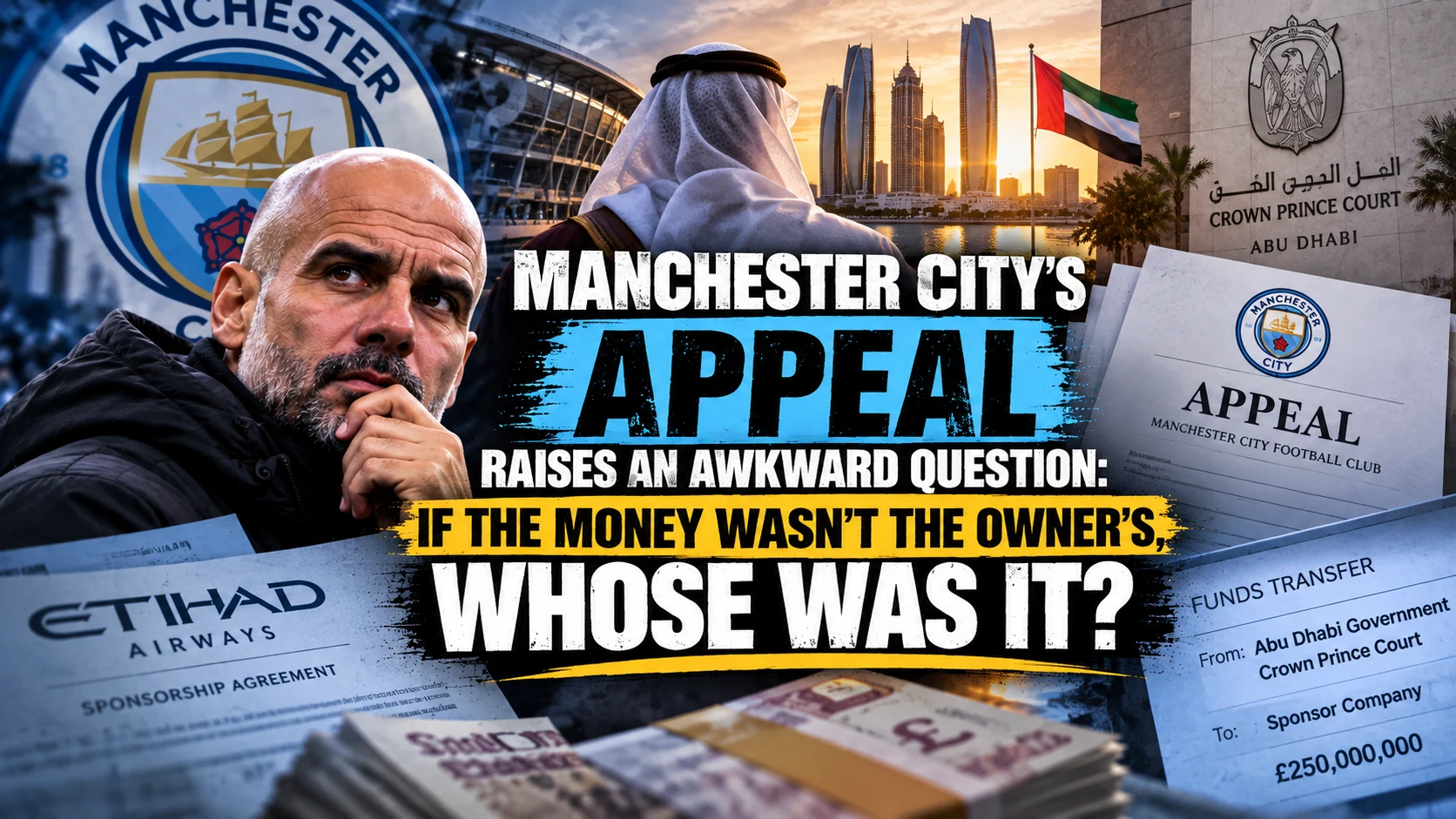
Manchester City have formally appealed against the independent Commission’s findings that they systematically breached Premier League financial rules – and one argument appears set to sit at the heart of their challenge.
The money, City say, did not come from their owner.
Instead, the club will argue that funding used to assist Abu Dhabi-based sponsors came from the Abu Dhabi government, including through the Crown Prince Court.
That distinction could prove enormously important.
The Commission concluded that more than £830 million recorded through sponsorship arrangements was ultimately disguised owner funding from Abu Dhabi United Group (ADUG), the investment vehicle of Manchester City owner Sheikh Mansour.
City say that conclusion is wrong.
But their proposed explanation creates an intriguing question of its own.
If the money was not being provided by Manchester City’s owner, why was an Abu Dhabi government body financially assisting companies to meet sponsorship obligations to Manchester City?
That question does not establish another breach. Nor does government support for a commercial sponsor automatically make a sponsorship illegitimate.
But it demonstrates why City’s appeal may have consequences extending well beyond the narrow question of where individual payments originated.
Manchester City Have Now Lodged Their Appeal
Manchester City confirmed on Friday that they had submitted what the club described as a “comprehensive appeal” against the independent Commission’s findings.
The club argues that the ruling contains material errors of law, principle and fact.
It follows the Commission’s conclusion that City committed serious financial-rule breaches during the period between 2009/10 and 2017/18.
As we explained in our detailed analysis of the Manchester City verdict and what happens next, the eventual consequences could include substantial financial or sporting sanctions if the findings survive the appeals process.
Those sanctions have not yet been determined.
The appeal must now be considered by a separate three-person Appeal Board, including a member who has held judicial office.
What Is Manchester City’s Abu Dhabi Government Argument?
At the centre of the dispute are sponsorship arrangements that the original Commission concluded were not what they appeared to be.
The Commission found that £830.69 million of funding presented through commercial sponsorship arrangements was actually owner funding.
Its conclusion was that money from ADUG was channelled through sponsors and recorded as commercial revenue.
That distinction matters because genuine sponsorship income and owner investment are treated differently under football’s financial regulations.
City’s position is that the Commission identified the wrong source of the money.
The club is expected to rely upon bank statements, money transfers and witness evidence which it says demonstrate that the additional funding did not originate with Sheikh Mansour or ADUG.
Instead, City argue that financial assistance came from the Abu Dhabi government, including through the Crown Prince Court, and was provided to businesses so they could meet their sponsorship obligations.
Manchester City chief executive Ferran Soriano has described the allegation that the owner’s money was secretly channelled into the club through sponsors as the fundamental error underpinning the Premier League’s case.
Why Does It Matter Who Provided the Money?
At first glance, the distinction might appear technical.
If hundreds of millions of pounds ultimately reached Manchester City through companies based in Abu Dhabi, why should it matter whether the original source was ADUG or another Abu Dhabi entity?
Legally and regulatorily, it could matter enormously.
The Commission’s finding was not simply that sponsors received outside financial assistance.
It found that Manchester City’s owner was effectively putting money into the club while that money was being recorded as independent commercial revenue.
If City can establish that the money instead came from an independent government body and that the arrangements complied with the rules applicable at the time, they could undermine a central factual foundation of the Commission’s decision.
That is why the distinction between owner funding and government support is potentially crucial to the appeal.
But it does not necessarily end the discussion.
The Awkward Question: Why Was the Government Funding City’s Sponsors?
Suppose, for the sake of argument, that Manchester City establish exactly what they say happened.
The money did not come from Sheikh Mansour.
It did not come from ADUG.
Instead, an Abu Dhabi government entity provided financial assistance to companies that had sponsorship agreements with Manchester City.
That may answer one question.
It immediately creates another:
Why?
Why would a government body provide substantial financial assistance enabling companies to fulfil commercial sponsorship agreements with one particular football club?
What was the commercial or governmental rationale?
How were those decisions made?
Were equivalent forms of assistance routinely provided to companies sponsoring other sporting organisations or international businesses?
And how independent were those arrangements from Manchester City and its ownership?
None of those questions, by themselves, proves wrongdoing.
Government bodies around the world support businesses, tourism initiatives, international marketing campaigns and major sporting projects.
Abu Dhabi has also deliberately used sport and international investment as part of its economic development and global positioning.
There could therefore be legitimate explanations for government support.
But given the extraordinary sums involved and the relationship between Manchester City’s ownership and Abu Dhabi, the explanation deserves careful examination.
This Is Not a New Argument
There is another important detail that could easily be lost amid headlines about City’s appeal.
The Abu Dhabi government explanation was not discovered after the Commission delivered its verdict.
Manchester City advanced the argument during the original proceedings.
And the Commission rejected it.
Its conclusion was extremely damaging to City’s case.
The Commission said it did not accept the Crown Prince Court explanation and concluded that it had been developed after the event to obscure what the Commission considered the reality of the funding arrangements.
That means City’s appeal is not simply a matter of producing an alternative explanation that the original Commission never considered.
The club must persuade the Appeal Board that the Commission was wrong to reject an explanation it had already heard.
City Say They Have ‘Irrefutable Evidence’
Manchester City believe they can do precisely that.
Soriano has told club staff that evidence presented in the case includes bank statements, money transfers and witnesses which City believe demonstrate that the disputed funds could not have originated with the owner.
The club therefore regards the Commission’s central conclusion as factually unsustainable.
That evidence will now face renewed scrutiny.
The Appeal Board will have to consider not simply where particular transfers originated, but how the entire arrangement operated and whether the Commission was entitled to draw the conclusions it did from the evidence before it.
Government-Backed Is Not Automatically Owner-Funded
This distinction is particularly important because it is easy for the debate to become politically charged.
Manchester City are owned by Sheikh Mansour, a senior member of Abu Dhabi’s ruling family.
That does not mean every Abu Dhabi government entity is legally interchangeable with Sheikh Mansour or ADUG.
Nor does government financial support automatically constitute disguised owner investment under Premier League rules.
City’s appeal may therefore turn partly upon whether the Commission drew distinctions between those entities correctly.
For critics of City, the political and commercial relationships may appear inseparable.
For a disciplinary tribunal, appearances are not enough.
The question is what the rules said, who provided the money, how the arrangements operated and how they were accounted for.
But City’s Explanation Could Broaden the Scrutiny
This is where the appeal becomes particularly interesting.
A successful defence against one regulatory allegation does not necessarily make every surrounding question disappear.
If City’s evidence establishes that an Abu Dhabi government body provided substantial financial assistance to sponsors connected with Manchester City, regulators may still want to understand precisely how those relationships operated.
That is not the same as saying City would automatically have committed another offence.
There is currently no basis for claiming that proving government involvement would, by itself, establish third-party control, manipulation or fraud.
But it could shift the focus.
The original question was:
Did Manchester City’s owner secretly fund sponsorship revenue?
City’s answer is effectively:
No. The money came from the Abu Dhabi government.
If the Appeal Board accepts that answer, another legitimate question follows:
What exactly was the relationship between that government funding, the sponsors and Manchester City?
The Fallout Is Already Moving Beyond the Premier League
That wider scrutiny is no longer theoretical.
The Football Association has said the Commission’s findings have significant implications for the integrity of the game and that it is considering the decision and its potential consequences.
The Independent Football Regulator is also following developments.
Meanwhile, questions surrounding the financial arrangements have attracted attention outside football regulation itself.
Parliament’s Treasury Committee has sought information from HM Revenue & Customs about the possible implications of the Commission’s findings.
None of this establishes additional wrongdoing by Manchester City.
It does demonstrate how difficult it may now be to contain the case within a single Premier League disciplinary process.
Etihad Has Rejected Suggestions of Impropriety
The wider commercial consequences are also becoming apparent.
Etihad Airways has rejected any suggestion that it participated in improper sponsorship arrangements and is reportedly considering its legal position following publication of the Commission’s findings.
That matters because the reputational implications extend beyond Manchester City.
Companies whose names become associated with disputed financial arrangements have their own commercial interests to protect.
If City’s appeal establishes that government assistance rather than owner funding sat behind sponsorship payments, those companies may also have strong views about how the original Commission characterised the arrangements.
Why the Appeal Is About More Than a Bank Transfer
There is a temptation to imagine this dispute being resolved simply by following money from one bank account to another.
It is unlikely to be that straightforward.
Imagine that City produces a bank statement showing money originated from a government entity rather than ADUG.
That would clearly be important evidence.
But regulators could still ask why the payment was made, who authorised it, what obligations accompanied it, whether there were connected arrangements and how all parties understood the transaction.
The source of money matters.
So does its purpose.
That distinction may become one of the most important aspects of the appeal.
Could Manchester City Win the Appeal?
It is impossible to answer responsibly before the Appeal Board considers the evidence.
City plainly believe the original Commission made fundamental mistakes.
The Commission, after a lengthy hearing and consideration of extensive evidence, reached the opposite conclusion.
The Appeal Board will now have to decide whether those findings should stand.
Under the Premier League’s current procedures, the appeal is intended to move much more quickly than the original case.
The hearing should conclude within 12 weeks, with a decision expected within 30 days after that.
City may also challenge whether those newer accelerated procedures should apply to a case that began under earlier rules.
Either way, the appeal represents the next major stage of a dispute that has already become unprecedented in Premier League history.
Manchester City’s Defence May Answer One Question and Create Another
The temptation following City’s appeal will be for both sides of the argument to race towards their preferred conclusion.
City’s supporters may regard evidence of Abu Dhabi government funding as proof that the Premier League’s case has collapsed.
Critics may regard government involvement as evidence of an even larger scandal.
Neither conclusion has yet been established.
The more interesting position lies between them.
If Manchester City can prove that the Commission wrongly identified government money as owner money, that could materially alter the case against the club.
That is not a semantic technicality. It goes directly to one of the Commission’s central findings.
But establishing a different source for the money does not necessarily make the underlying arrangements uninteresting.
It potentially makes them more interesting.
If an Abu Dhabi government body really was providing substantial financial assistance to companies so that they could fulfil sponsorship commitments to Manchester City, English football is entitled to understand why.
What was the purpose of that support?
How independent was it from the club and its owner?
How were the sponsorship values determined?
And did every element of those arrangements comply with the financial regulations in force at the time?
Those are questions, not conclusions.
But they illustrate the unusual position Manchester City now occupy.
The club’s appeal seeks to overturn the finding that its owner secretly funded its sponsors.
To do so, City may have to persuade an Appeal Board that hundreds of millions of pounds connected with those sponsorship arrangements instead came from the government of Abu Dhabi.
That distinction could help Manchester City win an important legal argument.
It could also ensure that the relationship between Manchester City, its Abu Dhabi sponsors, its ownership and the emirate itself receives more scrutiny than ever before.
This article reflects the position as of 2 October 2026 and will be updated if further details of Manchester City’s appeal become public.

