
Manchester City Found Guilty: What Happens Now and What Does It Mean for the Premier League?
Admin
- posted on
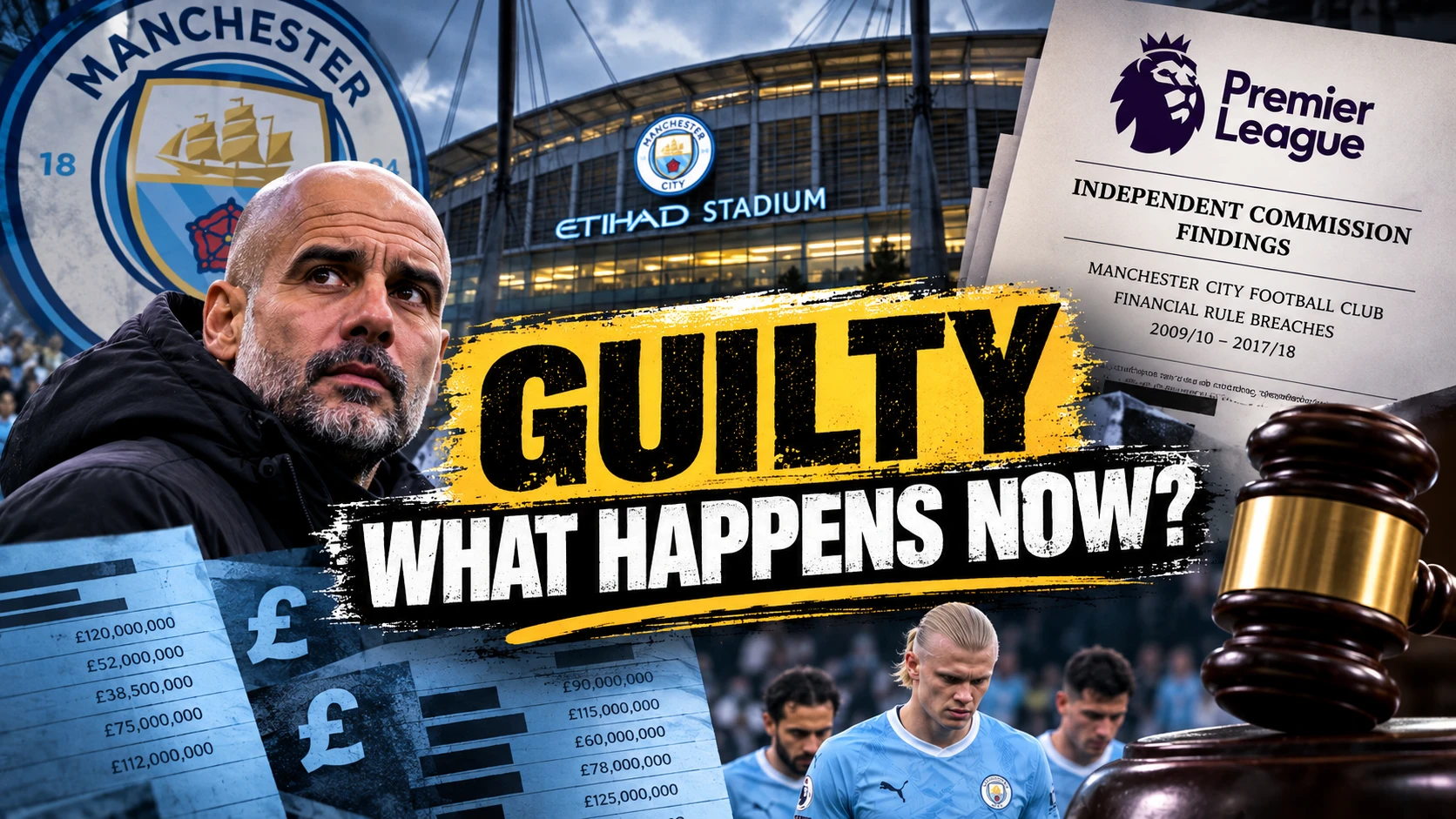
Manchester City have been found guilty of serious breaches of the Premier League’s financial rules across a nine-season period, bringing one of the most significant disciplinary cases in English football history to a potentially decisive stage.
But this is not the end of the case.
Far from it.
An independent Commission has established its findings against Manchester City. The club strongly disputes those findings and has indicated that it intends to appeal. Meanwhile, the question dominating English football remains unanswered:
What punishment, if any, will Manchester City ultimately receive?
A fine, points deduction and even expulsion from the Premier League are among the sanctions permitted under the rules. Yet no sanction has been imposed at the time of writing.
Then there are the much more complicated questions.
Could Manchester City’s previous titles be affected? Could rival clubs pursue compensation? What happens to the current Premier League season? And how can football meaningfully address breaches relating to seasons that finished many years ago?
Here is what we know, what remains uncertain and why the Manchester City case could have consequences far beyond the Etihad Stadium.
What Have Manchester City Been Found Guilty Of?
The Premier League announced on 29 September 2026 that an independent Commission had found Manchester City guilty of all charges relating to serious financial rule breaches over a nine-season period.
The relevant period runs from the 2009/10 season through to 2017/18.
The Commission also upheld three of four alleged breaches concerning City’s obligations to co-operate with the Premier League’s investigation.
According to the Premier League’s published account of the decision, the Commission found that City used what it described as “sham” commercial arrangements with sponsors and other parties.
It concluded that these arrangements artificially increased revenue and reduced the costs recorded by the club.
The Commission further found that Manchester City submitted misstated accounts and concealed the true financial position from auditors and football regulators.
The scale is substantial.
According to the Premier League, the arrangements resulted in City’s revenues being inflated and costs reduced by more than £900 million during the period concerned.
The Commission concluded that, had the relevant arrangements been recorded accurately, Manchester City would have substantially exceeded both Premier League and UEFA spending limits.
What Were the Alleged Commercial Arrangements?
The case is considerably more complicated than a football club simply spending too much money.
The Commission found that some sponsorship agreements did not accurately represent who was ultimately providing the money involved.
According to the Premier League’s summary, certain commercial partners were required to provide only part of the sponsorship payments recorded by Manchester City.
The remainder was funded by Abu Dhabi United Group Investment & Development Ltd, the company that owned the club.
The Commission also identified arrangements relating to operating expenses and player image rights.
Its conclusion was that the combined effect was to make Manchester City’s financial position appear considerably different from its underlying reality.
That distinction is crucial.
Football’s financial regulations allow clubs to generate substantial commercial income. What they do not allow is owner funding to be presented as independent commercial revenue where the rules require those things to be treated differently.
Manchester City Also Failed to Co-operate Fully
The findings extend beyond the club’s historical financial reporting.
The Commission upheld three of the four alleged breaches concerning Manchester City’s obligation to co-operate with the Premier League.
The Premier League investigation began in December 2018.
The Commission subsequently concluded that City had made concerted efforts to frustrate that investigation.
This element matters because sporting regulators depend heavily upon clubs providing accurate documents and information.
Financial regulation becomes extremely difficult to enforce if the governing body cannot obtain the material necessary to establish whether its rules have been followed.
How Did the Case Take So Long?
The Manchester City case has been hanging over English football for years.
The Premier League began investigating in December 2018 and formally referred its complaint to an independent Commission in February 2023.
The Commission eventually conducted a 42-day hearing that concluded in December 2024.
Even then, producing the decision took considerably longer than anticipated.
The scale of the material helps explain why.
The Commission had approximately 7,000 pages of witness and expert transcripts alongside extensive documentation and detailed legal submissions from both sides.
This was never going to be a simple disciplinary hearing.
It became one of the most complex regulatory cases English football has seen.
What Does Manchester City Say?
Manchester City reject the Commission’s conclusions and intend to challenge them.
Club chief executive Ferran Soriano has publicly maintained City’s position that the findings are based upon flawed factual and legal reasoning.
The club has consistently denied wrongdoing throughout the proceedings.
That is important context.
The Commission’s findings are highly significant, but Manchester City retain a right of appeal.
The club has until 2 October to exercise that right.
Until the appeals process is exhausted, the ultimate legal and sporting position remains unresolved.
What Happens Next?
There are effectively two major processes still ahead.
First, the independent Commission must determine the appropriate sanction arising from the breaches it has found.
That will take place at a separate hearing.
The proceedings will remain private until publication of the outcome is permitted.
Second, Manchester City can appeal the Commission’s findings.
That creates the possibility of further legal proceedings before the case finally reaches a conclusion.
The Premier League has said it wants the remainder of the process, including appeals, concluded as quickly as possible.
Given the scale and complexity of the dispute, however, predicting precisely when that will happen would be unwise.
What Punishment Could Manchester City Receive?
This is the question attracting the most speculation.
It is also the question for which there is currently no definitive answer.
Premier League rules provide commissions with significant disciplinary powers.
Potential sanctions can include financial penalties and points deductions, while expulsion from the competition is also possible under the rules.
That does not mean any particular sanction will necessarily be imposed.
The Commission must consider the circumstances and determine the appropriate punishment.
Until it does so, headlines claiming Manchester City will definitely be relegated, deducted a particular number of points or stripped of specific trophies should be treated as speculation rather than established fact.
Could Manchester City Be Relegated?
Expulsion from the Premier League is within the range of possible disciplinary consequences.
Whether the Commission would choose such an extreme sanction is a separate matter.
There is no confirmed decision that Manchester City will be relegated or expelled.
The unprecedented nature of the case makes comparisons difficult.
The Commission has found serious and systematic breaches spanning almost a decade, but English football has no directly equivalent Premier League case from which an obvious punishment can simply be copied.
That is one reason speculation about an exact sanction is currently unreliable.
Could Manchester City Receive a Points Deduction?
Yes, a points deduction is another sanction available within the Premier League disciplinary framework.
Recent seasons have already demonstrated that financial-rule breaches can result in sporting penalties rather than fines alone.
Everton and Nottingham Forest both received points deductions following breaches of the Premier League’s Profitability and Sustainability Rules.
However, those cases should not be treated as a mathematical formula for determining Manchester City’s punishment.
The nature, duration and findings in the City case are different.
It would therefore be misleading simply to take a previous points deduction and multiply it according to the number of City’s breaches.
Could Manchester City’s Premier League Titles Be Stripped?
This may ultimately become the most emotionally charged question surrounding the case.
Manchester City won numerous trophies during and following the period covered by the Commission’s findings.
Supporters of rival clubs will inevitably ask whether those achievements should now be reconsidered.
At present, however, no Manchester City title has been stripped.
Nor has the independent Commission announced that previous league tables will be rewritten.
The practical problems would be enormous.
Removing a trophy from one club many years later does not recreate the season for everybody else.
It does not restore lost Champions League qualification, prize money, commercial opportunities or the experience of winning a championship on the pitch.
Even the apparently simple question of awarding a title to the second-placed team raises difficult sporting and legal questions.
Teams approached matches during those seasons according to the league table that existed at the time.
Football cannot simply rewind the competition and replay it under different circumstances.
What About Liverpool and Manchester United?
The historical implications inevitably draw attention to the clubs that finished immediately behind Manchester City during affected seasons.
Manchester United finished second to City in 2011/12 and 2017/18, while Liverpool finished one point behind City in 2018/19 and 2021/22.
Those title races form an important part of Premier League history.
But it would be premature to describe any of those clubs as retrospective champions.
No decision has been announced to reallocate previous titles.
Former Liverpool manager Jürgen Klopp has also urged caution over the fallout, saying he is comfortable with Liverpool’s achievements and prefers to allow the legal process to run its course.
Could Other Premier League Clubs Claim Compensation?
This could ultimately prove almost as consequential as the sporting sanction.
British media reports indicate that rival clubs are considering their legal positions following the Commission’s findings.
The potential arguments are obvious.
A club that missed Champions League qualification could argue that it lost substantial revenue.
A club relegated during an affected season could potentially point towards enormous financial consequences.
Others could argue that league positions, prize money or commercial opportunities were affected.
Establishing legal causation and calculating losses many years later would be extraordinarily complicated.
But if compensation claims proceed, the financial consequences of this case could extend far beyond any fine imposed directly by the Premier League.
The Biggest Problem Is That Football Cannot Go Back in Time
This is where the Manchester City case exposes a fundamental weakness in retrospective sporting justice.
The Commission can impose a sanction.
It cannot recreate the past.
Consider a club that missed Champions League qualification by a single point during an affected season.
The financial consequences might have influenced transfers, managerial decisions and the club’s development for years afterwards.
Or consider a club that was relegated.
Its players may have left. Its manager may have been dismissed. Revenue disappeared. The entire trajectory of the club may have changed.
No disciplinary hearing in 2026 can reproduce the alternative history in which those events never happened.
This does not mean historical breaches should go unpunished.
It demonstrates why enforcing sporting regulations promptly is so important.
Justice delayed in sport can become justice that is almost impossible to administer cleanly.
Would Punishing Today’s Manchester City Be Fair?
There is another uncomfortable issue.
The conduct identified by the Commission relates to the period between 2009/10 and 2017/18.
Many of Manchester City’s current players had nothing whatsoever to do with it.
Some were children when the earliest breaches occurred.
The current coaching staff cannot be held personally responsible for historical accounting decisions either.
Neither can supporters.
Yet sporting sanctions inevitably affect the current team and its fans because a football club continues as the same sporting entity even when its personnel change.
This is not unique to Manchester City.
It is an inherent problem whenever organisations are punished for historical conduct.
The Commission will therefore have to balance accountability for the club with the practical reality that many of those experiencing the consequences today played no role in the breaches.
What Does This Mean for Pep Guardiola’s Manchester City Legacy?
Pep Guardiola managed Manchester City from 2016 until the end of the 2025/26 season and presided over the most successful period in the club’s history.
He won six Premier League titles and finally delivered the Champions League as part of the 2023 Treble.
Following the Commission’s findings, Guardiola publicly expressed his support for his former club.
The financial case will inevitably become part of the wider discussion surrounding City’s era of dominance.
But it is important to distinguish between different questions.
The Commission’s findings concern Manchester City’s compliance with financial regulations and the accuracy of information provided by the club.
They are not a finding that Guardiola, City’s players or coaching staff fixed matches or did not legitimately win games on the pitch.
At the same time, financial regulations exist precisely because spending power can influence sporting competitiveness.
That tension is why the historical debate will not disappear regardless of the eventual sanction.
Guardiola Has Backed His Former Club
Guardiola has made his position clear following the verdict.
The former City manager publicly expressed solidarity with the club, its leadership, players and supporters.
That is unsurprising given his long relationship with Manchester City.
Throughout his tenure, Guardiola repeatedly defended the club when questions about its finances arose.
The Commission’s decision now means those debates are taking place in a fundamentally different context.
Previously, the discussion centred upon allegations.
There is now a formal finding from an independent Premier League Commission, albeit one Manchester City intends to challenge on appeal.
The Etihad Fallout Extends Beyond Football
The repercussions have already spread beyond Manchester City itself.
Etihad Airways, one of City’s most prominent commercial partners, has said it is seeking legal advice following publication of the findings.
The airline denies involvement in improper arrangements and has expressed concern about the reputational consequences arising from the case.
That illustrates another dimension of the problem.
Major football sponsorships connect clubs with multinational companies whose reputations extend far beyond sport.
The legal and commercial consequences of the Commission’s decision may therefore develop in directions that have little to do with league tables or points deductions.
What Does This Mean for Manchester City’s Players?
For the current squad, uncertainty may be the biggest immediate problem.
Players preparing for Premier League and European matches have no control over a legal dispute concerning financial arrangements from years earlier.
Yet they must operate amid speculation about points deductions, relegation, contracts and the club’s future.
If the appeals process becomes prolonged, that uncertainty could extend across transfer windows and potentially multiple seasons.
Rival clubs may inevitably monitor the situation, particularly if questions emerge about City’s future competition status.
For now, however, Manchester City remain a Premier League club and continue to compete normally.
Why This Case Matters to Every Premier League Club
The significance of the Manchester City case goes well beyond one club.
Financial rules only function if clubs believe they will be enforced.
If regulations can be circumvented without meaningful consequences, compliant clubs could reasonably question why they should restrain their own spending.
Conversely, sanctions must be proportionate, legally robust and imposed through a process clubs can trust.
That is why this case matters even to supporters with little interest in Manchester City.
It is ultimately a test of whether the Premier League can regulate its own competition effectively.
The Premier League Faces Its Most Difficult Decision
Premier League chief executive Richard Masters has described the disciplinary case as the most significant in the competition’s history.
That does not feel like an exaggeration.
The Commission has found that one of the defining clubs of the modern Premier League systematically breached financial rules across almost a decade.
Manchester City reject those findings and intend to appeal.
The sanction remains unknown.
Potential compensation claims remain unresolved.
The status of historical titles has not changed.
And nobody yet knows how long the remaining legal process will take.
That leaves English football in an extraordinary position.
For years, the central question was whether the Premier League could prove its case against Manchester City.
An independent Commission has now made findings that substantially answer that question at the first stage of the disciplinary process.
The question facing the Premier League has changed.
What can football realistically do about it now?
Whatever answer eventually emerges will matter not only to Manchester City, but to every club expected to compete under the same financial rules in the future.
This article reflects the position as of 1 October 2026 and will be updated as the sanctions and appeals process develops.

