
Premier League VAR Controversy: When the Rules Stop Making Sense
Admin
- posted on
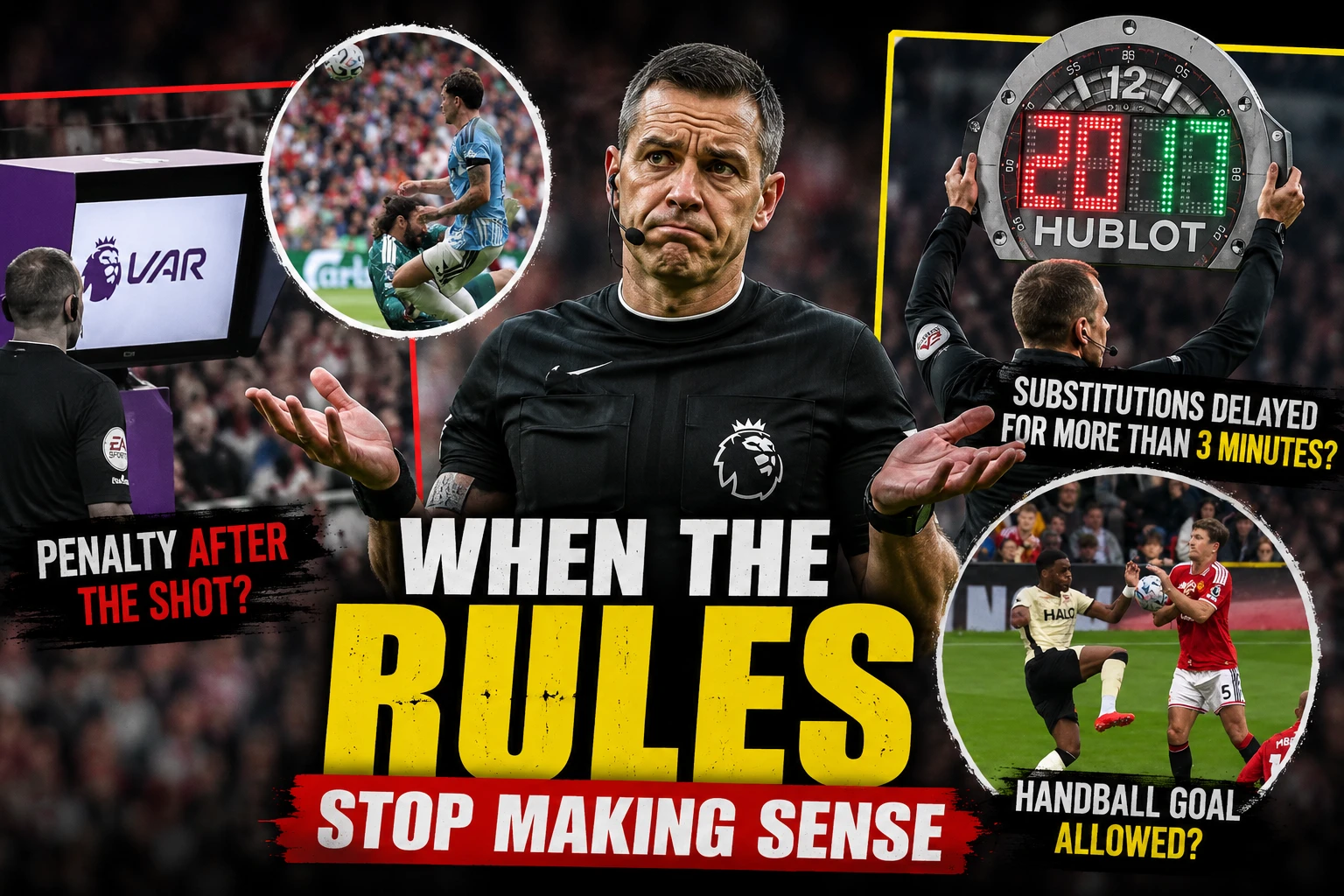
Premier League Refereeing Controversies Raise Questions Over VAR and Common Sense
The Premier League is only two weekends into the new season, but familiar arguments about refereeing, VAR and increasingly complicated laws are already back.
There will always be controversial decisions in football. Referees make mistakes, players make mistakes and supporters will inevitably see incidents differently depending on which team they support.
But two incidents from this weekend raise a slightly different question.
What happens when a decision can be explained according to the laws of the game, yet still appears completely contrary to what actually happened on the football pitch?
Liverpool’s 2-2 draw with Nottingham Forest and Manchester United’s 5-2 victory over Ipswich Town provided two remarkable examples.
Nottingham Forest’s Penalty at Liverpool
Nottingham Forest were awarded a penalty at Anfield when Neco Williams went down following a challenge from Liverpool goalkeeper Alisson.
The referee considered that Alisson had failed to play the ball and made contact with Williams. VAR reviewed the incident and supported the on-field decision.
There was contact. That much is not really in dispute.
But the timing of that contact deserves considerably more discussion.
Williams had already taken his shot before the contact occurred.
That immediately creates an interesting question about how penalties are judged.
If an attacker successfully gets his shot away and the goalkeeper makes contact afterwards, should every such collision automatically be considered a foul?
Football has traditionally allowed a degree of natural follow-through. Players collide after shots, crosses, headers and tackles throughout every match.
There is obviously a point at which late contact becomes reckless or dangerous and should be punished regardless of whether the ball has already gone.
But if ordinary contact after a shot is treated in exactly the same way as a challenge which prevents the attacker from playing the ball, the penalty law begins to produce some strange outcomes.
In this case, the attacking action had effectively already happened.
The shot had been taken.
Alisson did not prevent Williams from shooting.
Yet the subsequent contact resulted in arguably the most valuable decision available to an attacking team: a penalty.
But Liverpool Had Another Reason to Be Furious
The penalty itself was only part of the controversy at Anfield.
Liverpool had been attempting to make a triple substitution before the incident.
The changes were not completed.
Play continued.
There appeared to be several opportunities during stoppages in play for the substitutions to be made, yet Liverpool’s players remained waiting on the touchline.
One restart was taken quickly from a throw-in and the sequence eventually resulted in Forest winning the penalty.
Only after the penalty had been awarded were Liverpool finally able to complete the changes.
Liverpool manager Andoni Iraola was understandably frustrated afterwards, saying that the club had been trying to make the substitutions for several minutes.
Reports indicated that problems with the fourth official’s electronic substitution board contributed to the delay.
That explanation may account for what happened.
It does not necessarily make it acceptable.
Technology Should Not Prevent a Substitution
This is where football sometimes appears to make a simple sport unnecessarily complicated.
If an electronic substitution board fails, why should a football match effectively become dependent upon repairing or replacing it?
The important information is hardly complicated.
One player is leaving the pitch.
Another is replacing him.
The referee, fourth official, teams and spectators can all be informed without an electronic board.
The board is useful for communicating shirt numbers to the stadium. It should not become a technological barrier preventing a legitimate substitution from taking place.
When Liverpool were trying to change three players and play was repeatedly allowed to restart, the administrative process began influencing the sporting contest itself.
That should concern the Premier League considerably more than whether a malfunctioning board can eventually be made to work.
Then Came Manchester United Against Ipswich
If the Liverpool incident raised questions about how the laws are interpreted, Manchester United’s second goal against Ipswich provided an even better example of football disappearing down its own regulatory rabbit hole.
Harry Maguire was involved in the build-up to United taking a 2-1 lead at Old Trafford.
The ball struck Maguire’s hand before he subsequently fired towards goal.
His effort was heading off target.
It then struck Ipswich defender Jacob Greaves and went into the net.
The goal was awarded as a Greaves own goal.
VAR checked the handball.
And the goal stood.
Why Was the Manchester United Goal Allowed?
The Premier League’s explanation demonstrates just how peculiar the modern handball law has become.
Because Maguire’s handball was considered accidental, it would only automatically invalidate the goal if Maguire himself immediately scored.
But he didn’t.
His shot was judged to be off target.
It hit Greaves.
The goal therefore became an own goal.
As a result, Maguire was not considered the immediate goalscorer following the accidental handball and the goal was allowed to stand.
Technically, according to the current interpretation, that makes sense.
From the perspective of what actually happened, it is considerably harder to explain.
The Shot Was Off Target – But It Still Produced a Goal
This is where football supporters could reasonably ask whether the law is achieving what it was designed to achieve.
Maguire gained possession following contact with his hand.
He then shot.
That shot struck a defender.
The ball went into the goal.
Without Maguire’s shot, there is no goal.
Without the preceding contact with his hand, the attacking sequence may not happen in the same way.
Yet because the shot happened to be travelling wide before touching Greaves, the law treats the sequence differently.
Consider the alternative.
If Maguire had struck exactly the same shot and it had travelled directly into the net, the goal would have been disallowed.
But because a defender inadvertently diverted the off-target shot into his own goal, the accidental handball ceased to be an automatic offence.
The difference between a legal goal and a disallowed goal therefore depended not upon Maguire’s action, but upon what happened to the ball after he kicked it.
That might satisfy the wording of the law.
Whether it satisfies football’s sense of fairness is another matter entirely.
VAR Is Not Always the Real Problem
VAR will inevitably receive much of the criticism after incidents like these.
But blaming VAR for everything risks missing the larger problem.
VAR can only operate within the laws and interpretations it has been given.
In the Manchester United incident, VAR appears to have applied the current handball interpretation correctly.
The more important question is therefore whether the law itself is sensible.
Technology cannot make an unnecessarily complicated rule simple.
Nor can VAR manufacture consistency when supporters, players and even experienced pundits struggle to understand why seemingly similar incidents produce different outcomes.
Football Needs Laws That Pass the Common-Sense Test
The laws of football inevitably need detail.
Elite football moves quickly, enormous amounts of money are involved and referees require clear guidance.
But there should still be a basic test for any law:
Can an ordinary supporter watch an incident and understand why the decision was made?
If explaining why a goal stands requires a discussion about whether a shot was technically on target, whether the final touch constituted an own goal and whether the player who handled the ball can therefore be classified as the immediate goalscorer, something has probably gone wrong.
The same applies when an electronic board apparently contributes to preventing substitutions being made despite several stoppages in play.
Technology and regulation are supposed to help officials manage football matches.
They should not become the story themselves.
The Premier League Has an Opportunity to Simplify
Neither of this weekend’s controversies requires accusations of bias or conspiracy.
That is too easy and rarely useful.
The more interesting issue is whether football’s rule-makers have created interpretations which officials can defend technically but supporters cannot reconcile with the game taking place in front of them.
The Forest penalty will divide opinion. There was contact, but it occurred after Williams had taken his shot.
The Manchester United goal appears to have been correctly awarded under the present interpretation of accidental handball, but that interpretation produced an outcome many supporters will understandably find bizarre.
And Liverpool’s substitution problems demonstrate how even basic match administration can affect the sporting contest when technology fails.
Refereeing will never be perfect.
VAR will never eliminate controversy.
But football can at least aim for laws and procedures that make intuitive sense.
After this weekend, the Premier League might reasonably ask whether some of them still do.

