
Spain 2–3 England: Has Thomas Tuchel Finally Changed England’s Mentality?
Admin
- posted on
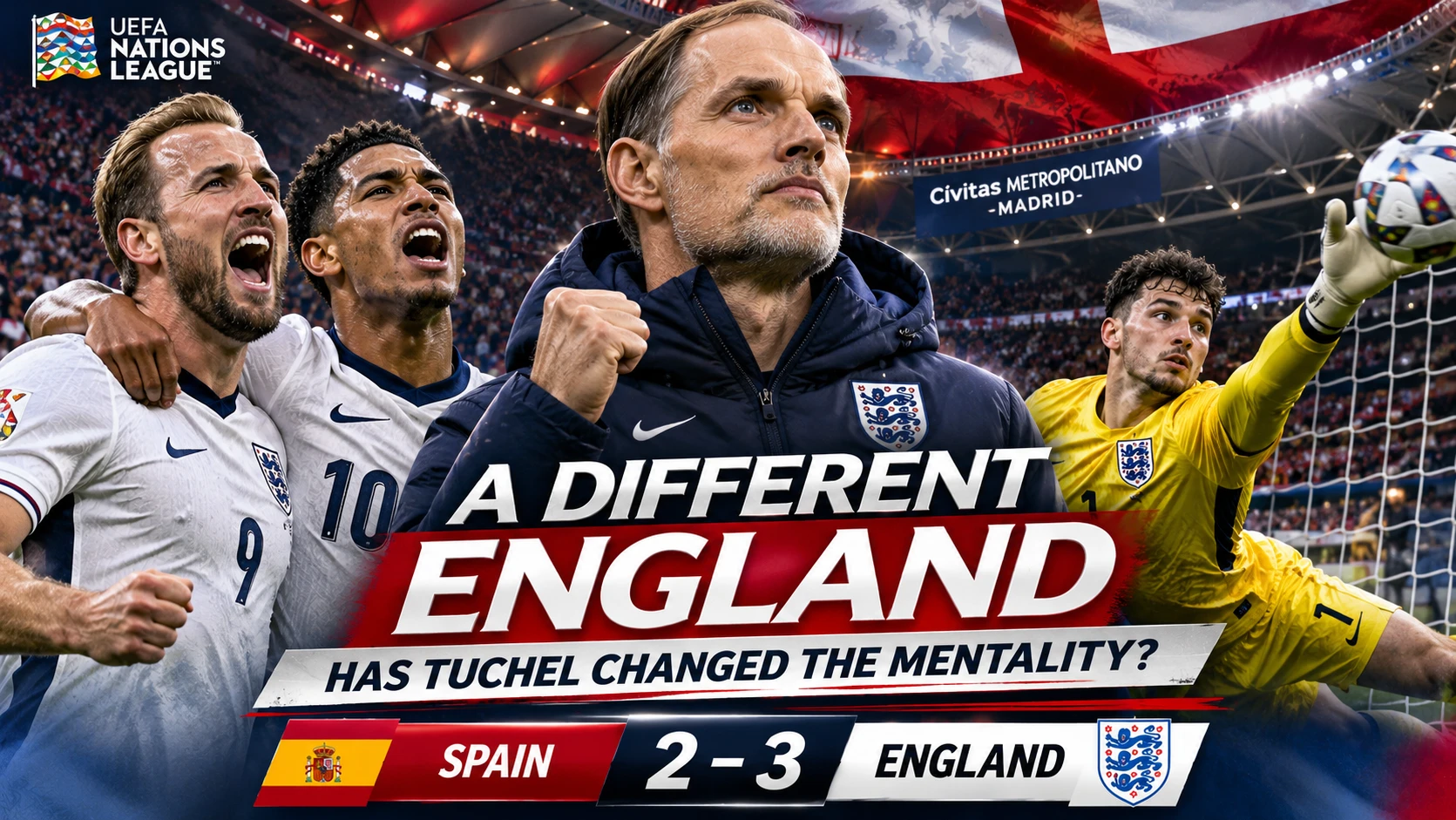
For almost an hour in Madrid on Sunday evening, England made the reigning world champions look remarkably ordinary. For the remainder of the match, they were required to demonstrate an entirely different set of qualities.
That they emerged with a 3-2 victory, despite playing the closing stages with ten men, might tell us more about England’s development under Thomas Tuchel than any comfortable victory against inferior opposition.
England finished top of their Nations League group, ended Spain’s remarkable winning sequence and recorded a tenth consecutive away victory.
Impressive achievements, certainly. But the significance of Sunday’s performance extends beyond those statistics.
For years, England have struggled to impose themselves against the strongest international teams. They have frequently possessed the individual talent to compete at the highest level, yet something has been missing when the opposition has demanded more of them.
Perhaps we are beginning to see that change.
 Spain 2-3 England: A Game of Two Very Different Challenges
The final score suggests a relatively evenly contested encounter. The reality was rather more complicated.
England established a three-goal advantage before the hour mark through Harry Kane, Ezri Konsa and Ben White. They had approached the game with attacking intent and challenged Spain’s ability to dictate proceedings.
Then Elliot Anderson’s dismissal in the 63rd minute changed everything. Spain converted the resulting penalty through Mikel Oyarzabal before Nico Williams reduced England’s advantage to a single goal.
Suddenly, a match England had every reason to believe was comfortable became a test of defensive organisation, concentration and character.
James Trafford proved instrumental in protecting the lead, producing a series of important saves as Spain threatened an equaliser.
England eventually survived.
What makes the performance particularly interesting is that Tuchel’s players demonstrated two contrasting ways of competing against an outstanding international team within the same match.
They imposed themselves when the opportunity existed and defended their advantage when circumstances changed.
Neither approach would have been sufficient on its own.
England Were Not Intimidated by Spain’s Reputation
There is something about facing Spain that has traditionally encouraged England to become more conservative.
The quality of Spanish possession football can persuade opponents that their best chance of success involves retreating into a defensive shape and waiting for opportunities to counterattack.
Against technically superior opposition, that approach can be understandable. But surrendering territory and initiative too readily creates its own problems.
Spain are exceptionally comfortable when opponents allow them time to establish possession, move the ball between midfielders and gradually dictate the tempo.
England’s approach in Madrid was different.
They were prepared to press Spain high up the pitch and make the home side uncomfortable from the outset. Their attacking players were not simply waiting for Spanish mistakes; they were actively attempting to create them.
That distinction matters.
England have players who regularly compete against the finest footballers in Europe at club level. Many are accustomed to Champions League football and the tactical demands associated with playing against elite opposition.
There is no compelling reason why those players should suddenly adopt an excessively cautious mentality when wearing an England shirt.
Tuchel appears increasingly willing to trust their capabilities.
The Statistics Do Not Tell the Whole Story
Anyone studying the final match statistics without having watched the game might conclude that England secured an unlikely victory against a dominant Spanish side.
| Match statistic | Spain | England |
|---|---|---|
| Goals | 2 | 3 |
| Possession | 58% | 42% |
| Total attempts | 22 | 9 |
| Shots on target | 8 | 6 |
| Corners | 4 | 6 |
| Goalkeeper saves | 3 | 6 |
| Red cards | 0 | 1 |
Source: UEFA official full-time match report, 15 November 2026.
However, the first-half figures provide a rather different picture.
England had six attempts to Spain’s four, with four efforts on target compared with none from the home side. Possession was also considerably more evenly distributed.
The dismissal of Anderson fundamentally altered the complexion of the match, and the final statistics inevitably reflect Spain’s subsequent numerical advantage.
This is an important distinction when assessing Tuchel’s tactical approach.
England did not arrive in Madrid intending to spend 90 minutes defending their penalty area. They were forced into prolonged defensive work by circumstances that developed after they had established a commanding lead.
Possession statistics are useful, but without context they can lead to misleading conclusions.
Has England Finally Learned That Possession Is Not Everything?
English football has spent much of the past two decades attempting to become more technically accomplished.
The success of Spanish football, particularly during the period between 2008 and 2012, understandably influenced coaching philosophies throughout Europe.
Keeping the ball became associated with sophistication. Direct attacking football was sometimes regarded as outdated, while teams that conceded possession were frequently accused of lacking ambition.
Yet football has never awarded points for possession.
The ability to recognise when to accelerate an attack, exploit available space or change the direction of play remains just as valuable as retaining the ball.
England’s third goal in Madrid was a particularly encouraging example. Harry Kane’s involvement in the build-up, Jude Bellingham’s distribution and Ben White’s movement demonstrated the advantages of attacking decisively rather than allowing Spain time to reorganise.
England do not need to become a replica of Spain to beat Spain.
Their strengths are different, and a successful international coach should be capable of constructing an approach that makes the most of those differences.
Tuchel’s task is not to win a debate about footballing philosophy. It is to develop a team capable of winning international tournaments.
James Trafford and the Importance of Genuine Competition
One of Tuchel’s more interesting selection decisions was giving James Trafford the opportunity to start ahead of Jordan Pickford.
Pickford has been an important figure for England over several major tournaments. His experience, performances under pressure and contribution to the national team deserve considerable respect.
However, international football cannot afford to operate on the assumption that established players should retain their positions indefinitely.
Trafford’s performance in Madrid demonstrated why competition for places is essential.
He found himself facing sustained Spanish pressure in the second half and responded with the composure required at this level. His stoppage-time intervention proved particularly important in preserving England’s advantage.
Tuchel now has a meaningful selection decision to make in future internationals.
That is a positive development.
Whether Trafford ultimately becomes England’s first-choice goalkeeper is less important at this stage than establishing an environment in which players believe exceptional performances will be rewarded.
Reputation should carry weight. It should not guarantee selection.
Harry Kane’s Contribution Goes Beyond Goals
Kane’s penalty was another addition to his extraordinary international goalscoring record, but his wider contribution deserves attention.
One of the recurring debates surrounding England has been how to accommodate a centre-forward who enjoys dropping into deeper positions alongside attacking midfielders who naturally occupy similar areas.
When the movement around Kane is insufficient, England can become predictable. Possession circulates in front of the opposition without anyone consistently threatening the space behind the defensive line.
When runners anticipate Kane’s movement, however, his ability to connect different parts of the team becomes an enormous advantage.
England’s attacking play in Madrid offered evidence of what can happen when those relationships function effectively.
Kane remains an outstanding finisher, but treating him exclusively as a penalty-box striker overlooks much of what makes him such an influential footballer.
The challenge for Tuchel is ensuring that England’s other attacking players complement those qualities rather than competing for the same space.
What Tuchel Can Build on From the Southgate Era
It would be easy to use Sunday’s victory as an opportunity to criticise Gareth Southgate retrospectively.
That would be unfair.
Southgate inherited an England side whose relationship with major international tournaments had become increasingly uncomfortable. He restored a degree of confidence, developed a more cohesive squad environment and took England to consecutive European Championship finals.
Those achievements should not be dismissed simply because England ultimately fell short of winning a trophy.
The frustration was that England often appeared reluctant to take the initiative during the decisive stages of major matches.
The 2021 European Championship final against Italy, the defeat by Croatia in the 2018 World Cup semi-final and the Euro 2024 final against Spain all contributed to that perception.
England could compete with the strongest teams, but there remained questions about their willingness and ability to control important moments.
Tuchel inherits both the benefits of Southgate’s work and the responsibility of addressing those shortcomings.
His considerable experience of knockout football at club level was one of the reasons his appointment attracted such interest.
The expectation was that he might introduce a more adaptable tactical approach and help England make better decisions when matches become difficult.
Sunday evening offered an encouraging glimpse of that possibility.
The Final Half-Hour Should Not Be Ignored
For all the enthusiasm surrounding England’s victory, there were also moments that should concern Tuchel.
Anderson’s dismissal exposed England to a considerable period of pressure, but the circumstances leading to that incident also illustrated the risks associated with losing possession in dangerous areas against technically gifted opponents.
There were occasions when England’s defensive shape was stretched and Spain were able to create opportunities with worrying ease.
Without Trafford’s interventions, the final result could have been very different.
That does not diminish the achievement. Playing against Spain with ten men is an extraordinarily difficult assignment.
Nevertheless, there is a distinction between demonstrating defensive resilience and developing sufficient control to prevent opponents from creating repeated chances.
England succeeded on Sunday, but they cannot assume that similarly demanding situations will always end favourably.
A winning mentality is not merely the determination to survive difficult moments. It also involves recognising how those moments arose and reducing the likelihood of repeating the same mistakes.
Tuchel will have plenty of material to examine when the players return for international duty.
Does the Nations League Really Matter?
There will inevitably be supporters who question the significance of a Nations League victory in the wider context of international football.
Winning in Madrid is not the same as defeating Spain in a World Cup or European Championship final.
But England need meaningful opportunities to test themselves against elite opposition between major tournaments, and the Nations League provides precisely that.
Comfortable qualifying victories can establish confidence and improve familiarity between players. They rarely reveal how effectively a team responds when confronted by world-class opponents capable of exposing its weaknesses.
Madrid provided that examination.
England have now secured a seeded position for next spring’s Nations League quarter-finals, where another demanding test awaits.
For Tuchel, these competitive occasions are valuable opportunities to refine his team’s approach ahead of Euro 2028.
For the players, they offer something equally important: experience of winning difficult matches against opponents they may encounter when considerably more is at stake.
Our Verdict: A Change in Mentality, but Still Work to Do
One victory does not transform England into the undisputed favourites for their next major international tournament.
Nor does it establish that Thomas Tuchel has solved every tactical problem that has frustrated England supporters over the years.
What it does provide is evidence of a team becoming more comfortable with the demands of elite international football.
England went to Madrid and attacked the world champions with conviction. They established a substantial lead through their own initiative before demonstrating the resilience necessary to protect it under exceptionally difficult circumstances.
Both qualities will be required if England are eventually to win another major trophy.
The most encouraging aspect of Sunday’s performance was not simply that England survived Spain’s late pressure. It was that they had been sufficiently ambitious during the opening stages to give themselves something worth defending.
For too long, England have entered important matches hoping their opponents would allow them to play.
In Madrid, they demonstrated that they were prepared to make the opposition uncomfortable instead.
England do not need to dominate every opponent. They need to believe they can beat every opponent and possess the tactical intelligence to make that belief count.
Sunday’s victory suggests Thomas Tuchel is moving them in that direction.
Fantasy Sports Portal | 18 November 2026
Sources and Further Reading
- England Football – Official match report: Spain 2-3 England
- UEFA – Official match statistics and full-time report
- Sky Sports – England’s historic victory in Madrid
- Spanish Football Federation – Spain’s perspective on the defeat
- The Guardian – England withstand Spain’s fightback
More From Fantasy Sports Portal
The International Break Nobody Wants: Is Football Asking Too Much of Its Players?

