
Rory McIlroy: Eight European Crowns and a Legacy Still Being Written
Admin
- posted on
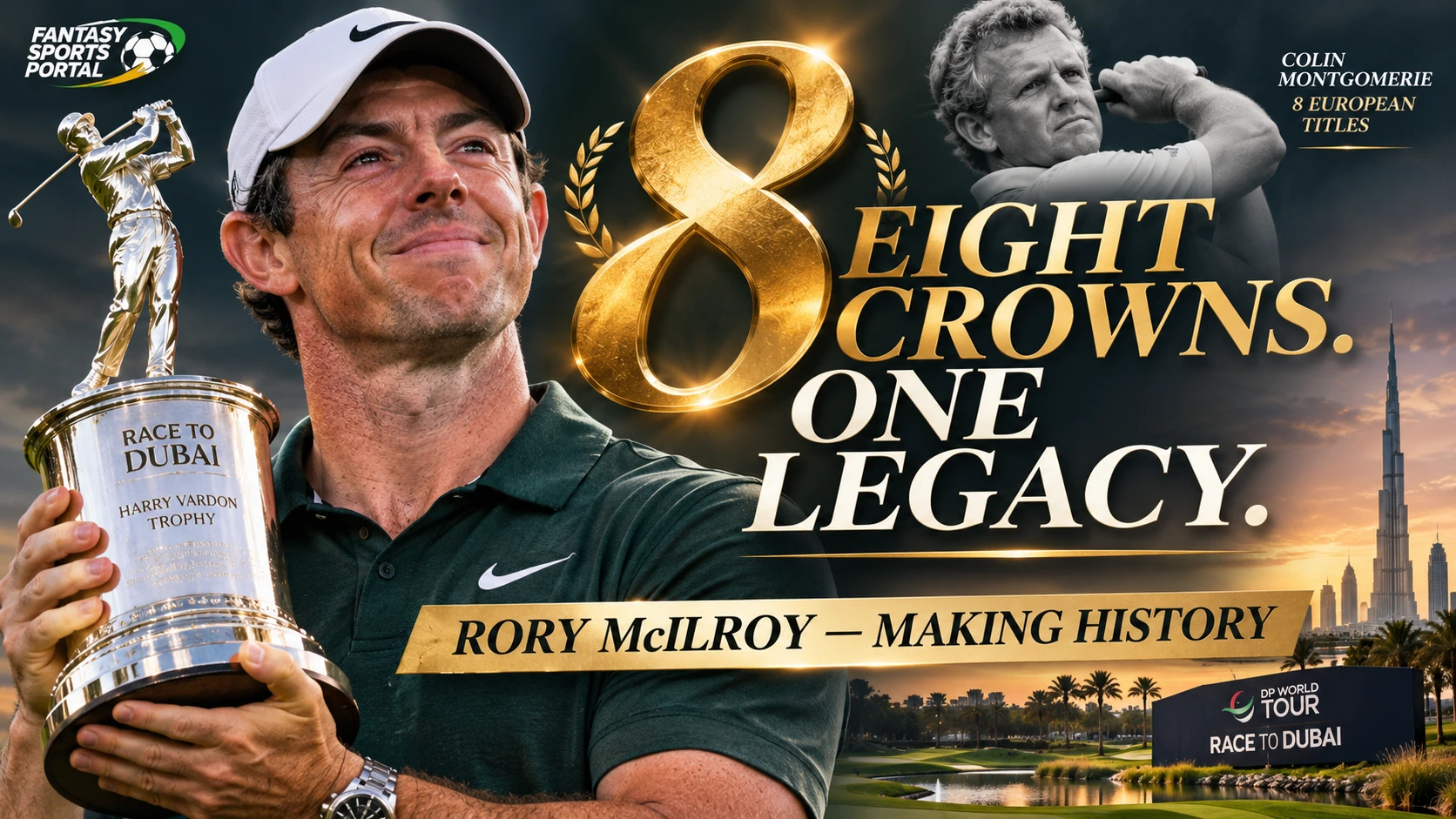
There was something rather moving about watching Rory McIlroy struggle to hold back the tears in Dubai on Sunday. Here was a man who had already achieved almost everything he could reasonably have dreamed of as a young golfer growing up in Holywood, Northern Ireland, yet another trophy still meant so much.
McIlroy’s eighth Race to Dubai title brought him level with Colin Montgomerie’s record of European Tour Order of Merit victories. It was also his fifth consecutive season-long European crown.
At 37, having completed the career Grand Slam in 2025 and successfully defended his Masters title in 2026, McIlroy might have been forgiven for feeling that he had nothing left to prove.
Instead, he found himself fighting for another piece of golfing history on the final afternoon of the European season.
And this particular achievement carried a significance that extended well beyond the record books.
Rory McIlroy’s Race to Dubai Victory Was Anything but Straightforward
It would be misleading to describe Sunday’s achievement as another comfortable demonstration of McIlroy’s superiority.
Spain’s Eugenio Chacarra entered the season finale with a meaningful advantage in the Race to Dubai standings and came remarkably close to denying McIlroy his eighth title.
The permutations changed repeatedly during the final round at Jumeirah Golf Estates. At one stage, the projected standings separated the two players by just 0.10 points.
McIlroy’s birdie at the 16th proved particularly important, swinging the balance in his favour as the competition approached its conclusion.
A bogey-free final round of 67 secured second place in the tournament, behind Tyrrell Hatton, whose excellent performance earned him a five-shot victory in the DP World Tour Championship.
McIlroy had won the season-long contest rather than the tournament itself.
There is an important distinction between the two achievements. Winning an individual tournament requires four days of exceptional golf. Winning a season-long championship is a measure of performance accumulated over a much longer period.
McIlroy has become remarkably accomplished at both.
 The Promise That Made Number Eight Different
Much of the discussion before the tournament concerned McIlroy’s pursuit of Montgomerie’s record. What emerged afterwards was a rather more personal story.
His father, Gerry, has been recovering in hospital in the United States following a double lung transplant in September.
McIlroy revealed that he had spent considerable time with his father during his recovery and had questioned whether travelling to compete internationally was the right thing to do.
Before his son departed for the Middle East, Gerry encouraged him to go and win the Race to Dubai.
Suddenly, the emotion surrounding Sunday’s achievement became understandable.
For all the wealth, recognition and opportunities that professional sport brings, those closest to an athlete often remain the people whose approval matters most.
Gerry McIlroy introduced his son to golf and played an important role in encouraging his early ambitions. Long before Augusta National, Ryder Cup victories or lucrative sponsorship agreements, there was a family making sacrifices to give a talented young golfer an opportunity.
Sunday’s trophy was a reminder of where that journey began.
It was also a refreshing moment in a sporting world increasingly dominated by discussions about prize money, commercial agreements and financial incentives.
McIlroy had a deeply personal reason to care about winning in Dubai, and no financial statistic could adequately explain it.
Why Colin Montgomerie’s Record Deserves Respect
Whenever a contemporary sporting star equals a longstanding record, there is a temptation to focus almost exclusively on the new achievement.
That would do a considerable disservice to Colin Montgomerie.
The Scotsman won seven consecutive European Tour Order of Merit titles between 1993 and 1999 before adding an eighth in 2005.
His dominance came during an era in which European golf was establishing itself as a formidable force on the international stage.
Montgomerie’s precision, consistency and ability to produce results across an entire season made him one of the most formidable competitors of his generation.
His Ryder Cup performances were equally significant. Montgomerie competed in eight editions of the competition without losing a singles match, an extraordinary record against some of America’s finest golfers.
His career is sometimes viewed through the unfortunate prism of the major championship he never won.
That is understandable given the importance attached to golf’s four major tournaments, but it is also a remarkably narrow way of judging such an accomplished player.
McIlroy has now matched Montgomerie’s overall European season-title record. He has not yet matched his seven consecutive victories.
Both achievements deserve recognition, and the comparison should enhance Montgomerie’s legacy rather than diminish it.
Two Different Eras of European Golf
Comparing golfers from different generations is rarely straightforward.
Montgomerie’s most successful years coincided with a period when the European Tour retained a different competitive structure and identity.
Many of Europe’s leading players competed extensively on their home tour, even as opportunities in the United States became increasingly attractive.
Today’s professional landscape is considerably more fragmented. The PGA Tour, DP World Tour and LIV Golf have introduced different financial incentives, scheduling priorities and competitive opportunities.
The Race to Dubai points system also differs from the traditional money-based Order of Merit.
McIlroy’s achievement cannot simply be described as an identical reproduction of what Montgomerie accomplished three decades earlier.
What makes McIlroy’s record particularly interesting is his ability to remain enormously influential in European golf while competing extensively on the other side of the Atlantic.
He has reached the highest level of the global game without completely abandoning the tour that provided the foundations of his professional career.
For the DP World Tour, that relationship carries enormous value.
Having one of the world’s leading golfers regularly competing in European events strengthens tournament fields, attracts spectators and helps maintain the tour’s international relevance.
Is Rory McIlroy Europe’s Greatest Golfer?
It is a question that has been asked with increasing frequency since McIlroy completed the career Grand Slam at Augusta National in April 2025.
His second Masters victory in 2026 strengthened his position considerably.
With seven major championships to his name, McIlroy has surpassed Nick Faldo’s total of six and Seve Ballesteros’ five.
He has also accomplished something neither Faldo nor Ballesteros managed: winning each of golf’s four major championships.
From a purely statistical perspective, the case for McIlroy is exceptionally strong.
But European golf has produced several extraordinary figures whose contributions cannot be reduced to a single column of championship victories.
Seve Ballesteros: The Man Who Changed European Golf
Ballesteros brought imagination, charisma and a wonderfully unconventional approach to the game.
His influence extended far beyond his five major championship victories. He helped transform the Ryder Cup into a genuinely competitive international sporting event and inspired generations of European golfers to believe they could challenge American dominance.
His ability to escape seemingly impossible situations became part of golfing folklore.
Without Seve, the development of modern European golf might have followed a very different path.
McIlroy may ultimately possess the greater collection of trophies, but surpassing Ballesteros in terms of cultural influence is a rather more complicated proposition.
Nick Faldo: The Relentless Pursuit of Perfection
Faldo’s career provides a fascinating contrast to both Ballesteros and McIlroy.
His success was built around technical precision, extraordinary concentration and an almost obsessive determination to improve.
Three Masters victories and three Open Championships established him as one of the finest major championship competitors of his generation.
Where Ballesteros could produce spectacular improvisation, Faldo often dismantled opponents through control and patience.
McIlroy has surpassed Faldo’s major championship total, but the Englishman’s ability to reconstruct his game and subsequently dominate at the highest level remains one of golf’s great stories.
Bernhard Langer: A Lifetime of Excellence
Any serious discussion of European golfing greatness must also acknowledge Bernhard Langer.
The German won two Masters titles and enjoyed an extraordinary career on both sides of the Atlantic.
His longevity, particularly his achievements in senior professional golf, demonstrates that greatness can take different forms.
Maintaining competitive excellence across several decades requires a level of discipline and adaptability that very few athletes possess.
McIlroy is still young enough to add significantly to his own legacy, but Langer provides a useful reminder that a player’s career should not necessarily be judged at its physical peak.
How the European Greats Compare
| Player | Major Championships | European Season Titles | Career Grand Slam |
|---|---|---|---|
| Rory McIlroy | 7 | 8 | Yes |
| Nick Faldo | 6 | 2 | No |
| Seve Ballesteros | 5 | 6 | No |
| Bernhard Langer | 2 | 2 | No |
| Colin Montgomerie | 0 | 8 | No |
Figures as of 17 November 2026. European season titles include the traditional European Tour Order of Merit and its successor, the Race to Dubai.
The comparison makes McIlroy’s achievements particularly compelling. He combines major championship success with the sustained European consistency that defined Montgomerie’s career.
Few European golfers have assembled such a balanced collection of accomplishments.
Completing the Grand Slam Appears to Have Changed Everything
For more than a decade, McIlroy arrived at Augusta National carrying the weight of one unfinished ambition.
However well he played elsewhere, the question of whether he would eventually win the Masters followed him throughout his career.
That burden disappeared in April 2025.
Winning at Augusta placed McIlroy among the exceptionally small group of male golfers to have completed the career Grand Slam.
Returning a year later and successfully defending the title demonstrated that the achievement had not diminished his competitive appetite.
There is something especially revealing about an athlete continuing to pursue excellence after achieving the objective that has defined much of their career.
McIlroy no longer needs to win another major championship to complete his collection. He does not need another Race to Dubai title to establish his place in European golfing history.
Yet he continues to compete with the younger generation of players who grew up watching him.
Chacarra’s challenge in Dubai offered a particularly interesting illustration of that changing relationship.
The established champion was no longer simply competing against his contemporaries. He was defending his position against a generation for whom McIlroy himself represents part of golfing history.
Breaking the Record in 2027 Will Not Be Easy
Attention will inevitably turn towards whether McIlroy can claim a ninth European season title next year and establish a record of his own.
The prospect of stronger competition from players such as Jon Rahm and Tyrrell Hatton could make that challenge considerably more demanding.
Chacarra has already demonstrated that the next generation should not be underestimated.
Nor can McIlroy assume that the consistent performances of recent seasons will continue indefinitely. Professional golf is a notoriously unforgiving sport, and relatively small changes in form can produce substantial differences in results.
His playing schedule will also need to accommodate the competing demands of major championships, American tournaments and European commitments.
Yet there was little in Sunday’s performance to suggest that McIlroy is approaching the end of his competitive ambitions.
He has already expressed his intention to pursue another European crown.
Given what he has achieved over the past two seasons, few would dismiss his chances.
Our Verdict: The Greatest European Golfer, but Not the End of the Story
Greatness in sport is ultimately a subjective concept. Different generations value different qualities, and statistics cannot fully explain the influence of players such as Ballesteros.
Nevertheless, if the discussion centres on competitive achievement, versatility across major championships and sustained success at the highest level, McIlroy now has an exceptionally persuasive claim to be Europe’s greatest golfer.
Seven majors. A career Grand Slam. Eight European season championships. A distinguished Ryder Cup career.
That combination is difficult to argue against.
What makes the story even more remarkable is that it remains unfinished.
There could be further major championships, another European record and more memorable Ryder Cup occasions ahead.
For now, however, perhaps the most meaningful image from Dubai was not McIlroy holding the trophy or celebrating another statistical milestone.
It was a son becoming emotional as he reflected on what the achievement would mean to his father.
After everything Rory McIlroy has accomplished, golf can still make him feel like the young boy whose dad first encouraged him to pursue his dreams.
Eight European crowns. A promise fulfilled. A legacy still being written.
Fantasy Sports Portal | 17 November 2026
Sources and Further Reading
- DP World Tour – McIlroy wins eighth Race to Dubai after final-day thriller
- DP World Tour – McIlroy dedicates his eighth title to father Gerry
- Reuters – McIlroy equals Montgomerie’s record
- RTÉ Sport – McIlroy claims record-equalling eighth Race to Dubai title
- Sky Sports – McIlroy’s place in European golfing history

