
This archived Fantasy Sports Portal case study examines how scoring categories, consistency and salary value influenced midfielder selection on Mondogoal during the 2014/15 Premier League season.
Although Mondogoal belongs to an earlier era of daily fantasy football, the core analytical principles remain relevant. Midfielders still need to be evaluated according to how they earn points, how reliable those returns are and whether their expected production justifies their cost.
Understanding Mondogoal Midfielder Scoring
The original analysis divided Mondogoal midfielder scoring into five main areas:
- Goals: points awarded when a midfielder scored.
- Attacking contribution: assists and shots on target, with deductions for missed penalties.
- Defence: clean sheets and matches in which only one goal was conceded.
- Discipline: yellow cards, red cards and fouls committed.
- Regular play: fouls won, minutes played and completed passes.
One notable omission was tackles won.
In the previous guide, Paul Scholes was used as an example of a complete midfielder whose aggressive tackling occasionally led to unnecessary cautions. It was therefore surprising that successful tackles were not included in Mondogoal’s midfielder scoring matrix.
Aside from that omission, the system rewarded a useful mixture of attacking output, possession involvement, defensive contribution and discipline.
Creating a Midfielder Consistency Rating
The original case study combined regular-play points with disciplinary deductions to produce a consistency rating.
This rating was designed to measure repeatable production rather than occasional explosive returns.
A midfielder could generate consistency points by:
- Playing substantial minutes.
- Completing a high volume of passes.
- Winning fouls through intelligent movement or dribbling.
- Avoiding cards and unnecessary fouls.
The analysis covered every Premier League match played through Gameweek 37 of the 2014/15 season and compared all midfielders with the top 25 performers ranked by average points per game.
Why Midfield Budget Management Matters
Midfield is usually the most demanding area of a fantasy squad.
Depending on the formation, managers may need to select four or five midfielders. That makes it difficult to fill every position with expensive premium players.
The challenge is therefore not simply to identify the highest-scoring midfielders.
Managers must build a group that combines:
- Reliable points.
- Attacking upside.
- Favourable fixtures.
- Secure minutes.
- Affordable salaries.
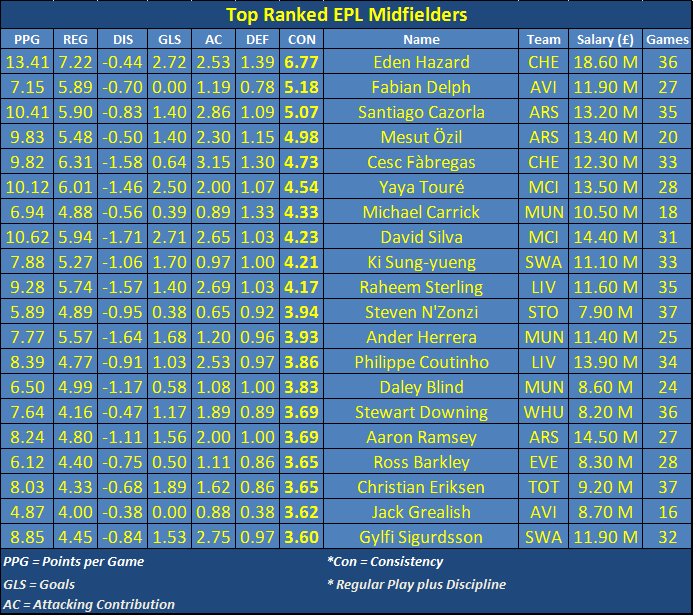
The following table shows the scoring distribution of the top 20 midfielders through Gameweek 37 of the 2014/15 Premier League season. Each player made at least 10 appearances.
Regular Play Was the Key Scoring Area
Breaking down midfielder scoring revealed that regular play had a major influence on overall performance.
For many players, it contributed more than either goals or attacking actions.
This mattered because regular-play points were generally more repeatable.
Goals and assists could produce high scores, but they were less predictable from one match to the next. Passing involvement, minutes played and fouls won gave certain midfielders a dependable scoring foundation.
This made it possible for a player to return useful fantasy points even without registering a goal or assist.
Eden Hazard and Repeatable Production
Eden Hazard provided one of the clearest examples.
His dribbling ability allowed him to draw fouls regularly, while his discipline limited negative points.
As a result, his consistency rating accounted for almost half of his average Mondogoal score.
That production was repeatable because it did not depend entirely on goals or assists.
However, Hazard also commanded a premium salary.
Selecting him required managers to make savings elsewhere, which meant his projected score needed to justify both his price and the opportunity cost of leaving less budget for other positions.
Comparing Midfielder Salary with Expected Points
The following graph compares average points per game with Mondogoal salary.
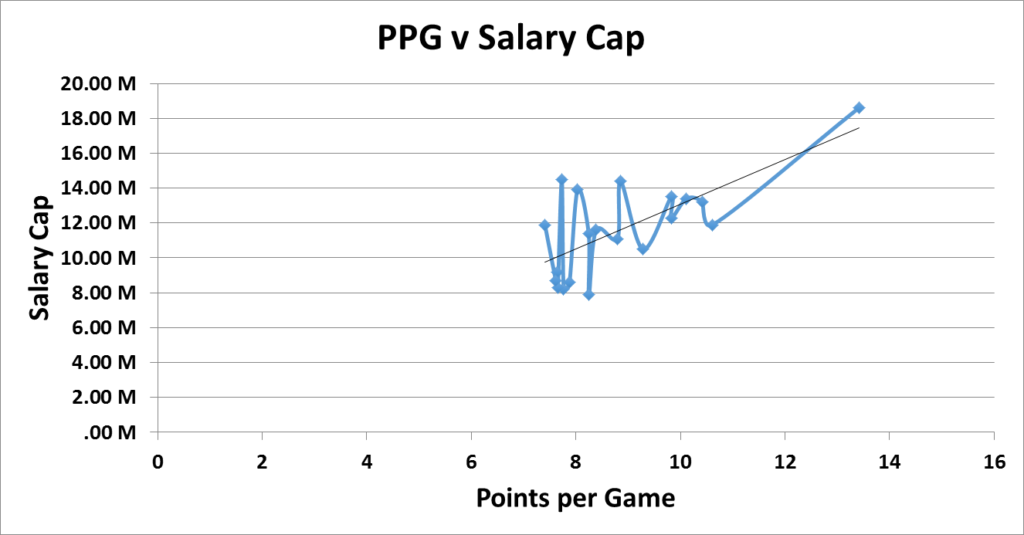
A line of best fit provided a broad indication of how much a midfielder might be expected to cost based on projected production.
Players positioned below the expected salary level could represent value, particularly when the upcoming fixture increased their scoring potential.
The purpose was not to select the cheapest midfielders.
It was to find those whose projected output exceeded the level implied by their salary.
How to Select Mondogoal Midfielders
The original case study recommended combining player ratings with fixture analysis.
Assess Team Goal Expectations
Begin by identifying teams expected to score more than their normal average.
Midfielders who regularly contribute through goals, assists and shots on target are more likely to benefit when their team has a favourable attacking fixture.
Defensive expectations also mattered because Mondogoal awarded midfielders points for clean sheets and low-scoring matches.
The ideal fixture could therefore offer both attacking and defensive upside.
Look for Advanced Midfielders
Player classification can create an important fantasy advantage.
Many teams use formations such as 4-3-3 in which players officially classified as midfielders operate in advanced attacking positions.
A midfielder playing as a winger, inside forward or second striker may offer greater goal involvement than a traditional central midfielder while retaining midfielder eligibility.
These players are often described as being out of position.
Identify Set-Piece Responsibility
Set pieces increase a midfielder’s routes to points.
Managers should identify players responsible for:
- Penalties.
- Direct free kicks.
- Indirect free kicks.
- Corners.
A player with regular set-piece duties can generate additional shots, chances created, assists and goals.
Consider Disciplinary Risk
Some fixtures are more volatile than others.
Derbies, relegation battles and matches involving aggressive teams can increase the risk of fouls and cards.
Midfielders with poor disciplinary records may become less attractive when negative points are likely to offset their positive contributions.
Understand the Expected Match Pattern
Possession can have a major effect on regular-play scoring.
If one team is expected to dominate the ball, its central midfielders may accumulate points through completed passes and sustained involvement.
Creative players may also benefit from spending more time in advanced areas.
However, midfielders from the defending side may earn points through counter-attacks, fouls won or other defensive actions, depending on the platform’s scoring rules.
Choosing Between Premium and Value Midfielders
Premium midfielders offer strong scoring potential, but using several can place excessive pressure on the salary budget.
A balanced midfield might include:
- One premium player with elite attacking potential.
- One or two reliable performers with strong consistency scores.
- A lower-cost midfielder benefiting from a favourable role or fixture.
This approach allows managers to retain upside without weakening every other area of the line-up.
The correct balance depends on the contest format, scoring system and available salaries.
Early-Season Midfielder Selection
At the beginning of a new season, current data is limited.
Managers may need to rely on previous-season statistics until enough new matches have been played to establish reliable trends.
Historical data can provide a useful starting point, but it must be adjusted for:
- Transfers.
- Managerial changes.
- New formations.
- Changes in set-piece responsibility.
- Promotion or relegation.
- Injuries and altered playing time.
Last season’s numbers are most useful when a player’s role and circumstances remain broadly unchanged.
Applying the Lessons to Modern Fantasy Football
The same framework can be used across modern fantasy formats.
Before selecting a midfielder, consider:
- Expected minutes.
- Goal and assist potential.
- Shots and shots on target.
- Expected goals and expected assists.
- Set-piece responsibility.
- Position within the team’s formation.
- Passing and possession involvement.
- Fouls won and disciplinary risk.
- Fixture difficulty.
- Price relative to projected output.
The strongest selections usually combine a reliable points floor with the potential for attacking returns.
Key Lessons from the Case Study
Midfield Scoring Is Not Only About Goals and Assists
Regular involvement can account for a significant share of a midfielder’s points.
Consistency Has Real Value
Repeatable actions such as passing, minutes played and fouls won create a dependable scoring floor.
Role Matters More Than Position Label
A midfielder operating in an advanced role may offer significantly more attacking potential than his official classification suggests.
Set Pieces Increase Upside
Penalty, free-kick and corner duties provide additional routes to fantasy returns.
Premium Players Require Sacrifices
An expensive midfielder must produce enough value to justify the weaker selections his salary may force elsewhere.
Fixture Context Is Essential
Expected goals, possession and match volatility should all influence midfielder selection.
Historical Context
This case study was originally produced using Mondogoal scoring and Premier League data from the 2014/15 season.
The platform-specific salaries, rankings and scoring categories should be treated as a historical snapshot of daily fantasy football at that time.
The analytical method remains valuable: understand the scoring system, identify repeatable production, study the fixture and compare expected points with price.
