
Mentality in Sport
Admin
- posted on
Last updated: 24 August 2026
Mentality in Sport: Why Rory McIlroy’s 2026 Masters Win Was Won in the Mind First
In elite sport, physical ability is rarely the deciding factor at the highest level. Margins are minimal, talent is widespread and preparation is assumed. What separates winners from the rest is often far less visible: mentality.
Rory McIlroy’s victory at the 2026 Masters Tournament offered a remarkable case study.
McIlroy arrived at Augusta National as the defending champion after finally winning his first Green Jacket in 2025. Twelve months later, he faced a different psychological challenge: not trying to complete the career Grand Slam, but trying to defend the Masters.
His eventual one-shot victory over Scottie Scheffler was not simply about execution or course management. It was about controlling pressure, responding when momentum disappeared and recovering after a commanding advantage had completely evaporated.
The Illusion of Control
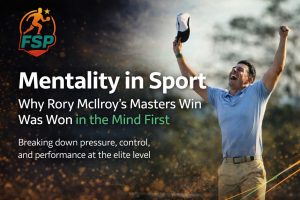
At 12-under through 36 holes, McIlroy appeared to be in complete control.
Rounds of 67 and 65 gave him a six-shot lead heading into the weekend — the largest 36-hole lead in Masters history.
Statistically, the position was dominant.
Psychologically, however, a large lead creates its own problems.
In golf — and sport more broadly — control is often an illusion. External variables, chasing opponents and internal pressure can begin to compress even the largest advantage.
The mindset can subtly shift from building a lead to protecting it.
This is where many athletes struggle.
When a Six-Shot Lead Disappears
Saturday transformed the tournament.
McIlroy followed his spectacular opening rounds with a one-over-par 73. Meanwhile, the chasing pack attacked.
Scottie Scheffler shot 65, while Cameron Young produced a 65 of his own to move alongside McIlroy at 11-under.
The six-shot advantage McIlroy had carried into the weekend was gone.
That is precisely where mentality becomes measurable.
- Do you become reactive or remain proactive?
- Do you protect what remains of the lead or continue playing your game?
- Do you become preoccupied with the leaderboard?
- Do you interpret a difficult round as failure or simply as part of the competition?
McIlroy entered Sunday no longer protecting a commanding advantage. He effectively had to begin again.
Emotional Control Is Not the Absence of Emotion
One of the defining characteristics of elite performers is the ability to manage emotion without pretending it does not exist.
Pressure produces genuine physical and psychological responses. Heart rate changes. Decision-making can become less instinctive. Athletes become more aware of consequences.
Mental strength is therefore not about feeling nothing.
It is about preventing emotion from taking control of the next decision.
Body language, tempo, routines and decision-making become particularly important when the competitive environment begins changing rapidly.
The best competitors cannot control what their opponents do. They can control how they respond.
The Final Round: Holding vs Winning
There is a fundamental difference between chasing a title and holding one.
Chasing can encourage aggression. Holding introduces something to lose.
Sunday at Augusta demonstrated both sides of that psychological equation.
At different stages of the final round, three players held a two-shot lead. Justin Rose mounted a charge, Scheffler moved into contention and the tournament repeatedly changed shape.
McIlroy therefore could not simply defend his overnight position.
He had to keep making decisions capable of winning the tournament.
The 12th Hole: Committing Under Pressure
One of the defining moments came at Augusta’s famous par-three 12th.
Rather than retreat into conservative golf, McIlroy produced an outstanding tee shot over Rae’s Creek to around seven feet and converted the birdie.
He followed it with another birdie at the par-five 13th.
Those two holes changed the tournament.
They also illustrated an important element of sporting mentality: composure should not be confused with caution.
Remaining mentally controlled does not mean avoiding risk. It means being capable of committing fully to the correct decision despite understanding the consequences of failure.
Mental Fatigue and Decision-Making
Over four rounds, mental fatigue becomes a significant performance factor.
Decision-making becomes harder, doubt can increase and technical execution can become less certain.
Elite athletes attempt to counter this through:
- consistent routines;
- simplified decision-making;
- trust in preparation;
- acceptance of previous mistakes; and
- concentration on the next action rather than the eventual outcome.
McIlroy’s weekend was not technically flawless. That is precisely what makes it such a useful example.
Mentality mattered because things went wrong.
Surviving the Final Holes
Even after McIlroy regained control, Augusta continued to test him.
He needed an inventive recovery to save par at the 16th and then found trouble from the tee at the 18th.
A closing bogey reduced his margin, but a final-round 71 was enough.
McIlroy finished the tournament at 12-under, one shot ahead of Scheffler.
The scorecard tells us who won.
It does not fully explain the psychological journey required to get there.
Why Back-to-Back Masters Titles Matter
The victory placed McIlroy in exceptionally rare company.
He became only the fourth golfer to win consecutive Masters titles, joining Jack Nicklaus, Nick Faldo and Tiger Woods.
Woods had been the most recent player to achieve it, winning in 2001 and 2002.
McIlroy’s two victories were also psychologically very different.
In 2025, he finally won the Masters after years of trying and completed the career Grand Slam.
In 2026, he returned as champion and successfully defended the title despite seeing a record halfway lead disappear.
One victory was about finally overcoming Augusta.
The other was about proving he could do it again.
Why Mentality Matters More Than Ever
Modern sport amplifies pressure.
- Constant media scrutiny
- Real-time statistics and analysis
- Immediate reaction on social media
- Public narratives developing during competition
- Increasingly detailed comparisons with previous performances
In this environment, mentality is not secondary. It is a genuine performance factor.
Technical skill determines what an athlete is capable of doing.
Mentality can determine whether that skill remains accessible when the consequences become greatest.
McIlroy’s 2026 Masters reinforces a simple reality:
At the highest level, many athletes can perform. Far fewer can sustain that performance when control begins to disappear.
What McIlroy’s 2026 Masters Victory Taught Us
Rory McIlroy’s second consecutive Masters victory will be remembered for the result, but the psychology behind it is equally compelling.
He established a record six-shot halfway lead.
He lost all of it.
He entered the final round tied for the lead.
He faced challenges from some of the world’s best golfers.
And he still found a way to win.
That is a better demonstration of sporting mentality than effortless dominance could ever provide.
Mentality is not about maintaining complete control.
It is about maintaining enough control over your own decisions when everything around you begins to change.
That is where championships are often decided.
Explore more: Golf news, analysis and features from Fantasy Sports Portal.

