
Inconsistency in English Football Officiating Is Becoming the Real Debate
Admin
- posted on
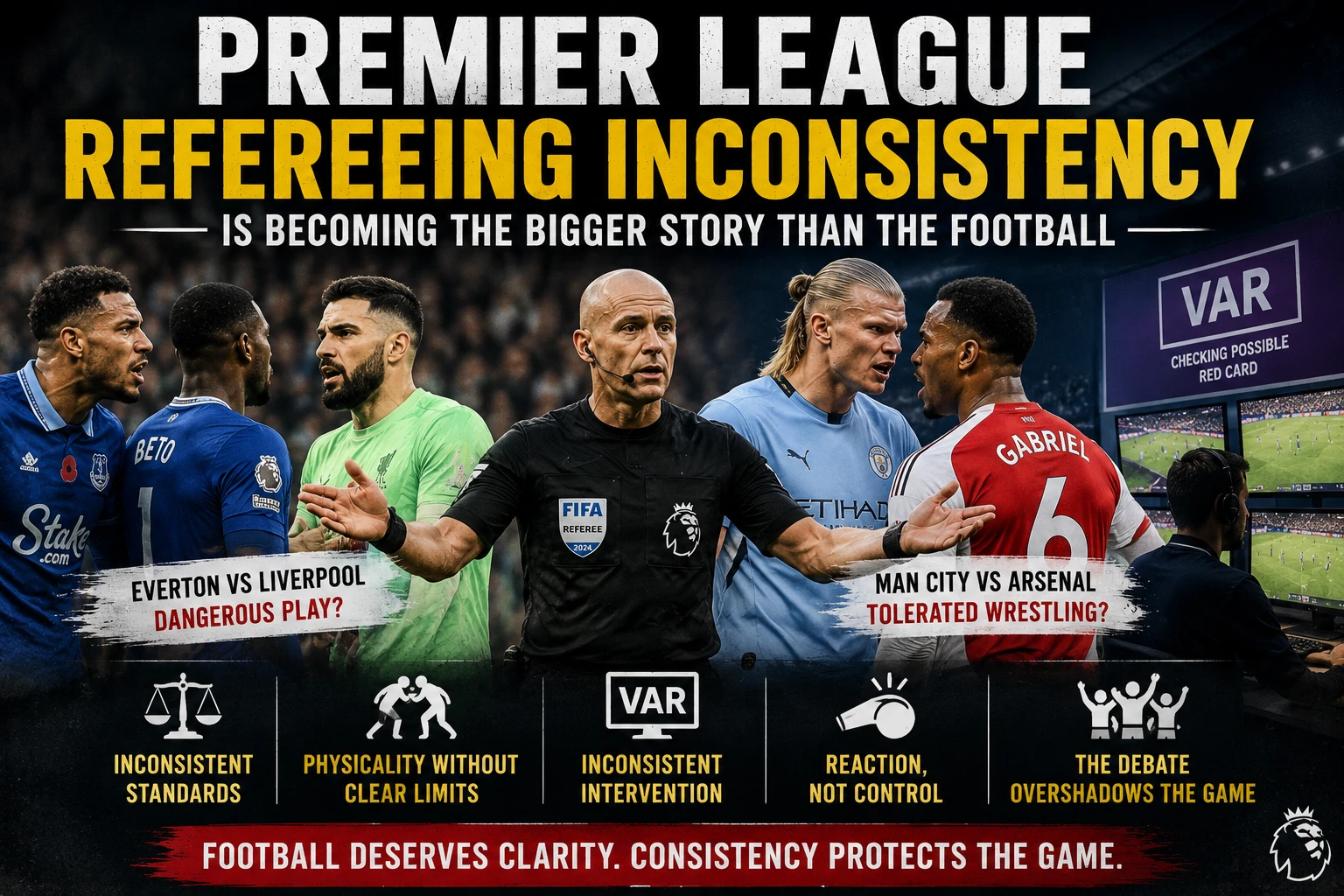
Premier League Refereeing Inconsistency Is Becoming the Bigger Story Than the Football
Premier League refereeing and VAR decisions are increasingly becoming talking points in their own right, with inconsistency rather than individual mistakes at the centre of the debate.
There are weekends when the football should dominate the conversation. Big matches, major moments and results that shift momentum across the league should naturally provide the headlines. Instead, attention can move towards the officials because similar incidents appear to be judged by very different standards.
Recent matches involving Everton and Liverpool, and Manchester City and Arsenal, provided examples of the problem. Both featured incidents that raised questions not simply about whether a particular decision was right or wrong, but about how consistently the Laws of the Game are being applied.
Mistakes have always been part of football and always will be. The deeper problem comes when players, managers and supporters cannot anticipate what will be penalised because the threshold appears to change depending on the incident, match or official.
 The Everton vs Liverpool incident
In the Everton vs Liverpool derby, Everton found the net after Beto got on the end of a cross from Dewsbury-Hall. On the follow-up, the striker collided with Liverpool goalkeeper Mamardashvili, whose knee was damaged badly enough for him to leave the pitch on a stretcher.
The issue is not whether the striker intended to injure the goalkeeper. That is not the point. The point is the action itself. Studs up, follow-through, real damage caused and a goalkeeper unable to continue. In the view of many, that meets the threshold for dangerous play.
This is where the inconsistency becomes obvious. Anywhere else on the pitch, a raised boot and forceful follow-through that endangers an opponent are far more likely to be penalised. In some cases, they would not only result in a foul but could easily trigger a card discussion as well.
That is what makes the decision so difficult to defend. Football already recognises the concept of dangerous play in other situations. A striker attempting an overhead kick or bicycle kick can be penalised simply for having a raised foot near an opponent, even when fans would much rather see the spectacle continue. If that standard exists there, why does it appear to soften in situations where the danger is more direct and the consequences are more obvious?
The contradiction is hard to ignore. One action is penalised because it looks dangerous. Another causes an actual injury and passes without the same scrutiny. That is not just frustrating; it is confusing.
Man City vs Arsenal and the return of tolerated wrestling
The second example came in Manchester City vs Arsenal, where Gabriel and Haaland were repeatedly involved in heavy physical contact. There is always an element of grappling between elite forwards and defenders, especially in high-pressure matches, but this felt like it drifted far beyond normal contesting.
Haaland’s shirt was quite literally ripped during one phase of the game, yet cards were not produced for the repeated grappling and shirt-pulling that had clearly become part of the duel. Only later, when tensions escalated further and Gabriel appeared to attempt a headbutt on Haaland, did the referee finally intervene with yellow cards for both players.
That sequence is part of the problem. The game was allowed to drift into disorder before the official decided to impose control. By then, the officiating was no longer preventive. It was reactive. And once officiating becomes reactive, the players start setting the physical standard for themselves.
Some older observers and even commentators seemed to enjoy that element, describing it as old-fashioned football and a throwback to an earlier era. But that nostalgia misses the point. The game has evolved. UEFA and FIFA frameworks have evolved. The Premier League itself is supposed to sit within a modern standard of player protection, discipline and consistency. You cannot celebrate the return of 1970s-style physicality in one breath and then claim to be applying contemporary laws in the next.
That is where the contradiction becomes most obvious. If this type of behaviour is no longer tolerated globally, why is it being indulged in England until it reaches boiling point?
The real issue is not physicality, but the line
Football is not meant to be sterile. It is not supposed to be stripped of contact, intensity or emotional confrontation. The physical contest is part of what gives the sport its edge. The issue is not whether players should be allowed to battle. The issue is whether the line is being applied consistently.
Right now, it often is not.
Officials seem to drift between two extremes. At times, they allow prolonged shirt-pulling, grappling and late contact under the banner of letting the game flow. At other times, minor contact is dissected in slow motion and judged with forensic precision. The gap between those two approaches is where frustration grows.
Players adapt quickly to whatever is tolerated. If they believe wrestling will be ignored, they will wrestle. If they believe raised boots will be interpreted loosely in one area of the pitch but strictly in another, they will test that inconsistency. This is why unclear officiating standards do not protect the game; they distort it.
VAR is making the confusion worse
VAR was introduced to reduce obvious mistakes, but one of the great frustrations of the modern game is that it often seems to magnify inconsistency rather than remove it. That problem was also evident in the West Ham vs Arsenal VAR controversy, where the debate again centred on interpretation and the consistency of intervention.
In some situations, VAR behaves as if every angle, touch and frame must be examined under a microscope. In others, it appears reluctant to intervene at all. That unevenness is part of what is ruining the spectacle. Supporters can accept that not every call will go their way. What they struggle to accept is that the intervention threshold seems to move from one match to another.
The problem is not only technical. It is cultural. VAR has not solved the question of interpretation because interpretation remains inconsistent at its core. Technology cannot create clarity if the people using it do not apply the same logic each time.
That is why the debate keeps returning. Fans are not simply angry about one decision here or there. They are frustrated because they can no longer predict how the game will be refereed. And once that uncertainty sets in, the focus shifts away from the football and onto the officials.
The old rule still applies
There used to be a simple idea in football: if nobody was talking about the referee after the match, it usually meant he had a good game.
That remains true.
No supporter turns up wanting to debate officiating philosophy. Nobody wants the post-match discussion to revolve around intervention thresholds, tolerance bands or whether a shirt pull counts more than a studs-up follow-through. People want to talk about the football.
They want to talk about shape, pressure, finishing, momentum and turning points created by players rather than officials. That is what makes the current situation so frustrating. The spectacle is increasingly interrupted not only by wrong decisions, but by inconsistent ones.
So what needs to change?
The answer is not to eliminate physicality or to stop referees from using common sense. It is to establish and maintain a visible, repeatable standard.
If dangerous play is dangerous play, it has to be applied that way regardless of where it happens on the pitch.
If shirt-pulling and grappling are acceptable to a point, that point must be clearer and enforced before matches descend into retaliatory behaviour.
If VAR exists to correct serious errors, it has to be applied with consistency instead of mood.
Football can survive mistakes. It always has. What it struggles to survive is uncertainty around the framework itself.
Final thought
The real concern is not that English football has bad weekends of officiating. Every league does. The concern is that inconsistency is beginning to feel structural rather than occasional.
When one dangerous act is waved through while another far softer one is punished elsewhere, confidence in the system weakens. When players are allowed to push each other beyond the limit until one finally retaliates, the referee loses control of the match instead of shaping it. And when VAR alternates between invisibility and over-analysis, supporters stop trusting the process entirely.
That is why the debate matters. Not because people enjoy complaining about referees, but because the game is at its best when the officials are almost invisible.
English football does not need less intensity. It needs more consistency. Until that arrives, the official will keep overshadowing the football — and that should worry everyone who cares about the game itself.
Further reading:
Fantasy Sports Portal publishes opinion and analysis on the biggest talking points in sport. This piece reflects an editorial viewpoint on officiating consistency in English football.

