
This archived Fantasy Sports Portal case study examines how goals, attacking contribution, consistency and salary value influenced forward selection on Mondogoal during the 2014/15 Premier League season.
Although Mondogoal belongs to an earlier generation of daily fantasy football platforms, the underlying selection principles remain relevant. Forwards still need to be judged by expected goals, shot volume, role, reliability, fixture conditions and whether their projected return justifies their price.
Understanding Mondogoal Forward Scoring
The original analysis divided Mondogoal forward scoring into four main areas:
- Goals: points awarded when a forward scored.
- Attacking contribution: assists and shots on target, with deductions for missed penalties.
- Discipline: yellow cards, red cards and fouls committed.
- Regular play: fouls won, minutes played and completed passes.
Defensive actions were not included in the scoring model for forwards.
Although modern football frequently demands that attackers press and defend from the front, Mondogoal placed the emphasis on the actions most closely associated with attacking performance.
Creating a Forward Consistency Rating
The original case study combined regular-play points with disciplinary deductions to create a consistency rating.
This rating was then compared with goals scored and other attacking contributions across all Premier League matches played through Gameweek 37 of the 2014/15 season.
The same comparison was also made for the top 25 forwards ranked by average points per game.
The general pattern showed a relatively balanced distribution between:
- Goals.
- Other attacking actions.
- Consistency.
The largest variations came from goals.
Higher-ranked forwards generally earned a greater proportion of their total points by scoring, which meant their fantasy production was often more dependent on finishing chances successfully.
Salary and Average Points per Game
The following chart compares Mondogoal salary with average points per game for the top 20 forwards who made at least 10 appearances during the 2014/15 season.
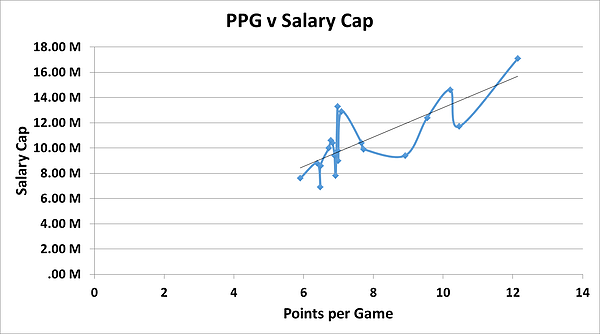
The chart provided a broad indication of how a forward might be valued according to expected production.
Managers could estimate a player’s likely score for an upcoming fixture and compare that projection with his salary.
The objective was not simply to select the highest-scoring forward.
It was to identify the player whose expected return offered the best value within the available budget.
Why Standard Deviation Matters
One important concept in forward selection is standard deviation.
In simple terms, standard deviation helps indicate how consistent or volatile a player’s fantasy scores are.
A player with a low standard deviation tends to produce scores closer to his average.
A player with a high standard deviation may alternate between very low and very high returns.
This distinction matters because different fantasy contests reward different approaches.
Consistent Forwards
Reliable forwards are usually more suitable for:
- Small-field contests.
- Head-to-head games.
- Cash games.
- Formats where avoiding a poor score is especially important.
Volatile Forwards
High-variance forwards may be more attractive in:
- Large-field tournaments.
- Contests where a top-heavy payout rewards risk.
- Situations where a manager needs a differential selection.
These players carry greater downside, but their explosive scoring potential can separate a line-up from the field.
Harry Kane and Goal-Dependent Production
Harry Kane provided a useful example during the 2014/15 season.
He emerged as one of the Premier League’s most productive forwards, but approximately 45% of his Mondogoal points came from goals.
That dependence on finishing meant his scores were likely to fluctuate more than those of a forward whose production was spread across goals, assists, shots, fouls won and regular involvement.
Kane could still produce elite totals, but his value depended heavily on whether the fixture offered enough scoring opportunity.
His suitability therefore varied according to:
- The contest type.
- The quality of the opposition.
- His expected goal involvement.
- His salary.
- The alternative forwards available.
Top-Ranked Mondogoal Forwards
The following table focuses on the top 20 forwards ranked by average points earned from goals scored.
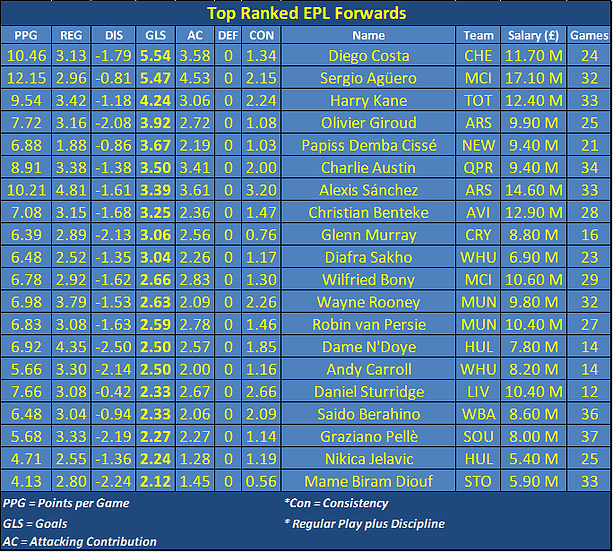
The table demonstrated why managers needed to understand how each forward accumulated points.
Two players with similar averages could have very different risk profiles.
One might rely heavily on goals, while another could supplement scoring with assists, shots on target, fouls won and regular involvement.
How to Select Fantasy Football Forwards
The original case study identified several key indicators for evaluating forward options.
Assess Team Goal Expectations
Begin with the number of goals a team is expected to score in the upcoming fixture.
Compare that forecast with the team’s usual scoring rate.
A forward becomes more attractive when his team is expected to perform above its normal attacking level.
Managers should also estimate the proportion of team goals in which the forward is likely to be involved.
A central striker who takes penalties and dominates shots may account for a much larger share of expected goals than a wide forward with a supporting role.
Understand Goal Involvement
Not every forward contributes equally when his team scores.
Consider:
- Share of team shots.
- Touches in the penalty area.
- Expected goals.
- Expected assists.
- Penalty responsibility.
- Likely minutes.
A team may have an excellent fixture, but that does not automatically make every attacker a strong fantasy selection.
Consider Disciplinary Risk
Some forwards give away more fouls than they win.
This can become especially relevant in volatile fixtures where a high card count is expected.
A striker prone to frustration, retaliation or persistent fouling may lose points through discipline even when his attacking role is favourable.
Study Individual Playing Traits
Every forward has a different fantasy profile.
Managers should consider whether the player:
- Shoots frequently.
- Runs with the ball.
- Wins fouls.
- Creates chances.
- Takes penalties.
- Takes free kicks or corners.
- Relies heavily on close-range finishing.
- Contributes through passing and combination play.
These traits determine both the player’s scoring ceiling and his reliability.
Account for Home and Away Performance
Some forwards perform significantly better at home than away.
Home advantage can influence:
- Shot volume.
- Touches in the box.
- Team possession.
- Penalty-area pressure.
- Goal expectation.
Jermain Defoe was a classic example during his early Tottenham career, when his output was often stronger in home fixtures.
Home and away splits should not be used in isolation, but they can strengthen or weaken the case for a particular selection.
Choosing Forwards for Different Contest Types
Contest structure should influence forward selection.
Small-Field and Safer Contests
Prioritise forwards with:
- Secure minutes.
- High involvement.
- Reliable shot volume.
- Penalty responsibility.
- Multiple routes to points.
Large-Field Tournaments
Managers may accept more risk in exchange for greater upside.
Potential tournament selections include:
- Low-owned forwards.
- Players with explosive scoring histories.
- Attackers facing favourable but overlooked fixtures.
- Forwards whose recent results understate their underlying numbers.
The objective is not simply to chase inconsistency.
It is to identify situations where the potential reward justifies the increased risk.
Comparing Premium and Value Forwards
Premium forwards often carry the highest goal expectations, but their salaries can weaken the rest of the line-up.
A cheaper forward may offer better value if:
- He has a favourable fixture.
- He is expected to start centrally.
- He takes penalties.
- His recent results disguise strong underlying statistics.
- His salary has not adjusted to a change in role.
The correct decision depends on expected points per unit of salary rather than reputation alone.
Applying the Lessons to Modern Fantasy Football
The same analytical framework remains useful in modern fantasy formats.
Before selecting a forward, consider:
- Expected minutes.
- Starting probability.
- Expected goals.
- Shots and shots on target.
- Touches in the penalty area.
- Penalty and set-piece duties.
- Team goal expectation.
- Share of team attacking output.
- Home and away performance.
- Disciplinary risk.
- Price relative to projected return.
- Contest type and ownership.
The best forward is not always the most expensive or the most prolific over an entire season.
It is the player whose role, fixture and price combine to create the strongest opportunity for the contest being entered.
Key Lessons from the Case Study
Goals Create the Greatest Volatility
Goal-dependent forwards can produce exceptional scores, but their returns may fluctuate significantly.
Consistency and Ceiling Are Different
A reliable player may be ideal for safer contests, while a volatile player may offer greater tournament-winning upside.
Team Expectations Are Only the Starting Point
Managers must estimate how much of the team’s attacking output is likely to involve the selected forward.
Player Traits Matter
Shot frequency, dribbling, set pieces and playing style all influence how a forward earns fantasy points.
Home and Away Splits Can Be Useful
Some players benefit significantly from home conditions, although these trends should always be considered alongside role and opposition.
Salary Must Be Judged Against Projection
A forward offers value when his expected return is greater than the level implied by his price.
Historical Context
This case study was originally produced using Mondogoal scoring and Premier League data from the 2014/15 season.
The platform-specific salaries, rankings and player examples should be viewed as a historical record of daily fantasy football strategy at that time.
The analytical method remains relevant: understand how a forward earns points, assess his reliability, evaluate the fixture and compare projected output with cost.
