
Successful fantasy football management is rarely about one inspired selection. It is usually the result of applying a small number of sound principles consistently.
This guide identifies seven fundamentals that can improve team selection across daily fantasy football, season-long fantasy games and salary-cap formats.
The examples originally used Mondogoal and data from the 2014/15 Premier League season, but the underlying principles remain relevant today: understand the scoring system, protect playing time, evaluate fixtures, identify value and adapt your approach to the contest.
The Seven Fundamentals of Fantasy Football Success
- Understand the optimum formation for the game you are playing.
- Never underestimate the importance of playing time.
- Know each team’s expected goals for the relevant fixtures.
- Identify players who may be undervalued.
- Allocate your budget efficiently.
- Know the set-piece takers.
- Adapt your tactics to the contest.
1. Choose the Optimum Formation
Every fantasy football game has its own scoring system, position classifications and formation rules.
The best formation is therefore not automatically the one preferred by a real football manager. It is the formation that gives you the greatest access to the highest-value fantasy positions.
The original Mondogoal analysis compared average points by position during the 2014/15 Premier League season.
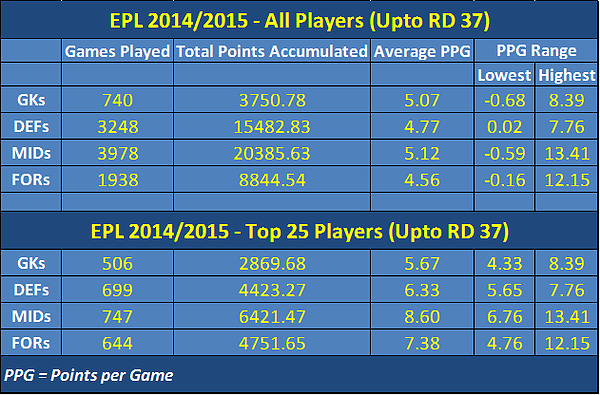
Under that particular scoring system, midfielders and forwards offered greater upside than defenders and goalkeepers.
Mondogoal also limited the number of players who could be selected from one club. This made three-defender formations such as 3-4-3 and 3-5-2 particularly attractive.
The broader lesson is more important than the historical recommendation.
Before choosing a formation, compare:
- Average points by position.
- Expected ceiling by position.
- Player prices.
- The number of required selections.
- Limits on players from the same team.
- The strength of the available player pool.
A formation should be selected because it maximises expected value, not simply because it looks balanced on paper.
2. Protect Playing Time
Playing time is one of the most important and most frequently underestimated factors in fantasy football.
A talented player cannot return value if he starts on the bench, is substituted early or is rotated unexpectedly.
Before submitting a line-up, check:
- Predicted starting elevens.
- Injuries.
- Suspensions.
- Recent rotation patterns.
- Fixture congestion.
- Managerial comments.
- European and domestic cup commitments.
Where the platform allows late changes, remain flexible until the relevant deadline.
Where no late-swap option exists, avoid unnecessary risk and prioritise players with secure starting roles.
The safest strategy is often to confirm selections as close to the contest deadline as possible, once reliable team information is available.
3. Use Goal Expectancies
Expected team goals influence almost every fantasy position.
For attacking players, a higher expected team total increases the probability of goals, assists, shots and chances created.
For defenders and goalkeepers, lower opposition goal expectations improve clean-sheet prospects.
Consider a striker who is normally involved in a large percentage of his team’s goals.
If his team is expected to score more than twice in a favourable home fixture, his potential return is considerably greater than it would be in a difficult away match where the team is expected to score once or less.
Useful indicators include:
- Bookmaker goal lines.
- Match odds.
- Team expected-goals data.
- Recent attacking and defensive performance.
- Home and away splits.
- Likely possession and territory.
Goal expectancy should not be the only factor in selection, but it should form a central part of fixture evaluation.
4. Identify Undervalued Players
Value is created when a player’s expected fantasy return is greater than the level implied by his price, ownership or reputation.
Undervalued players may include:
- Players returning from injury.
- Recent additions to the starting line-up.
- Players receiving more minutes than before.
- Players operating in a more advanced position.
- Players whose role has changed under a new manager.
- Set-piece takers whose duties are not fully reflected in their price.
- Players with strong underlying statistics but weak recent results.
- Players benefiting from an unusually favourable fixture.
Position classification can also create opportunities.
A player listed as a midfielder but operating as a forward may offer access to attacking returns from a less expensive or more flexible position.
The best value selections are often temporary.
Once prices, ownership or public perception adjust, the advantage can disappear.
5. Allocate the Budget Efficiently
Fantasy football is an exercise in resource allocation.
The objective is not to select the eleven best-known players. It is to build the strongest possible combination within the available budget.
In the original Mondogoal format, managers received £100 million to select eleven players. That represented an average spend of approximately £9.1 million per player.
In practice, an even distribution was rarely optimal.
Managers had to decide:
- Which positions justified premium spending.
- Where cheaper players could provide acceptable returns.
- How many high-cost players the squad could support.
- Whether one premium selection weakened too many other positions.
A useful approach is to think in terms of expected points per unit of cost.
A premium player may still be excellent value if his expected return is sufficiently high. Conversely, a cheap player is not necessarily valuable if his projected score is poor.
The aim is to spend where the marginal gain is greatest.
6. Know the Set-Piece Takers
Set-piece responsibility provides additional routes to fantasy points.
Managers should identify the players responsible for:
- Penalties.
- Direct free kicks.
- Indirect free kicks.
- Left-sided corners.
- Right-sided corners.
Set-piece takers can benefit through:
- Goals.
- Assists.
- Shots on target.
- Crosses.
- Chances created.
- Expected assists.
These duties can change after transfers, injuries, substitutions or tactical adjustments.
Do not assume that last season’s set-piece hierarchy remains current.
Monitor recent matches and confirm who is taking each type of restart.
7. Adapt Your Tactics to the Contest
The best fantasy line-up depends partly on the contest being entered.
A team designed for a head-to-head contest may differ from one built for a large-field tournament.
Small-Field and Safer Contests
In smaller contests, prioritise:
- Secure starters.
- Consistent performers.
- Reliable minutes.
- Strong points floors.
- Lower-risk selections.
The main objective is often to avoid failure rather than chase an unlikely maximum score.
Large-Field Tournaments
In larger tournaments, greater upside may be required.
Managers may consider:
- Lower-owned players.
- Volatile attackers.
- Unpopular team combinations.
- Players whose underlying numbers exceed their recent returns.
- Selections capable of producing unusually high scores.
Risk should still be calculated.
Being different has no value unless the selection also has a credible path to scoring well.
How the Seven Fundamentals Work Together
The strongest fantasy decisions usually combine several of these principles.
For example, an undervalued midfielder may become especially attractive because:
- He is expected to start.
- He is playing in an advanced role.
- His team has a favourable goal expectation.
- He has recently assumed set-piece duties.
- His salary has not yet adjusted.
- He suits the risk profile of the contest.
No single statistic should make the decision in isolation.
The advantage comes from combining role, fixture, price, playing time and contest context.
Modern Fantasy Football Applications
Today’s fantasy managers have access to far more data than those playing in 2014/15.
Useful modern metrics include:
- Expected goals.
- Expected assists.
- Non-penalty expected goals.
- Shots in the penalty area.
- Big chances.
- Key passes.
- Touches in the box.
- Progressive passes and carries.
- Expected minutes.
- Clean-sheet probability.
- Projected ownership.
These tools improve decision-making, but they do not replace judgement.
The seven fundamentals remain valuable because they provide a framework for interpreting the information rather than simply collecting it.
Key Lessons
Formation Is a Strategic Decision
Use the scoring system and available player pool to determine which formation offers the greatest expected value.
Minutes Come Before Potential
A secure starter is usually more valuable than a talented player with significant rotation risk.
Fixture Expectations Matter
Team goal expectations influence attacking returns, defensive points and overall player upside.
Value Is Relative
A player is valuable when his expected return exceeds the level implied by his cost.
Budget Must Be Managed Across the Whole Team
Every premium selection creates a trade-off elsewhere.
Set Pieces Create Additional Routes to Points
Penalty, corner and free-kick duties can transform a player’s fantasy appeal.
Contest Type Determines Risk
Consistency is usually more important in smaller contests, while controlled volatility can be useful in large tournaments.
Historical Context
This guide was originally created during the early growth of daily fantasy football and used Mondogoal’s 2014/15 scoring system as its principal example.
The platform references, salaries and statistical examples should be viewed as a historical snapshot.
The central lessons remain current: understand the rules, protect minutes, evaluate fixtures, recognise value, allocate the budget carefully, monitor set pieces and select players according to the contest.
