
The Manchester Giants
FSPortal
- posted on
Last updated: 24 August 2026
Manchester United’s Aerial Threat: When Mourinho Built a Team of Giants
Manchester United looked very different at the beginning of the 2016/17 season.
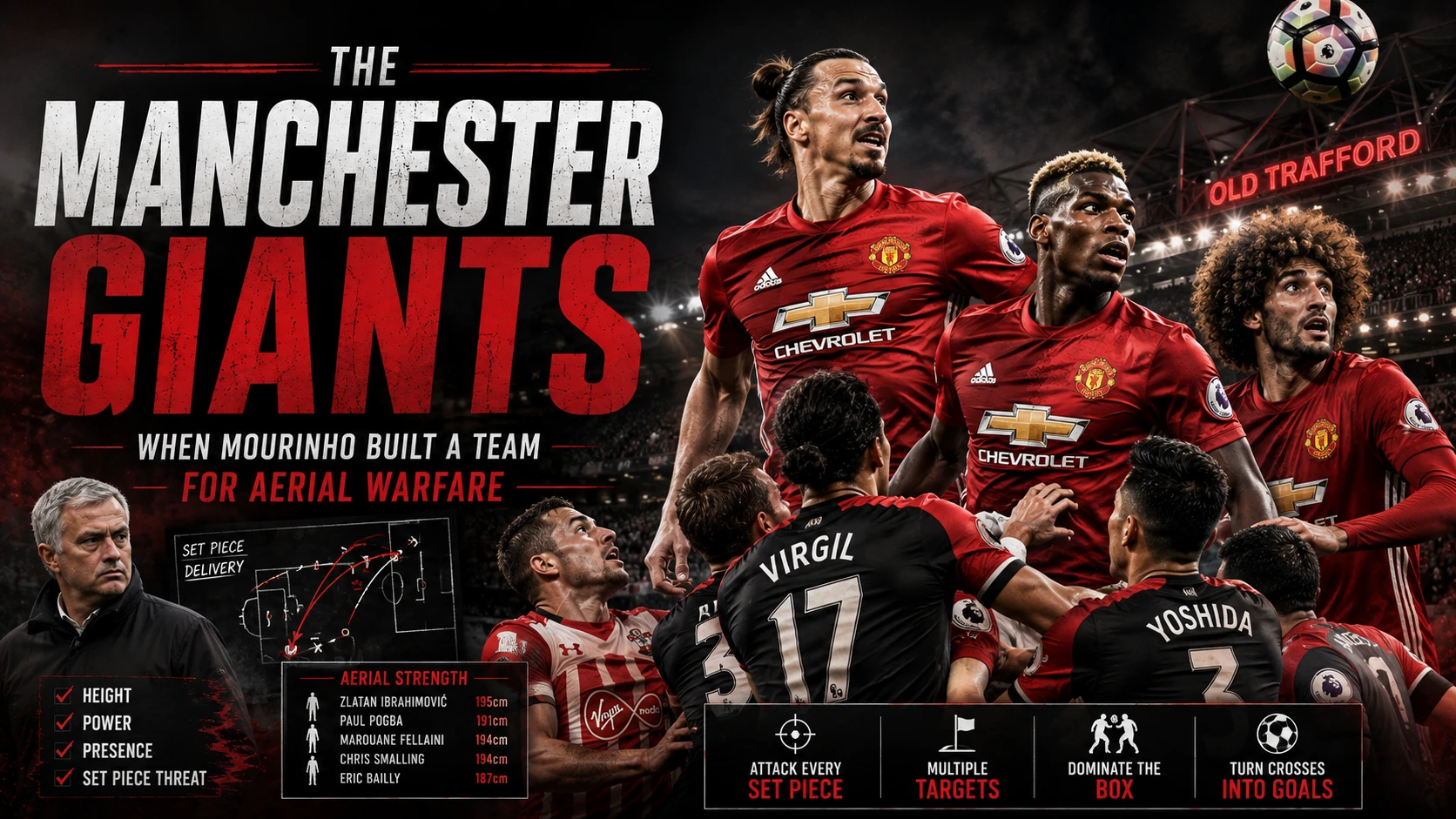
José Mourinho had arrived at Old Trafford, Zlatan Ibrahimović was leading the attack and Paul Pogba had returned to the club for a then-world-record transfer fee.
Alongside players such as Marouane Fellaini, Chris Smalling and Eric Bailly, United suddenly possessed one of the most physically imposing squads in the Premier League.
That prompted an obvious question at Fantasy Sports Portal in August 2016:
Could Manchester United’s height and aerial power become a significant competitive advantage?
Zlatan Ibrahimović Immediately Demonstrated the Threat
The idea gained credibility almost immediately.
United defeated Southampton 2-0 at Old Trafford, with Ibrahimović scoring both goals.
The first was a powerful header that demonstrated exactly why Mourinho’s new-look side appeared capable of causing serious problems from crosses and set pieces.
Ibrahimović was already one of Europe’s most accomplished forwards, but his combination of height, strength, movement and technical ability gave United another dimension.
He did not simply provide a target.
He provided a player capable of converting aerial opportunities at the highest level.
Why Height Can Matter in Football
Height alone does not make a football team effective.
A tall player still needs positioning, timing and the ability to attack the ball.
But when several physically strong players are combined within the same side, set pieces can become considerably harder to defend.
The attacking team can create multiple targets from:
- corners;
- wide free-kicks;
- deep crosses;
- second phases after set pieces; and
- direct balls into the penalty area.
The defending team can no longer concentrate on one obvious aerial threat.
That was what made Mourinho’s United squad interesting.
Headed Goals Were Already a Significant Premier League Weapon
The importance of aerial football was hardly new.
West Bromwich Albion had demonstrated how effective a physically powerful side could be during the previous seasons, regularly generating a significant proportion of their goals through headers and set-piece situations.
Chelsea also provided an obvious comparison.
Mourinho’s successful teams traditionally contained physically imposing defenders, midfielders and forwards capable of competing aggressively in both penalty areas.
His 2016 Manchester United squad appeared built with many of the same principles.
Manchester United Needed More Ways to Score
The contrast with Louis van Gaal’s final season was particularly striking.
United scored only 49 Premier League goals in 2015/16 and frequently struggled to convert possession into genuine attacking threat.
Only a small proportion of those goals came from headers.
The arrival of Ibrahimović, Pogba and other physically strong players therefore offered Mourinho an opportunity to increase United’s threat without relying exclusively on open-play combinations.
Set pieces could become another reliable route to goal.
Real Madrid and Athletic Bilbao Showed What Was Possible
European football at the time offered several examples of teams producing substantial numbers of headed goals.
Real Madrid combined enormous attacking quality with players such as Cristiano Ronaldo and Gareth Bale, both exceptionally dangerous in the air.
Athletic Bilbao also demonstrated that aerial success was not simply a consequence of dominating opponents through superior resources.
Their physical style, crossing and ability to attack the penalty area made headed goals an important component of their attacking identity.
Olivier Giroud Was Another Premier League Example
Arsenal provided an interesting contrast.
Arsène Wenger’s teams were traditionally associated with technical passing football, yet Olivier Giroud was one of the Premier League’s most effective aerial forwards.
Giroud’s movement, strength and ability to attack crosses gave Arsenal an alternative when intricate passing combinations failed to open the opposition.
That illustrates an important tactical point.
Aerial strength does not have to replace technical football.
It can complement it.
Mourinho vs Guardiola: Two Different Ways to Control a Match
The arrival of Mourinho at Manchester United coincided with Pep Guardiola taking charge of Manchester City.
That immediately gave the Manchester rivalry another tactical dimension.
Guardiola’s teams were associated with positional play, possession and creating numerical advantages through movement.
Mourinho was often more willing to use physical superiority, transitions and set pieces as weapons.
The contrast was never as simplistic as height versus possession, but it highlighted an important truth:
There is more than one way to create an advantage in football.
Why Set-Piece Delivery Matters as Much as Height
Possessing several excellent aerial targets is only useful if the delivery gives them an opportunity to attack the ball.
That was where the original fantasy football analysis became particularly relevant.
Manchester United could have Ibrahimović, Pogba, Fellaini and Smalling waiting in the penalty area, but somebody still needed to provide accurate corners and free-kicks.
For fantasy managers, that created another question:
Who would supply the assists?
Juan Mata and Wayne Rooney were among the players taking early set pieces, while Henrikh Mkhitaryan offered another possible delivery option if he established himself in Mourinho’s starting side.
Fantasy Football and Set-Piece Responsibility
Set-piece responsibility remains one of the most valuable pieces of information available to fantasy football managers.
A midfielder or full-back taking corners and free-kicks gains repeated opportunities to create goals without needing to reach the penalty area in open play.
That can significantly change the value of a player.
The attacking targets benefit as well.
A centre-back who regularly attacks corners may generate substantially greater expected goal involvement than another defender with a similar defensive role but fewer set-piece opportunities.
From Headed Goals to Modern Set-Piece Analytics
The way football discusses set pieces has changed considerably since this article was originally published.
Today analysts can examine:
- expected goals from set pieces;
- shots generated from corners;
- first-contact rates;
- delivery zones;
- aerial duel success;
- blocking and movement patterns; and
- individual set-piece xG.
What once looked like a relatively simple question — how many headed goals will Manchester United score? — can now be analysed in much greater detail.
But the original principle was already correct.
Physical mismatches can be identified and exploited just like any other tactical weakness.
Why Set Pieces Have Become Even More Important
Elite football has become increasingly structured.
Teams defend space more efficiently, pressing systems are better coordinated and the margins separating leading clubs have become smaller.
That makes dead-ball situations particularly valuable.
A corner or free-kick temporarily removes many of the variables found in open play.
Coaches can prepare specific movements, create blocks, target weaker aerial defenders and repeatedly attack particular zones.
Set pieces therefore represent one of football’s most controllable attacking situations.
What Manchester United’s 2016 Giants Taught Us
The Manchester United squad assembled in the summer of 2016 offered a fascinating experiment.
Ibrahimović, Pogba, Fellaini, Smalling and others gave Mourinho considerable size and physical power.
The original article asked whether that aerial strength could influence the Premier League title race.
United ultimately finished sixth in Mourinho’s first league campaign, so height alone was clearly not enough to create a championship team.
They did, however, win both the League Cup and Europa League that season.
The broader lesson remains relevant.
Successful teams need multiple ways to hurt opponents.
Possession matters. Pace matters. Movement matters. Technical quality matters.
And sometimes, when everything else is evenly matched, having the biggest player attacking the best-delivered cross still matters too.
Fantasy Football Implications
For fantasy managers, aerial strength should never be considered in isolation.
The more useful questions are:
- Which teams generate the most set-piece chances?
- Who takes the corners and free-kicks?
- Which defenders regularly attack the six-yard box?
- Which forwards receive the highest-quality crosses?
- Which opponents are vulnerable in aerial situations?
Those questions were relevant when Mourinho assembled his Manchester United giants in 2016.
They remain relevant now.
Explore more: Football analysis and features from Fantasy Sports Portal.

