
West Ham vs Arsenal VAR Controversy
Admin
- posted on
Last updated: 24 August 2026
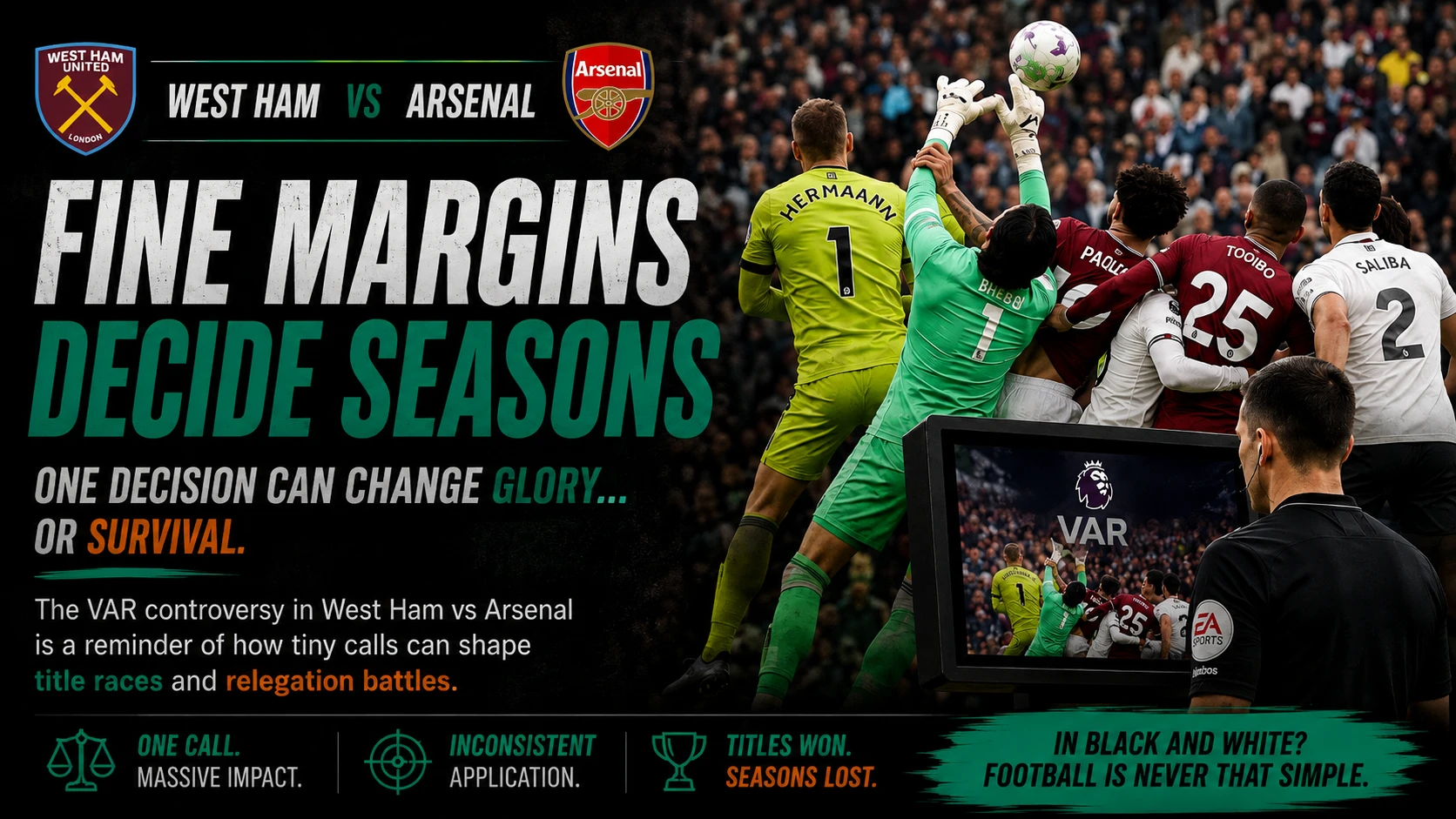
West Ham vs Arsenal VAR Controversy Shows How Fine Margins Decide Seasons
Premier League seasons are rarely decided by dominance alone.
More often, they are shaped by moments.
A deflection. A missed chance. A refereeing decision. A VAR review slowed down frame by frame until contact suddenly appears more dramatic than it looked in real time.
The VAR controversy surrounding West Ham and Arsenal provided another example of why individual refereeing decisions can generate debate far beyond the result of a single match.
When teams are competing for titles, European qualification or Premier League survival, those decisions can potentially influence an entire season.
The Goal That Changed the Match

The biggest talking point came when a West Ham goal was disallowed following VAR intervention for a foul on the goalkeeper.
At normal speed, the incident resembled the type of physical contact regularly seen during crowded set-piece situations.
Once the incident was replayed and examined more closely, however, the officials determined that there had been sufficient contact to overturn the goal.
The decision immediately divided opinion.
Those supporting the intervention could argue that VAR had done precisely what it was designed to do: identify an infringement that the referee had not fully appreciated during live play.
Those disagreeing with it could reasonably question whether relatively ordinary football contact had been made to appear more significant through repeated slow-motion analysis.
Why VAR Consistency Matters
The frustration surrounding VAR is often not simply about whether one particular decision is technically correct.
It is about consistency.
Supporters naturally compare one incident with challenges and collisions elsewhere in the same match — and with similar situations from other Premier League fixtures.
When one incident receives lengthy examination while another apparently comparable incident does not result in intervention, confidence in the process can quickly disappear.
This creates one of the fundamental problems facing video-assisted refereeing.
Technology can provide officials with additional information, but it cannot completely remove interpretation from football.
VAR Cannot Remove Subjectivity
VAR was originally presented as a way of correcting clear refereeing errors.
But many of football’s most controversial decisions are not simple factual questions.
Offside technology can determine whether a player is beyond a particular line. Goal-line technology can determine whether the ball has crossed the line.
Judging the significance of physical contact is different.
Was there enough contact for a foul?
Was the contact responsible for the player going down?
Was a challenge careless, reckless or simply part of a physical contest?
Those remain matters of interpretation regardless of how many camera angles are available.
The Problem With Slow-Motion Football
One of the longest-running criticisms of VAR concerns the use of slow-motion replays to assess physical contact.
Football is naturally fast and chaotic.
Players change direction rapidly, bodies collide and challenges that appear relatively ordinary at full speed can look substantially worse when viewed frame by frame.
Slow motion can be extremely useful when officials need to establish exactly where contact occurred.
But there is an important distinction between identifying contact and determining its significance.
Removing an incident from its original speed can alter how the viewer perceives the force, intention and natural movement involved.
That is why the best use of replay technology must retain some appreciation of what actually happened in real time.
How Small Decisions Can Shape a Premier League Season
The league table magnifies controversial decisions because the difference between success and failure can be remarkably small.
A single point can potentially influence:
- the Premier League title race;
- Champions League and European qualification;
- relegation and survival;
- managerial pressure;
- summer transfer planning; and
- the significant financial consequences attached to a club’s final league position.
That does not mean one VAR decision should automatically be blamed for a club’s success or failure across a 38-match season.
Teams have thousands of opportunities to influence their own results.
But when the final table is decided by one or two points, controversial decisions inevitably become part of the story.
Why Pressure Changes How Decisions Are Perceived
The context of a match also affects the reaction to refereeing decisions.
A controversial call in a relatively inconsequential mid-table fixture is unlikely to generate the same response as an identical decision during a title race or relegation battle.
When the stakes increase, every challenge feels more important and every VAR intervention appears capable of changing the trajectory of a season.
That emotional investment is part of football rather than something technology can eliminate.
Has VAR Reduced Football Controversy?
VAR was introduced partly to reduce the impact of major refereeing mistakes.
It has undoubtedly corrected decisions that would previously have remained wrong.
But rather than eliminating controversy, video technology has often changed its nature.
Supporters now debate intervention thresholds, replay speeds, camera angles, consistency and whether an incident constitutes a sufficiently clear error to justify overturning the original decision.
The technology can help establish facts.
It cannot make every football decision objective.
The VAR Debate Is Not Going Away
The West Ham vs Arsenal controversy is therefore part of a much larger discussion about how football should use technology.
The challenge is not simply achieving greater accuracy. It is finding a balance between accuracy, consistency, transparency and allowing the game to retain its natural flow.
That balance remains difficult because football contains countless situations where two people can watch exactly the same replay and reach different conclusions.
VAR can provide another angle.
It cannot remove disagreement from football.
Explore more: Football news, analysis and features from Fantasy Sports Portal.

