
Premier League Summer Spending 2025 Breaks £3bn Record
Admin
- posted on
Last updated: 26 August 2026
Premier League Summer Spending 2025: How Clubs Smashed the £3bn Transfer Record
The summer 2025 transfer window provided another demonstration of the Premier League’s extraordinary financial power.
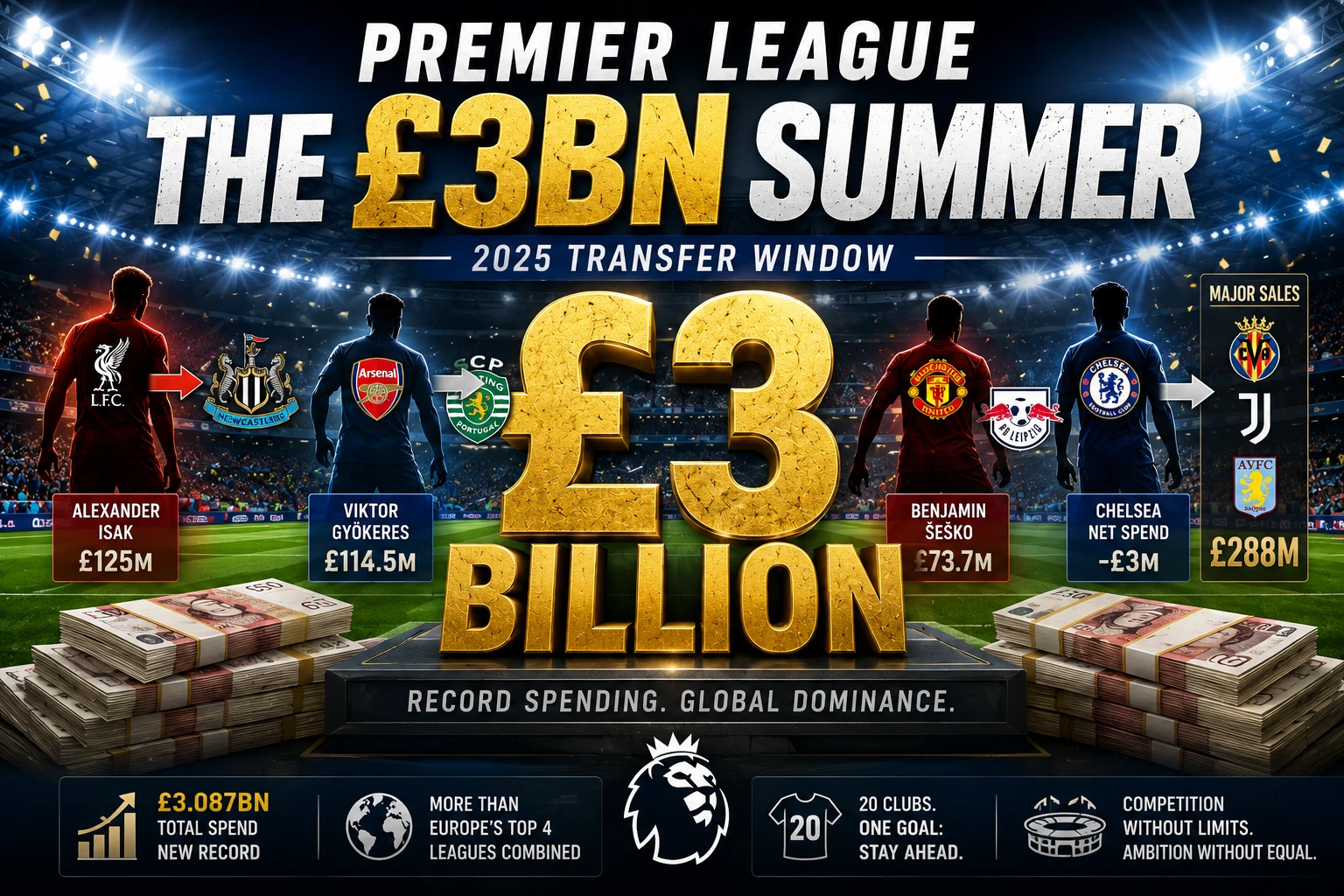
England’s 20 top-flight clubs spent more than £3bn on players, setting a new record for a single Premier League transfer window and substantially exceeding the previous summer’s expenditure.
Liverpool led the spending with an extraordinary recruitment programme that included Alexander Isak and Florian Wirtz, while Arsenal, Manchester United, Chelsea and even newly promoted Sunderland committed substantial sums to strengthening their squads.
The numbers told a bigger story than simply another expensive transfer window.
By 2025, the financial gap between the Premier League and most of European football had become impossible to ignore.
How Much Did Premier League Clubs Spend in Summer 2025?
Premier League clubs collectively spent approximately £3.1bn during the summer 2025 transfer window.
That represented a dramatic increase on the approximately £2bn spent during the previous summer window.
More significantly, English top-flight expenditure exceeded the combined spending of several of Europe’s other major domestic leagues.
Premier League clubs were not merely buying players from one another.
They were importing talent from Germany, Spain, Italy, France, Portugal and elsewhere, injecting enormous amounts of money into the wider European transfer market.
Why Did Premier League Spending Exceed £3bn?
There was no single reason for the record expenditure.
Instead, several structural advantages combined.
- Huge domestic and international broadcasting revenues;
- strong commercial income among the biggest clubs;
- wealthy ownership groups;
- the global popularity of the Premier League;
- intense competition throughout the table; and
- the financial consequences of both Champions League qualification and Premier League relegation.
The final point is particularly important.
Premier League clubs are not only competing for trophies.
They are competing to remain inside one of the world’s richest sporting competitions.
That creates powerful incentives to invest.
Liverpool Led the 2025 Transfer Market
Liverpool were at the centre of the summer’s spending.
The club committed more than £400m to new players across the window, although substantial player sales reduced the eventual net cost.
The headline arrival was Alexander Isak, who moved from Newcastle United in a British-record transfer worth around £125m.
It was an extraordinary deal even by Premier League standards.
But Isak was only one part of Liverpool’s recruitment.
Liverpool’s Major 2025 Signings
- Alexander Isak – Newcastle United;
- Florian Wirtz – Bayer Leverkusen;
- Hugo Ekitike – Eintracht Frankfurt;
- Jeremie Frimpong – Bayer Leverkusen;
- Milos Kerkez – Bournemouth;
- Giorgi Mamardashvili – Valencia; and
- Giovanni Leoni – Parma.
The scale of the rebuild was remarkable.
Rather than strengthening one or two positions, Liverpool substantially reshaped the squad.
Alexander Isak and the British Transfer Record
Isak’s transfer became the defining deal of the window.
Newcastle had previously resisted losing one of their most valuable players, but Liverpool ultimately completed the transfer for a fee reported at approximately £125m.
That made Isak the most expensive incoming player in British football history at the time.
The deal also demonstrated how Premier League wealth circulates internally.
A club can receive an enormous transfer fee and then immediately return to the market to replace the departing player.
That is exactly what Newcastle did.
Newcastle Responded With Major Investment
Isak’s departure left Newcastle needing attacking reinforcements.
Among their major additions was Yoane Wissa from Brentford.
The wider recruitment programme illustrated another characteristic of the modern Premier League.
Even when one club sells a player for a record sum, much of that money can quickly re-enter the domestic and European transfer markets.
This multiplier effect helps explain why total Premier League expenditure can grow so rapidly.
Arsenal Continued Building for a Title Challenge
Arsenal were another significant spender during the 2025 window.
The arrival of Viktor Gyökeres from Sporting addressed the long-running debate surrounding Arsenal’s centre-forward position.
Midfielder Martin Zubimendi also arrived from Real Sociedad as the club continued refining a squad built to challenge for major honours.
The investment reflected Arsenal’s position.
This was no longer a rebuilding team simply attempting to return to the Champions League.
Expectations had moved towards winning the Premier League and competing deep into Europe.
Manchester United Invested in Their Attack
Manchester United also committed substantial resources to attacking reinforcements.
Benjamin Šeško arrived from RB Leipzig in one of the club’s major deals of the summer.
United’s expenditure reflected the continuing cost of attempting to rebuild a squad capable of returning to the upper reaches of English football.
That illustrates one of the forces driving Premier League inflation.
The biggest clubs are under pressure to compete for trophies, while ambitious clubs immediately below them are spending heavily to close the gap.
Chelsea Demonstrated the Importance of Player Sales
Gross expenditure tells only part of the transfer story.
Chelsea remained extremely active but also generated substantial income from departures.
The club’s sales helped offset the cost of incoming players and demonstrated why net spend can sometimes provide a more useful measure than headline expenditure alone.
A club spending £250m while selling £200m of players is in a very different financial position from one spending £250m while generating almost nothing through departures.
Both contribute equally to the league’s gross spending figure, but their underlying transfer strategies are different.
Promoted Sunderland Spent More Than £150m
Perhaps one of the most revealing stories of the window came from Sunderland.
Returning to the Premier League after an eight-year absence, Sunderland invested more than £150m in their squad.
For a newly promoted club to spend at that level would once have seemed extraordinary.
By 2025, it illustrated the financial reality of Premier League survival.
Promotion delivers access to enormous revenue, but clubs know that failing to strengthen can result in immediate relegation.
The temptation to spend is therefore substantial.
Why Newly Promoted Clubs Spend So Much
The financial difference between the Premier League and the Championship creates one of football’s most dramatic economic transitions.
Promoted clubs suddenly gain access to vastly greater broadcasting and commercial revenues.
At the same time, the standard of opposition rises sharply.
Recruitment becomes a balancing act.
Spend too little and the existing squad may struggle to compete.
Spend too aggressively and relegation can leave the club carrying a wage bill and transfer commitments designed for Premier League income.
The size of Sunderland’s 2025 investment demonstrated how difficult that calculation has become.
The Premier League’s Financial Advantage Over Europe
The most significant feature of the 2025 window was not any individual transfer.
It was the difference between England and the rest of Europe.
Clubs in La Liga, Serie A, the Bundesliga and Ligue 1 continued producing and developing elite players.
Increasingly, however, Premier League clubs possessed the financial resources required to acquire them.
This created an unusual transfer ecosystem.
English clubs could spend heavily overseas while many European clubs depended upon transfer income before making significant investments of their own.
Why Premier League Clubs Have So Much Money
Broadcasting remains central to the league’s financial strength.
The Premier League has developed an enormous international audience alongside its valuable domestic television agreements.
Crucially, broadcasting revenue is distributed more evenly than in some competing leagues.
That means clubs outside the traditional elite can possess transfer budgets capable of competing with historically significant European teams.
A mid-table Premier League club can therefore become a formidable buyer in the international market.
The Transfer Market Has Become a Premier League Supply Chain
The economic relationship between England and other European leagues increasingly resembles a supply chain.
Clubs across Europe identify, develop and showcase talent.
Premier League clubs then pay premium prices to acquire players who have already demonstrated their ability at a high level.
The selling clubs reinvest some of those proceeds into younger replacements.
If those players develop successfully, the cycle can begin again.
This does not mean other leagues have become irrelevant.
Quite the opposite.
Their scouting systems, academies and development environments remain crucial to the European football economy.
But the direction of transfer money increasingly demonstrates where the greatest purchasing power resides.
Does Spending Guarantee Success?
No.
Football repeatedly demonstrates that transfer expenditure and sporting performance are related but not interchangeable.
Recruitment still has to work.
Players need to suit the manager’s tactical system, adapt to the league, remain fit and integrate into the squad.
Multiple expensive signings can even create additional problems if recruitment lacks a coherent sporting strategy.
The most successful clubs therefore do more than spend.
They spend with purpose.
Gross Spend vs Net Spend
Transfer-window headlines generally focus on gross expenditure because it produces the largest numbers.
For understanding club strategy, however, net spending matters too.
Gross spend is the total cost of incoming transfers.
Net spend subtracts income generated through player sales.
Neither metric tells the complete story.
Transfer fees may be paid in instalments, contracts extend over several years and accounting treatment can differ significantly from the headline figures reported when a transfer is announced.
Nevertheless, separating gross and net expenditure prevents some of the most misleading comparisons.
What About Profitability and Sustainability Rules?
Premier League clubs do not have unlimited freedom to spend simply because owners possess sufficient capital.
Financial regulations place constraints on allowable losses and encourage clubs to balance investment against sustainable revenue.
This makes player trading increasingly important.
Academy graduates can be particularly valuable from an accounting perspective because selling a home-grown player can generate substantial profit on a club’s books.
Recruitment departments consequently have to consider both sporting performance and financial structure.
Transfer Fees Don’t Tell Us the True Cost of a Player
A £70m transfer does not simply cost £70m.
There are wages, signing bonuses, agent fees and other contractual commitments to consider.
Likewise, the entire transfer fee may not be recognised financially in the same way or at the same time that supporters see it reported in the media.
This is why comparing transfer windows purely by headline fees has limitations.
It remains useful for measuring market activity, but it is not the same thing as measuring the complete financial burden on clubs.
Why the £3bn Barrier Still Matters
Despite those accounting complexities, passing £3bn in gross summer expenditure represented an important milestone.
It showed the extraordinary scale the Premier League transfer market had reached.
Individual £50m transfers had become commonplace.
Deals approaching or exceeding £100m were no longer unimaginable.
Even promoted clubs could enter the market with budgets that would attract attention across Europe.
The financial geography of elite football had changed considerably.
Can Premier League Spending Continue Rising?
There are reasons to think transfer expenditure cannot increase indefinitely.
Financial regulation, wage commitments and the need for sustainable business models all impose limits.
Transfer markets are also cyclical.
One extraordinary summer does not guarantee that the next will establish another record.
But the structural factors behind Premier League wealth remain powerful.
As long as the competition retains its enormous broadcasting reach, commercial appeal and competitive depth, English clubs are likely to remain among world football’s strongest buyers.
What the 2025 Window Told Us About Modern Football
The £3bn summer was ultimately about more than expensive players.
It demonstrated how economic power shapes the modern game.
Liverpool could undertake one of the largest squad investments English football had seen.
Title challengers could spend heavily attempting to gain marginal improvements.
Clubs seeking to return to the elite could commit enormous resources to rebuilding.
And newly promoted teams could spend sums once associated only with Europe’s biggest institutions.
Final Thought
The Premier League’s record-breaking 2025 summer transfer window was another milestone in the financial evolution of English football.
More than £3bn changed hands as clubs pursued everything from championships and Champions League qualification to simple survival.
The individual transfers made the headlines, but the collective figure told the more important story.
The Premier League had developed purchasing power on a scale unmatched by any other domestic football competition.
Whether that advantage is sustainable — and what it ultimately means for competitive balance across European football — is a much bigger question.
But the summer of 2025 established one thing beyond doubt.
English football’s transfer market had entered the £3bn era.
Explore more: Read the latest football analysis and features from Fantasy Sports Portal.
Transfer figures are based on widely reported fees and may vary according to add-ons, exchange rates and reporting methodology.

