
Most Weekend Predictions Fail Before Halftime
Admin
- posted on
Last updated: 26 August 2026
Why Most Weekend Football Predictions Fail Before Halftime
Every football weekend follows a familiar pattern. Fixtures stack up, opinions multiply and confidence rises long before the first whistle.
One team is supposedly in better form. Another has the stronger squad. A home favourite appears difficult to oppose. A struggling side looks destined for another defeat.
Then the matches begin.
By halftime, much of that pre-match certainty has already disappeared.
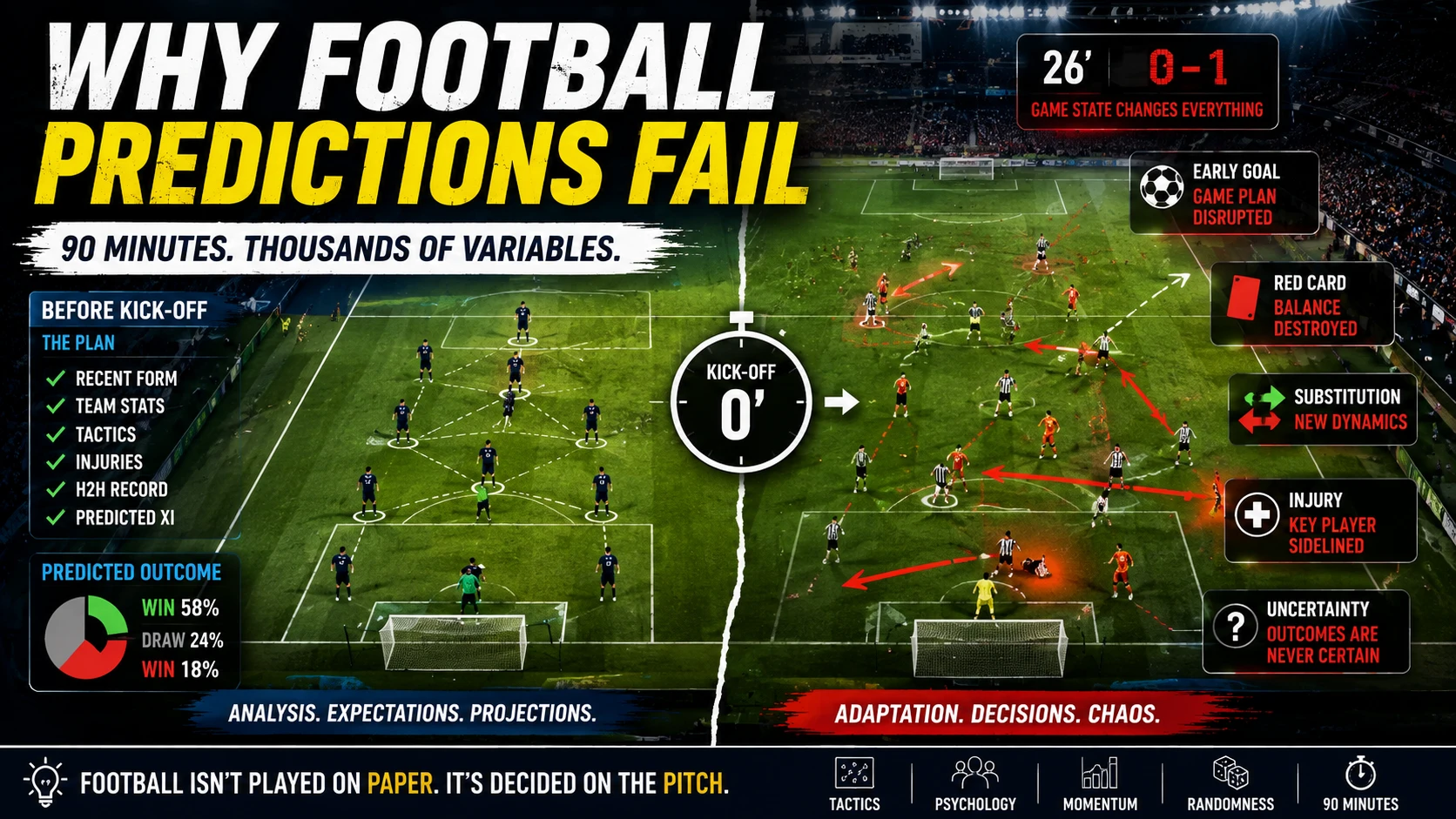
This does not necessarily mean the original analysis was poor. Football predictions frequently fail because they attempt to produce a fixed answer from a game built around changing conditions.
Form, team strength and historical results matter. But once a match starts, match state, tactical interaction, individual decisions and randomness begin changing the probabilities immediately.
Understanding that distinction is one of the most useful ways to analyse football.
The Illusion of Pre-Match Control
Pre-match analysis is generally built around information that already exists.
Typical inputs include:
- recent results;
- league position;
- home and away records;
- expected goals data;
- injuries and suspensions;
- historical meetings;
- probable line-ups; and
- perceived differences in squad quality.
All of these can improve a prediction.
The mistake is assuming they determine the match.
They don’t.
They describe the conditions before the game begins.
Football then introduces a new stream of information every few seconds.
A midfielder gets booked. A full-back struggles against his winger. A team expected to dominate possession cannot play through the press. A goalkeeper makes an early mistake. A striker misses a major chance. A tactical plan that looked logical on paper simply doesn’t work against the opposition’s shape.
The prediction may have been reasonable at kick-off while becoming progressively less reasonable as the game develops.
Football Predictions Are Probabilities, Not Certainties
This is the fundamental point.
A prediction should not really mean:
“This will happen.”
It should mean:
“Based on the information currently available, this outcome appears more likely than the alternatives.”
Those are very different statements.
Suppose analysis suggests a team has a 65% probability of winning.
That still leaves a 35% probability that it does not win.
If the favourite loses, the original prediction was not automatically wrong. An outcome carrying a 35% probability is hardly extraordinary.
This distinction is routinely lost when football predictions are discussed.
Why the First Goal Changes Everything
Perhaps the single most important event affecting a pre-match prediction is the opening goal.
Football is a relatively low-scoring sport, which makes each goal disproportionately important.
Once one team scores, both sides have new incentives.
The leading team can:
- defend slightly deeper;
- take fewer risks;
- attack through transitions;
- slow the tempo; and
- force the opposition to become more adventurous.
The team that concedes may need to do the opposite.
It can push additional players forward, increase pressing intensity and accept defensive risks that were unnecessary at 0-0.
The match being played after the opening goal is therefore tactically different from the match that existed before it.
Match State Is Constantly Changing the Game
Analysts use the term match state to describe circumstances such as the score, time remaining and competitive situation.
It matters because teams do not behave identically at every scoreline.
A side leading 1-0 after 75 minutes will usually make different decisions from the same side drawing 0-0 after 20 minutes.
A team needing three points in a title race may respond differently from one for which a draw is acceptable.
Even statistics generated during matches are affected by this.
A losing team may accumulate possession and shots because its opponent has deliberately surrendered territory.
Looking only at the final numbers can consequently create a misleading picture of who actually controlled the important phases of the match.
Early Momentum Is Not the Same as Control
One of the easiest mistakes to make when watching football is confusing activity with authority.
A team may dominate the opening 15 minutes, generate several attacks and force its opponent backwards.
That looks impressive.
But there is an important question:
Is that pressure sustainable?
Some teams deliberately begin matches with exceptional intensity. If they fail to score, the physical cost of that approach can become apparent later.
Others are comfortable defending compactly before attacking once the initial pressure subsides.
Territorial dominance therefore does not necessarily mean one side has solved the match.
Sometimes it merely describes the current phase.
Styles Make Matches
League position is useful, but football is not played by league tables.
It is played by teams with particular tactical strengths and weaknesses.
A technically superior possession team may struggle against an opponent capable of pressing its build-up.
A dominant high-line defence can be vulnerable to a fast counterattacking forward.
A team excellent at defending open play may struggle against set pieces.
A side that routinely dominates weaker opponents may find very little space against another elite team.
This is why analysing the match-up is often more informative than simply comparing the overall quality of the two sides.
Why Form Can Be Misleading
“Form” is one of football’s most commonly used analytical shortcuts.
A team has won four of its last five matches, therefore it is in good form.
But those five results may conceal very different performances.
Who were the opponents?
Were three victories at home?
Did the team score from unusually difficult chances?
Did opponents miss penalties or major opportunities?
Were important players unavailable?
Did underlying performance actually improve?
Results matter, but a sequence of results is not automatically a reliable description of future performance.
Small Samples Create Big Narratives
Football coverage naturally searches for stories.
A striker scores in three consecutive matches and is suddenly “unstoppable”.
A team loses twice and enters a “crisis”.
A goalkeeper makes two mistakes and supposedly has a confidence problem.
Some narratives are legitimate. Others are simply small samples being given more meaning than the evidence supports.
This creates a particular problem for weekend predictions because recent events tend to dominate human judgement.
What happened last Saturday feels more important than what happened two months ago, even when the larger sample provides better evidence.
Team News Can Completely Alter a Prediction
A prediction made on Thursday may not be the same prediction you would make after seeing Saturday’s starting XI.
One unexpected absence can materially change a team.
This is particularly true when the missing player performs a specialised role:
- a defensive midfielder protecting transitions;
- a centre-back responsible for progression;
- a creative midfielder breaking compact blocks;
- a forward providing runs behind the defence; or
- a goalkeeper essential to playing through an opposition press.
Squad depth also matters.
Two teams can lose equally talented players while experiencing completely different consequences because one has a natural replacement and the other does not.
Red Cards Destroy Pre-Match Models
Few events alter a football match as dramatically as a red card.
The tactical structure changes instantly.
A team may sacrifice an attacker, abandon its press and defend close to its own penalty area.
The opposition gains additional possession and territorial control.
Any prediction based on 11 players facing 11 players has suddenly encountered a condition it was never designed to model.
This is not evidence that football cannot be analysed.
It is evidence that uncertainty has to be included in the analysis.
Set Pieces Add Another Layer of Volatility
Open-play performance is only part of football.
Corners, free-kicks and penalties can transform matches that otherwise appear tactically controlled.
A team can defend extremely well for 40 minutes, concede one corner and reach halftime behind.
The scoreboard records 1-0.
The underlying match may have been far more balanced.
This is particularly important when comparing teams with very different set-piece strengths.
A supposedly weaker side that excels from corners may possess a much more realistic route to victory than broad team-quality comparisons suggest.
Finishing Is Inherently Variable
Creating chances and converting them are different skills.
Even elite forwards miss good opportunities.
Average finishers sometimes score spectacular goals.
A team can generate substantially better chances than its opponent and still lose.
Expected goals models help describe chance quality, but they do not remove this uncertainty.
A 0.40 xG opportunity means the chance is good — not that a goal must follow.
Over large samples, these probabilities become extremely useful.
Across a single 90-minute match, variance remains powerful.
Why High-Profile Fixtures Are Often Misread
The biggest matches attract the strongest narratives.
Title deciders, derbies and clashes between major clubs generate enormous amounts of analysis before kick-off.
That can create an illusion that the game is easier to understand because more information is available.
Sometimes the opposite happens.
Popular narratives begin reinforcing each other.
If enough commentators describe one team as vulnerable, that assessment can become accepted without the underlying assumption being tested.
Independent analysis becomes particularly valuable in these situations.
The useful question is not “What does everyone expect?”
It is “What would need to happen tactically for that expectation to be correct?”
Decision-Making Under Pressure Is the Real Divider
Statistics can tell us a great deal about what teams normally do.
The hardest variable to quantify is how players respond when the match stops following the expected script.
What happens after conceding unexpectedly?
Does the team remain patient?
Does it abandon its structure?
Do midfielders start forcing passes?
Do defenders become reluctant to hold a high line?
Does a booked player stop making challenges?
Elite footballers make hundreds of decisions during a match, many while physically fatigued and under intense pressure.
Those decisions can overwhelm the neat assumptions of pre-match analysis.
Good Predictions Allow More Than One Match Path
Weak predictions often imagine only one version of the game.
“Team A will dominate possession and win.”
A stronger analysis asks what happens under several plausible conditions.
- What if Team A scores first?
- What if Team B scores first?
- What if the match remains 0-0 for an hour?
- What if Team A cannot play through the press?
- What if Team B sits much deeper than expected?
This does not mean predicting every possible event.
It means recognising that football has branching paths rather than one predetermined script.
What Can Actually Be Predicted Reliably?
Nothing in an individual football match is completely reliable.
But some questions can be approached probabilistically.
We can estimate:
- which team is more likely to control possession;
- which side is likely to create more chances;
- where tactical mismatches may occur;
- which players occupy the most dangerous areas;
- how injuries alter team strength;
- whether a fixture is likely to be high or low scoring; and
- how particular game states could favour either side.
That is a more realistic objective than trying to predict the exact story of the match.
How to Make Better Football Predictions
A useful framework is to separate evidence from narrative.
Before making a prediction, consider:
- Underlying performance: Are recent results supported by the quality of performances?
- Match-up: How do the two tactical styles interact?
- Personnel: Are important players missing or returning?
- Location: How meaningful is home advantage for these particular teams?
- Schedule: Has either side played recently in Europe or travelled extensively?
- Set pieces: Does one team have a significant advantage?
- Game state: How might each side behave if it scores or concedes first?
- Uncertainty: How confident should the prediction actually be?
The final point may be the most important.
Good analysis does not eliminate uncertainty.
It measures it.
Why Halftime Is Such an Important Checkpoint
By halftime, analysts possess approximately 45 minutes of information that did not exist before kick-off.
We have seen the actual formations rather than predicted ones.
We know whether the press is working.
We can see where space is appearing.
We know which players are struggling with particular match-ups.
We may also have goals, cards, injuries and substitutions altering the original assumptions.
This is why a pre-match prediction should never become something that needs defending regardless of what subsequently happens.
New evidence should change the analysis.
Final Thought
Most weekend football predictions do not fail because predicting football is pointless.
They fail because certainty is often assigned where only probability exists.
Pre-match statistics provide a starting point.
Then football happens.
The score changes incentives. Tactical plans collide. Players make mistakes. Managers adapt. Chances are missed. Set pieces intervene and occasionally one extraordinary moment overrides everything that came before it.
The objective of good football analysis should therefore not be to pretend uncertainty can be removed.
It should be to understand where that uncertainty comes from.
That produces better predictions — but, more importantly, it produces a better understanding of the game.
Explore more: Football analysis and features from Fantasy Sports Portal.
Fantasy Sports Portal provides independent football analysis and editorial content. Predictions are opinions based on available information and should never be treated as guaranteed outcomes.

