
This archived Fantasy Sports Portal case study examines how defender scoring, consistency and salary value influenced daily fantasy football selection on Mondogoal during the 2014/15 Premier League season.
Although Mondogoal is no longer the focus of modern fantasy football, the underlying selection principles remain useful. Successful managers still need to understand how defenders earn points, which statistics provide the most reliable returns and whether a player’s expected output justifies his price.
Understanding Mondogoal Defender Scoring
The first step was to divide Mondogoal’s defender scoring system into the main areas where players could earn or lose points:
- Goals: points awarded when a defender scored.
- Attacking contribution: assists, with penalties applied for missed spot kicks.
- Defence: clean sheets and matches in which only one goal was conceded.
- Discipline: yellow cards, red cards and fouls committed.
- Regular play: tackles won, fouls won, minutes played, interceptions and completed passes.
The scoring system was broadly balanced, although interceptions appeared to be undervalued considering their relative rarity and the game intelligence required to make them.
For defenders, the important question was not simply whether a player represented a strong team. Managers needed to understand which scoring categories produced the most consistent returns.
Where Defenders Earned Their Points
The original analysis compared the average points-per-game contribution of each skill group across all Premier League defenders and the top 25 defenders ranked by average points per game through Gameweek 37 of the 2014/15 season.
Disciplinary points were excluded from the initial comparison because they represented deductions rather than positive contributions.
The trends were clear.
Defenders from the strongest teams generally earned slightly more from clean sheets and goals-conceded scoring. However, goals and assists accounted for a relatively small proportion of overall defender points.
Players with the greatest attacking potential were usually priced accordingly, which reduced the likelihood of finding obvious value through attacking output alone.
The most important scoring category was regular play.
Tackles won, interceptions, completed passes, minutes played and fouls won provided the majority of points for many defenders.
This meant a defender could remain productive even when his team failed to keep a clean sheet.
Why Regular Play Was So Important
Traditional fantasy football often places heavy emphasis on clean sheets and attacking returns.
Mondogoal’s scoring model rewarded a broader range of actions.
A defender who consistently won tackles, intercepted passes, completed possession and drew fouls could generate a reliable points floor without scoring or assisting.
This reduced the dependence on unpredictable attacking returns.
It also created opportunities to identify defenders whose real match contribution was greater than their reputation or salary suggested.
Defender Consistency
Once disciplinary deductions were included, it became possible to evaluate what the original case study described as defender consistency.
This represented the balance between:
- Regular positive involvement.
- Controlled aggression.
- Reliable playing time.
- Limited disciplinary risk.
A defender who accumulated tackles, interceptions and completed passes but frequently conceded fouls or collected cards could lose much of that value.
The most dependable options combined regular involvement with discipline.
Comparing Defender Salary and Performance
The following chart plots the salaries of the top-performing defenders against their average points per game.
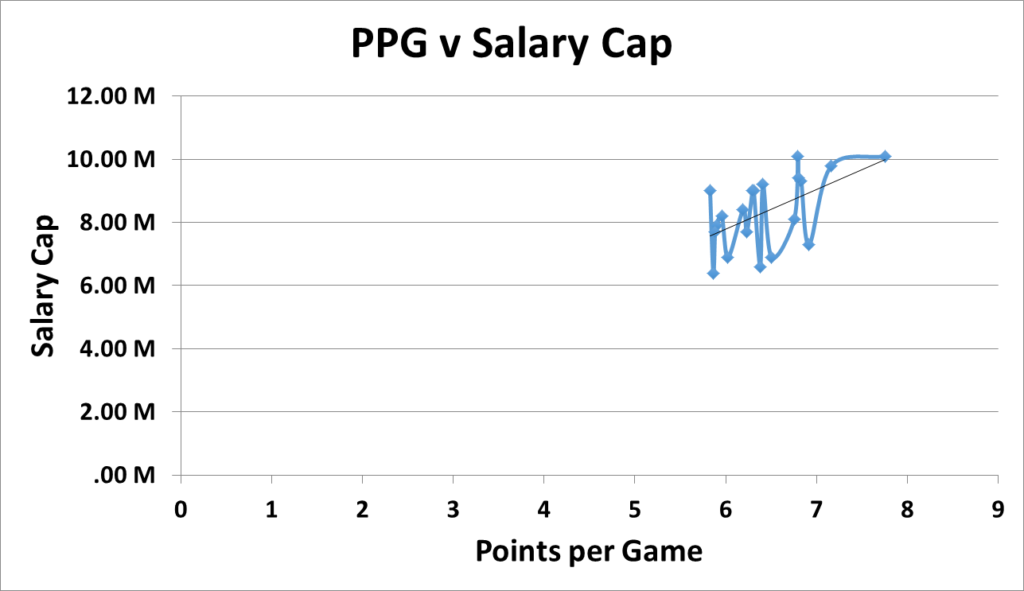
A best-fit line provided a useful reference point for estimating whether a defender was expensive, fairly priced or potentially undervalued.
Players positioned below the expected salary level for their projected output could represent value selections.
However, average performance alone was not enough.
The upcoming fixture still needed to be considered.
How to Identify Good-Value Defenders
The original case study recommended a four-step selection process.
1. Rank Defenders by Consistency
Begin by identifying players who regularly produce positive points through tackles, interceptions, passing, minutes played and fouls won.
Consistent involvement creates a stronger fantasy floor than relying only on goals, assists or clean sheets.
2. Estimate Goals-Conceded Risk
Consider how many goals each team is expected to concede in the upcoming fixture.
Compare that forecast with the team’s normal defensive record and the strength of the opposition.
A defender facing a weak attack may have greater clean-sheet potential, while one facing sustained pressure could earn more through defensive actions.
3. Compare Projected Points with Salary
Estimate the defender’s likely score for the fixture and compare that projection with his price.
The objective is to find players whose expected output exceeds the level implied by their salary.
4. Confirm the Player Is Expected to Start
A defender cannot provide value from the bench.
Always check team news, injuries, suspensions, rotation risk and likely formations before submitting a fantasy line-up.
This remains one of the most important principles in every fantasy football format.
Defender Consistency Rankings
The following table was used to rank defenders according to their consistency within the Mondogoal scoring model.
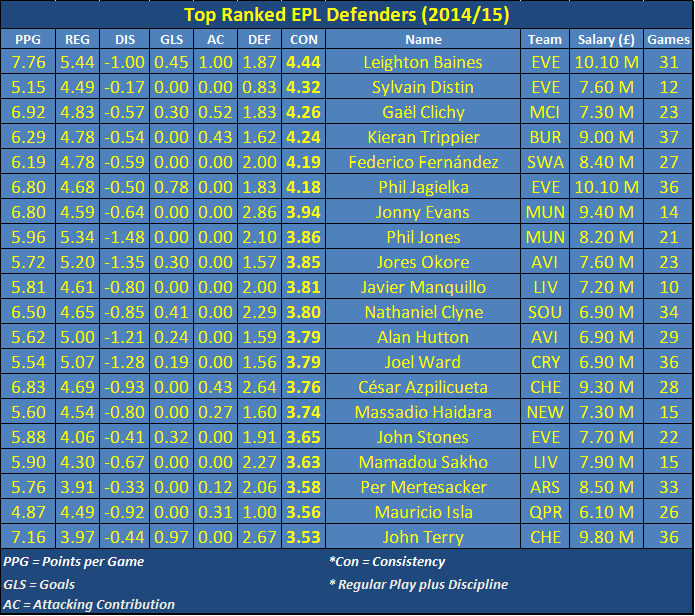
The rankings helped distinguish reliable defenders from players whose average scores were influenced by occasional goals, assists or unusually strong individual performances.
For daily fantasy football, reliability was particularly important because managers were selecting players for one fixture rather than an entire season.
Attacking Defenders and Salary Inflation
Goals and assists can produce large fantasy returns, but they are difficult to predict.
Defenders known for attacking output were often priced at a premium, meaning managers paid in advance for the possibility of a goal or assist.
This did not automatically make them poor selections.
However, the higher salary had to be justified by additional factors such as:
- Set-piece responsibility.
- Crossing volume.
- Touches in advanced areas.
- Expected assists.
- Shots inside the penalty area.
- Clean-sheet probability.
A cheaper defender with strong regular-play statistics could sometimes offer a better points-per-salary return.
Applying the Lessons to Modern Fantasy Football
Modern fantasy platforms use different scoring systems, but the same analytical framework remains valuable.
Before selecting a defender, consider:
- Expected minutes and likelihood of starting.
- Clean-sheet probability.
- Goals-conceded expectations.
- Attacking involvement.
- Set-piece duties.
- Tackles, interceptions and recoveries.
- Passing volume and progressive involvement.
- Disciplinary risk.
- Salary or transfer cost.
The best defender is not necessarily the player from the strongest team.
It is the player whose expected contribution offers the greatest value within the rules of the game being played.
Key Lessons from the Case Study
Do Not Rely on Clean Sheets Alone
Defenders who earn points through regular involvement can remain productive even when their team concedes.
Consistency Creates a Reliable Floor
Tackles, interceptions, passing and minutes played provide more dependable returns than occasional goals or assists.
Attacking Potential Must Be Priced Correctly
A defender’s attacking role can justify a premium, but only when the expected returns outweigh the additional cost.
Fixture Context Matters
Team strength, opposition quality, expected possession and goals-conceded risk should all influence selection.
Team News Is Essential
Always confirm that a player is expected to start before committing salary or a transfer to him.
Historical Context
This case study was originally produced using Mondogoal scoring and Premier League data from the 2014/15 season.
The platform-specific salaries, player rankings and scoring categories should therefore be viewed as a historical record of daily fantasy football strategy at that time.
The analytical method remains relevant: separate scoring into components, measure consistency, project the fixture and compare expected output with cost.
