
AI in Football Scouting, Analysis & Recruitment
Admin
- posted on
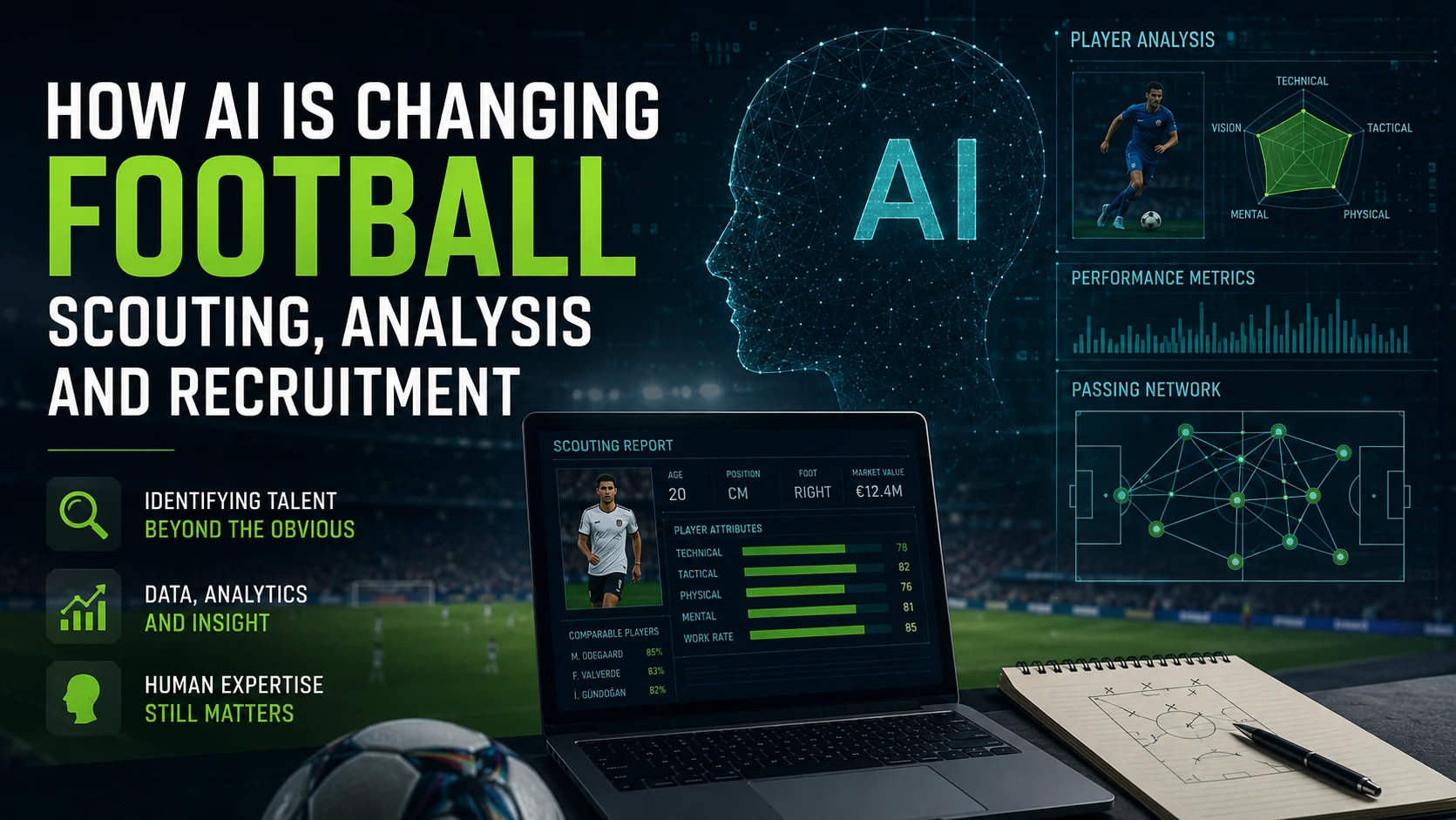
Artificial intelligence is becoming another tool in modern football’s search for an edge. From identifying potential signings to analysing matches and assessing player performance, clubs increasingly have access to technology capable of processing far more information than any individual scout or analyst.
That does not mean football is about to hand recruitment decisions to machines. The more interesting development is how artificial intelligence can complement traditional scouting, analytics and football expertise.
From the Scout’s Notebook to the Data Platform
Football scouting was traditionally built around observation. Scouts travelled to matches, watched players repeatedly and produced reports based on technical ability, tactical awareness, mentality and potential.
That expertise remains valuable, but the amount of information available to clubs has expanded enormously.
Modern recruitment departments can analyse thousands of players across multiple leagues using event data, tracking information, video and performance metrics. Instead of beginning with a shortlist created entirely through personal networks and observation, clubs can use data to identify players whose characteristics fit a particular requirement.
Artificial intelligence potentially makes that process faster and more sophisticated.
Finding Players Who Fit the System
Recruitment is not simply about identifying the player with the best statistics.
A striker suited to a counter-attacking team may not necessarily perform the same role effectively in a side dominating possession. A full-back asked to overlap constantly requires different attributes from one expected to move into midfield during possession.
Modern analysis can therefore examine players according to their tactical profile rather than simply ranking goals, assists or appearances.
Passing patterns, defensive actions, movement, pressing behaviour, ball progression and positioning can all contribute to a much broader picture of how a footballer actually plays.
AI-assisted systems can help recruitment departments search those enormous datasets for players displaying particular combinations of characteristics.
Discovering Players Beyond the Obvious Markets
One of the most interesting applications is the potential to widen football’s recruitment network.
Traditional scouting resources are finite. Even wealthy clubs cannot physically watch every player in every professional competition.
Data provides an initial filter.
A player performing in a less prominent league can potentially be identified because their underlying performance resembles players operating successfully at a higher level.
That does not prove the player will succeed after a transfer. Differences in league quality, tactics, culture and physical demands remain significant.
But it can put players on a recruitment department’s radar who might otherwise have been overlooked.
AI and Match Analysis
The same principles extend beyond recruitment.
Football clubs already generate enormous quantities of information from matches and training. Analysts can study passing networks, pressing structures, defensive positioning, transitions and individual player actions.
AI can assist by identifying recurring patterns within that information.
An opposition analyst might want to understand where a team becomes vulnerable when possession is lost. A coaching department may want to identify how opponents progress the ball against a particular pressing structure.
Technology can help process the information, allowing analysts to spend more time interpreting what it means.
The Human Scout Still Matters
There is an obvious danger in assuming that more data automatically produces better decisions.
Footballers are human beings rather than collections of performance metrics.
Personality, adaptability, communication, injury history, motivation and the ability to cope with a different country or club environment can all determine whether a transfer succeeds.
Some qualities are also difficult to capture adequately through statistics alone.
A scout watching a player repeatedly may notice decision-making, communication or reactions to difficult moments that are not immediately apparent in a dataset.
The strongest recruitment model is therefore unlikely to be AI replacing scouts. It is more likely to combine technology with experienced football judgement.
Analytics Have Already Changed Football
This evolution did not begin with artificial intelligence.
Football has gradually become more comfortable with analytical concepts that were once considered specialist terminology. Expected goals (xG), expected assists (xA), pressing metrics and detailed positional data are now routinely discussed by coaches, analysts, journalists and supporters.
Fantasy football has played its own part in that change. Fantasy managers have spent years studying fixtures, player roles, minutes, shot volumes, set pieces and underlying statistics in an attempt to predict future performance.
The tools have become more sophisticated, but the fundamental question remains familiar: what information helps us make a better decision?
AI Will Not Remove Uncertainty
Football’s unpredictability is precisely why analysis can never provide perfect answers.
A highly rated signing can struggle. An overlooked academy player can become a star. Tactical systems change, managers leave and injuries alter careers.
Artificial intelligence cannot eliminate those uncertainties.
What it can potentially do is help clubs organise information, identify patterns and narrow the enormous pool of possible decisions into something their scouts, analysts and coaches can investigate more intelligently.
The Next Competitive Advantage
Football has always searched for marginal gains.
Sports science, video analysis, nutrition, recruitment databases and performance analytics all became competitive advantages before gradually becoming normal parts of professional football.
AI may follow a similar path.
The clubs that benefit most are unlikely to be those that simply possess the newest technology. The advantage will come from knowing which questions to ask, understanding the limitations of the information and combining technological capability with genuine football expertise.
Machines can process the data.
Football people still have to make the decision.

