
Liverpool 0–1 Arsenal: When Staying on Your Feet Costs You a Penalty, Football Has a Problem
Admin
- posted on
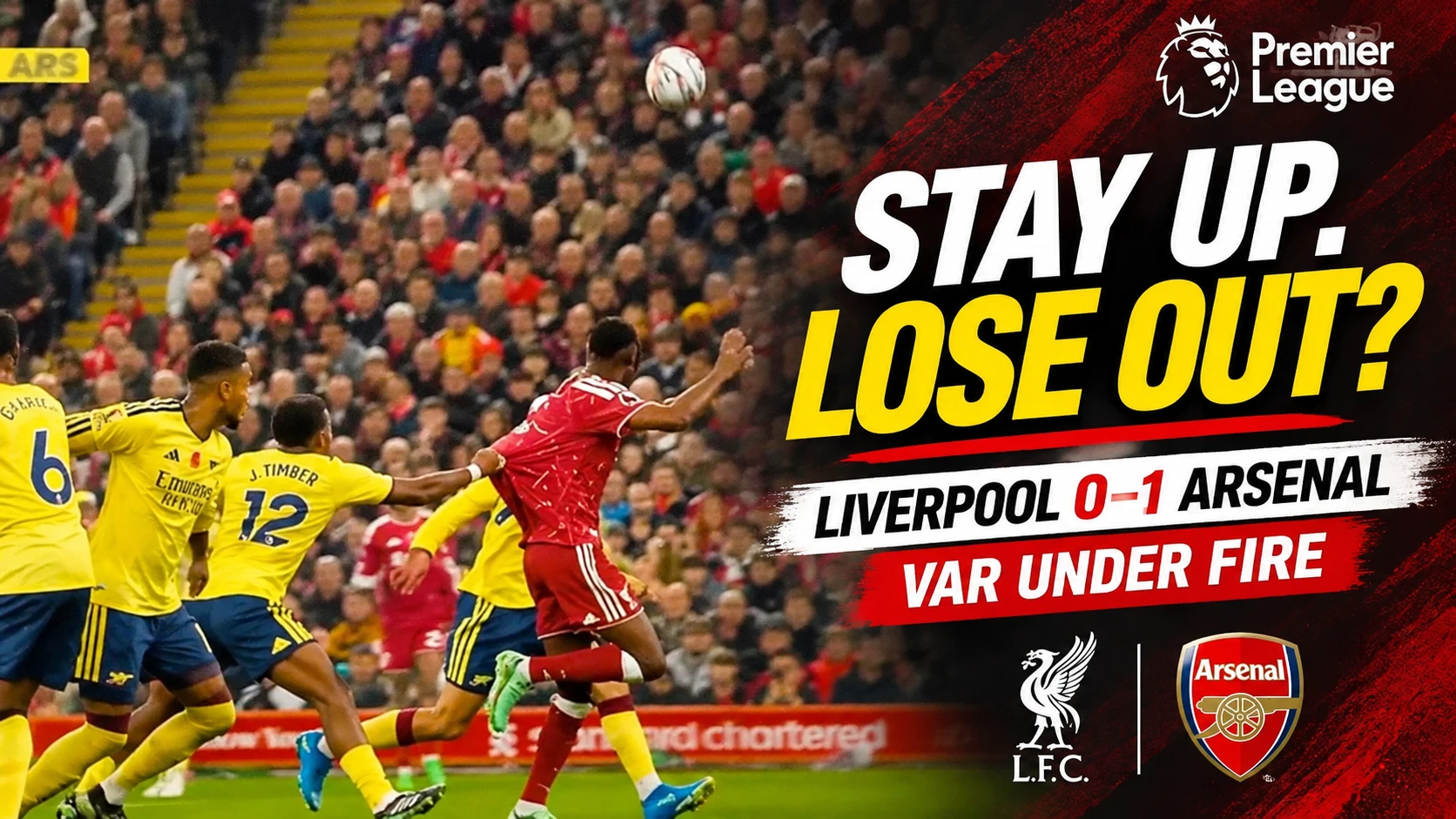
Arsenal left Anfield with three points, a three-point lead at the top of the Premier League and their first league victory at Liverpool in 14 years. Yet the biggest talking point on Sunday evening was not Kai Havertz’s winning goal. It was a Liverpool striker who refused to fall over.
Alexander Isak was trying to reach Bradley Barcola’s cross when Arsenal defender Jurriën Timber grabbed his shirt. The contact was visible, the pull was clear, and Isak’s attempt to reach the ball was affected. Referee Andy Madley allowed play to continue, and VAR Stuart Attwell did not recommend a review.
Isak stayed on his feet. Liverpool received nothing.
Afterwards, Liverpool manager Andoni Iraola suggested that the lesson for his players was obvious: next time, they should go down.
It was a remarkable admission from a Premier League manager, but perhaps the more remarkable thing is that so many football supporters understood exactly what he meant.
We have reached a strange point in modern football when a player trying to remain upright can appear to be putting his own team at a disadvantage.
 Liverpool’s Penalty Appeal Was About More Than a Shirt Pull
The incident came shortly after Arsenal had taken the lead through Havertz in the 16th minute.
Barcola delivered a dangerous ball into the Arsenal penalty area, with Isak moving towards it. Timber, positioned behind the Liverpool forward, took hold of his shirt as the striker attempted to make contact.
Isak still managed to get his head towards the ball, but his effort went wide.
There was no theatrical collapse, no exaggerated reaction and no desperate appeal to the referee. Isak simply continued trying to score.
That should not count against him.
Under football’s laws, holding an opponent can constitute a direct-free-kick offence, and a direct-free-kick offence committed by a defender inside their own penalty area can result in a penalty. A player does not have to fall to the ground for a foul to occur.
The important question is whether the holding actually impeded the opponent.
In this case, Timber’s grip was not incidental contact between two players competing for position. He visibly pulled Isak’s shirt while the Liverpool forward was attempting to reach a cross.
There is a strong argument that Liverpool should have been awarded a penalty.
Instead, the on-field decision stood, and the debate moved immediately to VAR.
What Exactly Is VAR Supposed to Be Correcting?
Video assistant referees are not expected to intervene every time there is physical contact in a penalty area. Football remains a contact sport, and not every push, tug or collision warrants a foul.
VAR also operates under a high threshold for overturning an on-field decision. It is designed to correct clear and obvious errors, not to re-referee every challenge.
That principle makes sense in theory.
The difficulty comes when supporters can watch a replay showing a defender pulling an attacker’s shirt, see the attacker struggling to reach the ball, and then watch the match restart without any intervention.
What are they supposed to conclude?
That the contact was insufficient? That Isak was not prevented from playing the ball? That the referee’s original decision was not clearly wrong enough to justify intervention?
Those are different explanations, and the distinction matters.
If VAR decides that a shirt pull has not materially affected the attacker, supporters deserve to understand why. Otherwise, the system risks appearing arbitrary, even when officials believe they are applying the correct threshold.
We have discussed this wider problem before in our examination of Premier League VAR, refereeing controversy and common sense.
The technology is not necessarily the problem. Cameras can show what happened. The difficulty is deciding how that evidence should be interpreted and ensuring similar incidents receive similar decisions.
When those interpretations become difficult to explain, confidence in the system suffers.
Iraola’s Diving Comment Exposes an Uncomfortable Truth
Andoni Iraola’s post-match comments were understandably provocative.
The Liverpool manager argued that Isak’s honesty had worked against him. Had the striker fallen to the ground when Timber pulled his shirt, Iraola believed the officials would have awarded a penalty.
He went further, suggesting that he would tell his players to go down in comparable situations in future.
That is hardly the message football wants its managers delivering.
Players should not be encouraged to deceive referees, and simulation remains something the sport should actively discourage. But Iraola was making a wider point about how decisions are reached.
There is an important difference between inventing contact and making genuine contact more obvious.
When a defender commits a foul but the attacker stays upright, the offence should not suddenly become less serious. Equally, an exaggerated fall should not transform minimal contact into an automatic penalty.
Yet the suspicion persists that officials are more likely to recognise an offence when the attacking player ends up on the ground.
That creates precisely the wrong incentive.
Imagine two identical challenges. In one, the attacker tries to continue and loses the opportunity to score. In the other, he falls dramatically and demands a penalty.
If the second player is more likely to receive the decision, football is effectively rewarding the reaction rather than judging the offence.
And that is the real concern raised by Iraola’s comments.
It is easy to criticise players for going down too easily. It becomes harder to sustain that criticism when managers believe staying on their feet reduces their chances of receiving a legitimate decision.
Not Every Liverpool Appeal Was Equally Convincing
There was another Liverpool penalty appeal involving Cody Gakpo and Arsenal’s Christos Tzolis.
Gakpo was held as he attempted to move towards the ball, but the officials decided against awarding a penalty.
That incident was less convincing than the Isak challenge.
The position of the ball and whether Gakpo had a realistic opportunity to reach it were relevant considerations. Iraola himself acknowledged the reasoning behind the decision, even though he remained unhappy about the earlier incident.
That distinction is worth making.
Criticising a refereeing decision does not mean insisting that every appeal from the same team must be upheld. There will always be judgement calls, particularly in crowded penalty areas.
There was also a separate flashpoint involving Noni Madueke and Alexis Mac Allister, when the players came together and their foreheads made contact. VAR reviewed the confrontation but did not recommend a red card.
Again, the context and intensity of the contact matter.
VAR should be capable of distinguishing between genuine violent conduct and a heated confrontation that does not meet the threshold for dismissal.
The argument is not that Liverpool should have received every decision. It is that the Isak incident deserved a more convincing explanation than the one supporters were left with.
Arsenal Still Deserve Credit for Winning at Anfield
None of the refereeing controversy should obscure what Arsenal achieved.
Winning at Anfield is difficult at the best of times. Doing so after a disappointing midweek League Cup exit to Fleetwood Town required a considerable response from Mikel Arteta’s players.
Arsenal provided one.
Havertz’s goal came from Liverpool’s failure to play out cleanly from the back. Arsenal recovered possession, Declan Rice advanced down the right and delivered a low cross that Havertz converted at the far post.
It was a well-executed attacking move, but one made possible by Liverpool’s own mistake.
From that point, the home side enjoyed periods of sustained pressure.
Florian Wirtz struck the crossbar with a free-kick, while Alexis Mac Allister missed an excellent headed opportunity before half-time. Liverpool had enough possession and territory to trouble Arsenal, but they struggled to turn that pressure into accurate finishing.
For all their attempts, Liverpool failed to register a shot on target.
Arsenal, meanwhile, remained disciplined. Their defensive organisation restricted Liverpool’s opportunities, and when the visitors found space on the counterattack, they threatened to extend their lead.
Alisson had to produce an excellent save to deny Tzolis in the second half.
It was not a flawless Arsenal performance, and Arteta will know his team benefited from the penalty decision. But winning a difficult away match while defending under pressure is part of what makes a credible title challenger.
Arsenal did not need to dominate every minute to deserve recognition for the result.
They scored, defended their advantage and took the points.
What Arsenal’s Victory Means for the Premier League Title Race
The wider significance of Sunday’s result should not be underestimated.
Arsenal’s victory moved them three points clear of Manchester City, who had suffered a surprising 1-0 home defeat to Brighton the previous day.
It also left Liverpool nine points behind the league leaders.
At this stage of the season, those gaps are not decisive. There is far too much football remaining to declare the championship settled in November.
But the psychological importance is considerable.
For Arsenal, winning at Anfield removes a long-standing obstacle. Their previous league victory there came in 2012, and successive Arsenal teams have struggled to turn promising performances into three points on Merseyside.
This time, they found a way.
It is the sort of result that can reinforce belief inside a dressing room, particularly after a disappointing cup defeat.
For Manchester City, the weekend represents a missed opportunity. Their defeat to Brighton gave Arsenal the chance to establish breathing space, and Arteta’s side took it.
For Liverpool, the situation is more troubling.
They are nine points adrift, have now lost twice under Iraola and continue to experience difficulties converting attacking pressure into goals.
The penalty controversy will dominate discussion, but Liverpool cannot afford to allow it to become an excuse for their wider problems.
A team with their attacking resources should not need a refereeing decision to register its first shot on target.
That is a separate issue, and one Iraola will need to address.
Are Arsenal Becoming the Team Others Must Chase?
There is a difference between leading the Premier League table and looking capable of staying there.
Arsenal’s performance at Anfield offered evidence of both their strengths and their limitations.
They showed resilience, concentration and the ability to take advantage of an opponent’s mistake. They also spent long periods defending rather than controlling the match through possession.
Some will see that as a sign of maturity. Others will argue that the best teams should be able to impose themselves more consistently.
Both observations have merit.
Championships are rarely won through attractive football alone. The eventual winners usually collect points on afternoons when circumstances are uncomfortable, performances are imperfect and opponents refuse to make life easy.
Arsenal managed that at Anfield.
The next challenge is maintaining the same standards when they are expected to dominate, beginning with their home fixture against Hull City.
Manchester City remain close enough to apply pressure, while Liverpool still have time to recover ground. But Arsenal have earned the advantage they currently hold.
They should be judged on how they use it, not merely on the controversy surrounding one match.
The Real VAR Problem Is What Football Is Teaching Its Players
There will be arguments about Timber’s challenge for days, perhaps longer.
Arsenal supporters will point to a disciplined defensive display and a historic away victory. Liverpool supporters will argue that a clear shirt pull denied Isak a legitimate opportunity to score.
Both discussions are part of football.
What should concern everybody, regardless of club allegiance, is the implication of Iraola’s reaction.
When a Premier League manager believes he must tell his players to fall over to receive decisions, something has gone wrong with the relationship between refereeing and the game itself.
That does not mean officials should award penalties whenever somebody goes to ground. Quite the opposite.
They should judge the offence, the degree of contact and its effect on the player, whether the attacker falls, stumbles or somehow manages to stay upright.
VAR was introduced to help officials make better decisions. It was not supposed to make footballers better actors.
The Isak incident illustrates why the distinction matters.
Arsenal have every right to celebrate a significant victory, and their position at the top of the Premier League is thoroughly deserved on the evidence of the season so far.
But Liverpool’s frustration deserves to be heard too.
Football should never reach a point where a striker is punished for trying to play football rather than trying to win a decision.
If that is the lesson players take from Anfield, the refereeing debate has become bigger than one missed penalty.
Fantasy Sports Portal | 2 November 2026
Editorial analysis based on the Liverpool–Arsenal match, official match statistics, televised incidents and post-match comments from both managers.

