
Why Football Data Is Becoming More Valuable Than Ever
Admin
- posted on
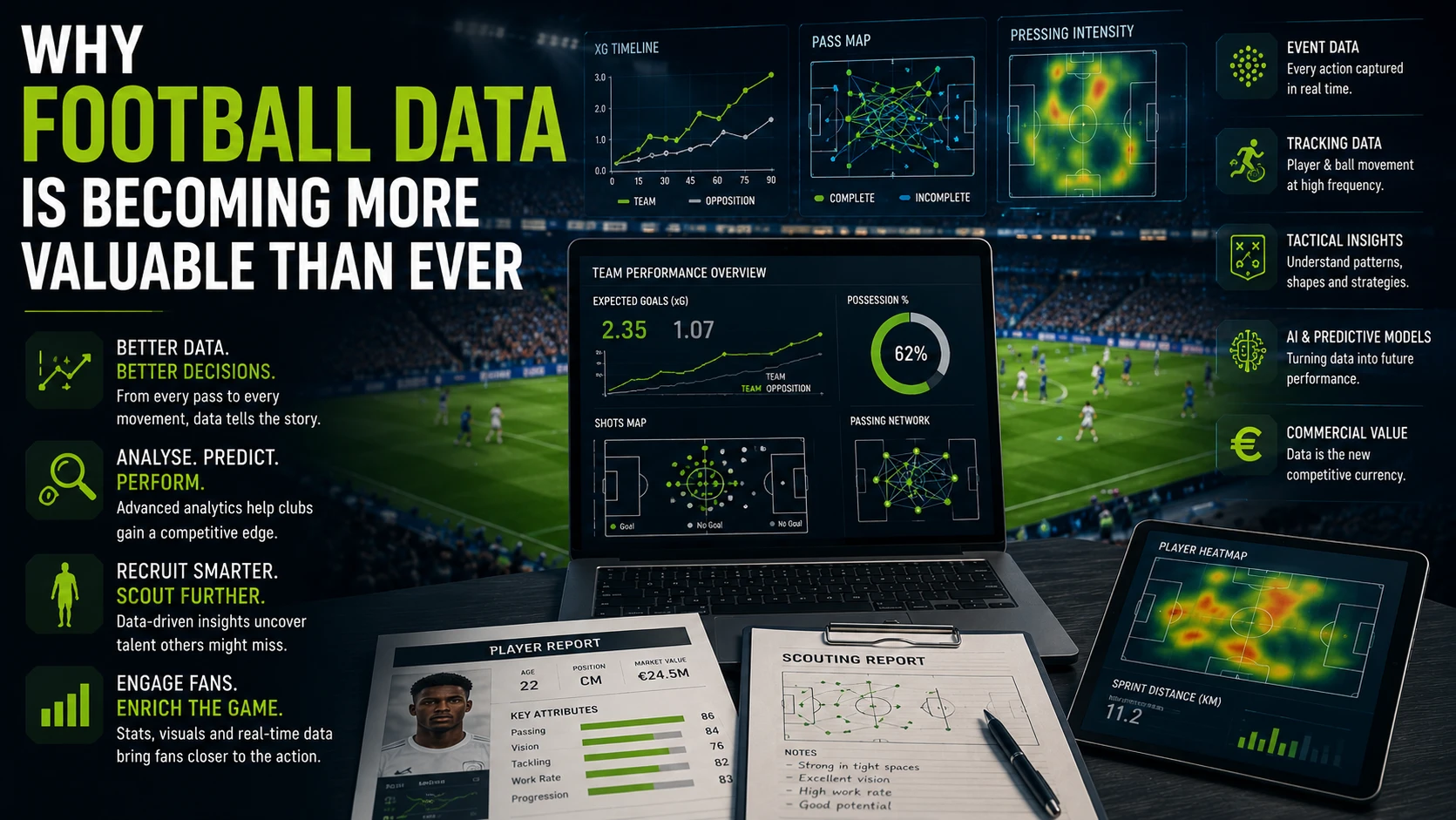
Football has always produced statistics, but the modern game is generating information on an entirely different scale. Every pass, shot, movement, defensive action and tactical pattern can now become part of a dataset used by clubs, broadcasters, analysts and technology companies.
The result is an industry developing alongside the sport itself: football data.
What began with relatively simple match statistics has evolved into sophisticated systems capable of describing where players move, how teams press, how possession develops and even the probability that particular actions will lead to a goal.
Football Statistics Have Changed
For generations, football statistics were relatively straightforward.
Goals, appearances, league positions and perhaps shots or possession provided most of the numerical information available to supporters.
Those numbers remain useful, but modern analysis goes considerably further.
Event data can record actions such as passes, tackles, interceptions, crosses and shots together with where they occurred on the pitch.
Tracking systems can add another dimension by recording the position and movement of players throughout a match.
Combine those sources and analysts can begin examining football in ways that were previously impossible.
Expected Goals Changed the Conversation
Few analytical concepts demonstrate the transformation better than expected goals, commonly known as xG.
Rather than treating every shot equally, an expected-goals model estimates the probability of a particular chance resulting in a goal based on characteristics such as location, angle and type of opportunity.
The concept gives analysts another way of evaluating attacking performance beyond the final score.
It has also travelled far beyond specialist analytics departments.
Expected goals is now routinely discussed during football broadcasts, in newspaper analysis and among supporters.
What once appeared to be specialist terminology has become part of mainstream football language.
From xG to a Much Bigger Analytical Picture
Expected goals is only one part of modern football analytics.
Expected assists can help evaluate the quality of chances created by passes. Passing networks can illustrate how teams circulate possession. Pressing statistics can provide clues about how aggressively teams attempt to regain the ball.
Other models attempt to measure progression, possession value and the contribution of actions occurring long before a shot is taken.
No individual metric explains football perfectly.
Together, however, they provide analysts with additional evidence when trying to understand why teams and players perform as they do.
Recruitment Makes Data Commercially Valuable
The importance of football data becomes particularly clear in player recruitment.
A successful transfer can be worth millions to a football club. A poor one can be enormously expensive.
Recruitment departments therefore have a powerful incentive to gather as much useful information as possible before making decisions.
Data allows clubs to screen large numbers of players and identify those whose performance characteristics appear suitable for a particular tactical system or position.
Scouts can then investigate those candidates in greater depth.
When transfer decisions involve substantial fees and long-term contracts, even a small improvement in decision-making can have significant financial value.
Data Is Changing Match Preparation
Coaches and analysts also use information to prepare for opponents.
Where does a team usually progress the ball? Which areas do they attack? How aggressively do they press? Where might space appear when possession changes?
Video has always helped coaches answer these questions.
Data allows analysts to examine recurring patterns across far larger samples of matches.
The objective is not to reduce football to numbers. It is to identify tendencies that coaches can then interpret using their tactical knowledge.
Broadcasters Want More Data Too
Football data is not confined to clubs.
Broadcasters increasingly use statistics to explain matches to viewers. Graphics can illustrate shot locations, possession patterns, player movement and probabilities while a match is taking place.
Digital platforms can go further by allowing supporters to explore statistics themselves.
As football broadcasting becomes more interactive, real-time data could become an increasingly important part of the viewing experience.
Fantasy Football Helped Create Data-Literate Supporters
Fantasy football has also played an important role in changing how supporters think about statistics.
Fantasy managers naturally look for information capable of predicting future performance.
Goals scored last week are useful, but shots, chances created, minutes played, set-piece responsibilities, expected goals and upcoming fixtures may provide better clues about what happens next.
That encourages supporters to think more like analysts.
Instead of simply asking which player scored, fantasy managers increasingly ask whether that performance is sustainable.
Who Owns Football Data?
As information becomes more valuable, an important commercial question emerges: who owns it?
Collecting high-quality sporting data requires infrastructure, technology and access. Once collected, that information can potentially be licensed to clubs, broadcasters, media organisations, gaming companies and other commercial partners.
This means football data is not merely an analytical resource.
It can also be intellectual property with significant commercial value.
Competitions and clubs therefore have good reason to think carefully about how their data is collected, distributed and monetised.
Artificial Intelligence Makes Data Even More Important
The growth of artificial intelligence adds another dimension.
AI systems are particularly powerful when they can process large quantities of structured information and identify patterns within it.
Football provides exactly that kind of environment.
As datasets become larger and more detailed, AI-assisted analysis may help clubs investigate tactical patterns, recruitment profiles and performance trends that would be extremely difficult to identify manually.
But the quality of the output still depends heavily on the quality of the underlying information.
Better algorithms cannot compensate for poor data.
Numbers Still Need Context
The growth of analytics does not mean football can be understood entirely through spreadsheets.
A player may produce different numbers because their tactical role changed. A team’s statistics may be influenced by injuries, opponents, game state or the instructions of a new manager.
Two identical statistical outcomes can sometimes have completely different explanations.
That is why interpretation remains so important.
Data can tell analysts what happened and help reveal patterns. Football knowledge is still required to understand why.
Football’s Information Economy
The value of football data is likely to continue increasing as clubs, media organisations and technology platforms become more sophisticated.
Better tracking will produce richer datasets. Artificial intelligence will make increasingly complex analysis possible. Broadcasters will find new ways of presenting information to supporters.
And fans themselves will continue becoming more comfortable with concepts that once belonged almost exclusively to professional analysts.
Football remains a game of goals, decisions and unpredictable moments.
But behind those moments, an increasingly valuable information economy is developing.

