
Multi-lingual Lukaku Becoming ‘Unplayable’
FSPortal
- posted on
Last updated: 25 August 2026
Romelu Lukaku at Everton: When the Belgian Striker Became Unplayable
By the autumn of 2016, Romelu Lukaku was no longer simply one of the Premier League’s most promising young strikers.
He was developing into one of its most dangerous.
Ronald Koeman had replaced Roberto Martínez at Everton and the early signs suggested that a more controlled, structured team could provide Lukaku with an even better platform from which to attack.
Fantasy Sports Portal examined his numbers at the time and found a forward performing at arguably the highest level of his career to that point.
Looking back a decade later, those performances represented another important stage in the development of a striker who would eventually score goals across several of Europe’s biggest leagues.
Everton Were Changing Under Ronald Koeman
Everton entered the 2016/17 season under new management after Koeman replaced Martínez.
The changes were visible quickly.
Idrissa Gueye strengthened the midfield, while Everton appeared more capable of controlling matches and preventing opponents from dictating play.
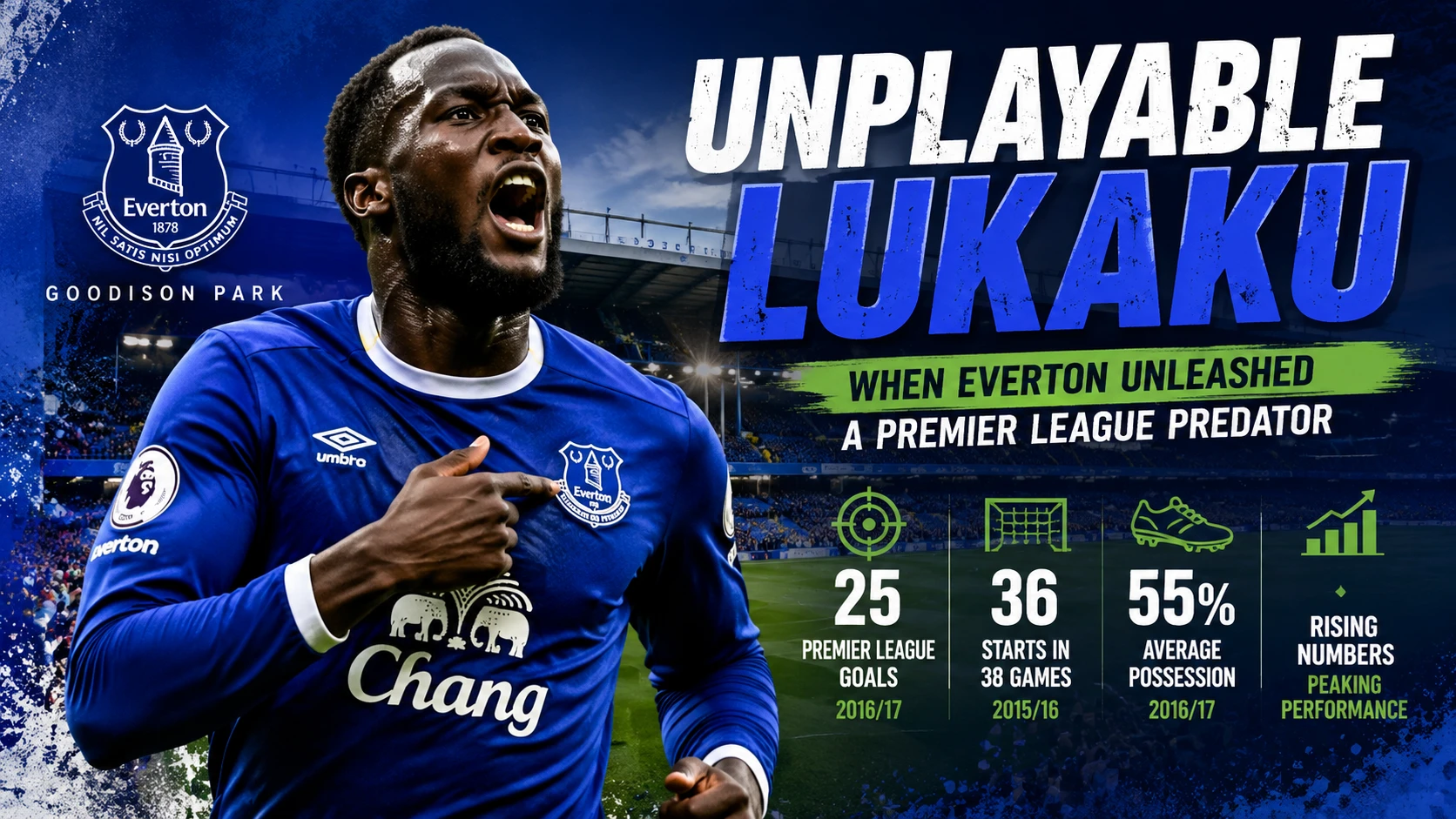
The Toffees were averaging approximately 55% possession during the opening stages of the campaign, but possession itself was not the most important development.
Everton were also creating opportunities and generating shots.
As we noted in our original Gameweek 6 fantasy football analysis, those improvements had obvious implications for the team’s principal goalscorer.
Why Romelu Lukaku Was the Biggest Beneficiary
Lukaku already possessed most of the physical attributes required of an elite centre-forward.
He was powerful enough to compete with centre-backs, quick enough to attack space behind them and increasingly composed when opportunities arrived inside the penalty area.
What he needed was a team capable of supplying those opportunities consistently.
A better-functioning Everton midfield meant Lukaku could spend more time occupying dangerous positions rather than becoming isolated from the rest of the attack.
For fantasy football managers, that distinction mattered enormously.
A talented striker playing in a dysfunctional attack can be frustrating. Put the same player into a side consistently creating chances and his fantasy potential changes considerably.
The Numbers Were Beginning to Match the Reputation
Lukaku had been described as potentially “unplayable” from relatively early in his career.
By 2016, performances were increasingly justifying that description.
His game was becoming about considerably more than physical power.
He could attack defenders in several ways:
- running behind a high defensive line;
- holding off centre-backs with his strength;
- attacking crosses inside the penalty area;
- finishing quickly when chances fell to him; and
- carrying the ball into space on transitions.
That variety made him increasingly difficult to defend.
A Remarkably Experienced Young Striker
One of the unusual things about Lukaku in 2016 was the amount of senior football he had already played despite still being only 23.
He had made his senior breakthrough with Anderlecht as a teenager before Chelsea brought him to England in 2011.
Loan spells with West Bromwich Albion and Everton demonstrated his Premier League goalscoring ability before Everton signed him permanently in 2014.
By the beginning of the 2016/17 season, Lukaku was therefore simultaneously a young player and an experienced Premier League striker.
That combination made the possibility of another substantial improvement particularly interesting.
Availability Added to Lukaku’s Fantasy Value
Goals are only useful to fantasy managers when a player is on the pitch.
Lukaku’s availability was consequently another significant attraction.
He started 36 of Everton’s 38 Premier League matches during the 2015/16 campaign, demonstrating an ability to cope with the physical demands placed on a first-choice centre-forward.
There had been previous injury interruptions, including ankle and thigh problems, but he had generally avoided the repeated absences that can undermine the fantasy value of otherwise outstanding attackers.
Regular starts, penalty-area involvement and a team increasingly capable of creating chances represented an attractive combination.
The 2016/17 Season Confirmed the Breakthrough
The question at the beginning of that campaign was whether Lukaku could genuinely challenge the Premier League’s established elite goalscorers.
His answer was emphatic.
Lukaku scored 25 Premier League goals in 2016/17, comfortably the best league return of his Everton career.
Only Tottenham’s Harry Kane finished above him in the race for the Premier League Golden Boot.
The original Fantasy Sports Portal analysis had asked whether Lukaku could challenge Sergio Agüero.
He did more than that: Lukaku finished the league season with more goals than the Manchester City striker.
From Everton to Manchester United
Lukaku’s performances inevitably attracted interest from clubs competing regularly for major trophies.
Manchester United signed him from Everton in the summer of 2017.
The move represented another substantial step in his career and placed him under considerably greater scrutiny.
He scored regularly at Old Trafford, including 27 goals in all competitions during his first United season, but his time at the club also illustrated the different demands placed on a striker at one of world football’s most closely watched teams.
Inter Milan and Lukaku’s Reinvention in Italy
A move to Inter Milan in 2019 provided another major chapter.
Under Antonio Conte, Lukaku became the focal point of an attack designed to exploit many of his strongest qualities.
His combination with Lautaro Martínez was particularly effective, while his strength in transition and ability to occupy defenders became fundamental to Inter’s system.
The result was both individual and collective success.
Inter won Serie A in 2020/21, ending Juventus’ long run of domestic championships, with Lukaku playing a central role.
A Career Across Europe’s Biggest Leagues
Lukaku’s career after Everton became considerably more complicated than the straightforward upward trajectory that appeared possible in 2016.
He returned to Chelsea in 2021, later went back to Inter, spent a season with Roma and subsequently continued his career in Italy with Napoli.
Different managers and tactical systems produced different versions of Lukaku.
At his best, however, the characteristics visible at Everton remained recognisable: power, direct running, penalty-area presence and an ability to score heavily when playing within a system suited to his strengths.
What Fantasy Managers Could Learn From Lukaku
The original article provides a useful fantasy football lesson because Lukaku’s improvement was connected to changes occurring around him.
Fantasy managers sometimes focus almost entirely on the individual player.
But attacking output is influenced heavily by team environment.
Useful indicators include:
- team shot volume;
- chances created;
- possession in attacking areas;
- the striker’s expected minutes;
- penalty responsibility;
- quality of supporting players; and
- changes in tactical structure.
Everton were improving several of those areas under Koeman.
Lukaku was the player positioned to benefit most.
Multi-Lingual Lukaku Did His Talking on the Pitch
The original title of this article played on reports about Lukaku’s impressive ability to speak multiple languages.
But during the 2016/17 season, his most persuasive communication came through goals.
Twenty-five of them in the Premier League confirmed that the outstanding early-season numbers were not simply a temporary run of form.
They were evidence of a striker approaching his peak.
Looking back, Everton in 2016 was one of the clearest periods in Lukaku’s career when opportunity, physical ability, confidence and tactical environment aligned.
Fantasy managers noticed it early.
The rest of the Premier League soon did too.
Explore more: Football history, analysis and features from Fantasy Sports Portal.

