
The International Break Nobody Wants: Is Football Asking Too Much of Its Players?
Admin
- posted on
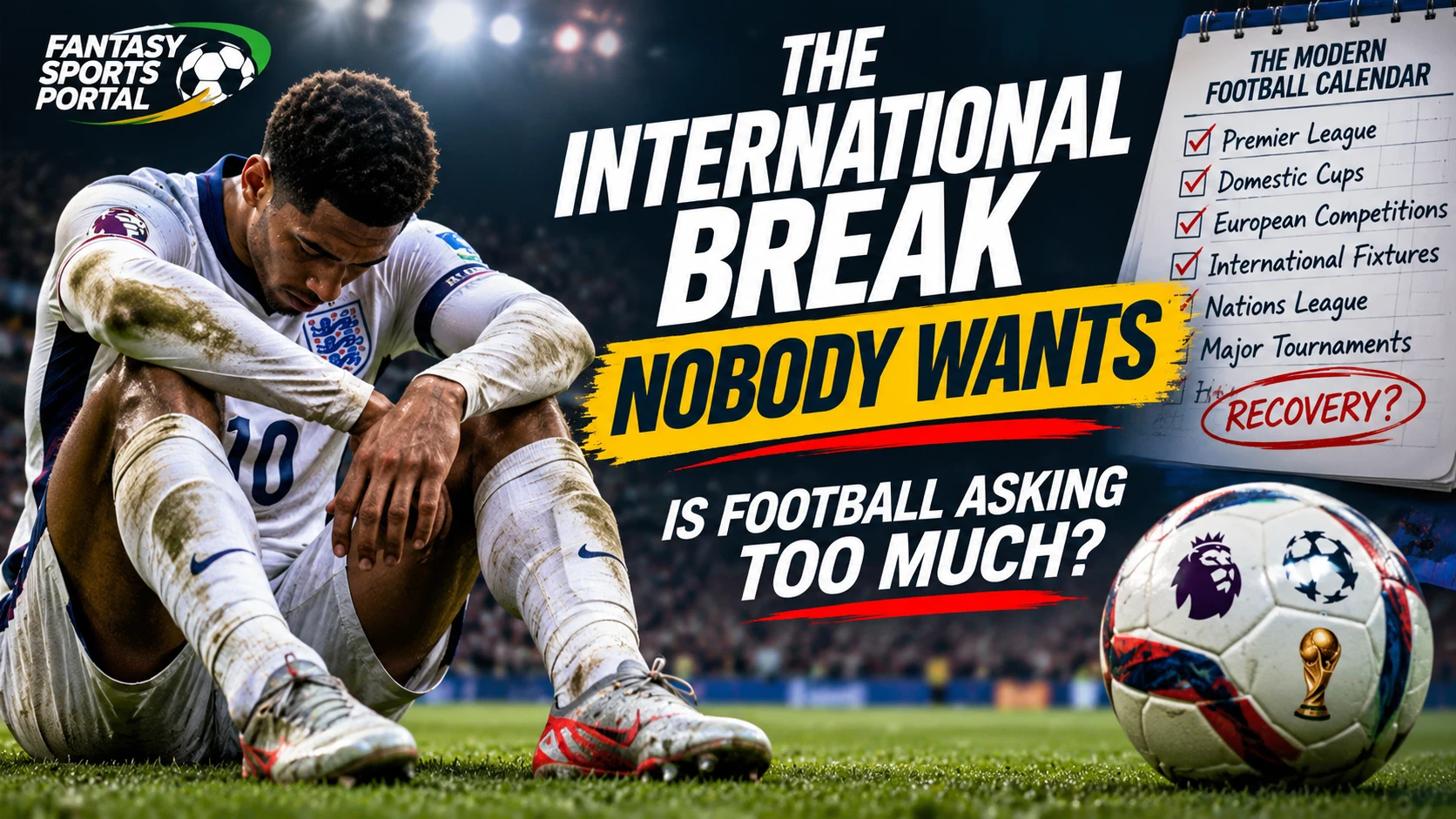
Another international break. Another round of complaints from club managers, anxious supporters and exhausted footballers. The Premier League has barely settled into its rhythm, yet once again the domestic season stops while players pack their bags and head off to represent their countries.
For supporters, it can feel like an unwelcome interruption. For club managers, it means watching valuable players disappear into somebody else’s care. For international coaches, however, these few days together are essential. They are expected to build competitive teams without the luxury of working with their players every week.
All three perspectives are understandable.
But as the November international break begins, there is a bigger question worth asking. Has football reached the point where everybody wants more matches, more competitions and more revenue, but nobody is prepared to accept responsibility for the consequences?
Because the problem is no longer simply the international break. It is everything surrounding it.
Another Break, but This One Comes After an Unusual Autumn
The November international window runs from 9 to 17 November 2026, allowing national teams to play up to two matches.
Ordinarily, that would attract relatively little attention. International football has been part of the calendar for generations, and clubs have always had to accommodate it.
What makes this autumn different is the experiment that preceded it.
For 2026, FIFA combined the traditional September and October international windows into one extended period running from 21 September to 6 October. National teams could play four matches rather than the usual two in each separate window.
The thinking was understandable. Fewer interruptions to domestic football, less repeated international travel and longer periods for national coaches to work with their squads.
On paper, there were advantages.
In practice, the arrangement created considerable dissatisfaction.
Several European football associations raised concerns about the demands of playing four international fixtures in a concentrated period. Smaller associations also faced logistical and financial pressures, while injuries and player fatigue became prominent talking points.
By October, some national football officials were already calling for the arrangement to be reconsidered.
That should tell us something.
When even the organisations responsible for running international teams begin questioning the international calendar, the debate has moved beyond club managers complaining about losing players for a fortnight.
Football Has Become Very Good at Finding Space for Another Match
Consider the demands placed on an established international footballer at a leading European club.
There is the domestic league, domestic cup competitions and European football. Depending on the country and club, there may also be another cup competition, a super cup or an expanded international club tournament.
Then come the national-team commitments.
World Cup qualifiers, continental championships, the Nations League and major international tournaments all compete for space in the same calendar.
And when the competitive season finally ends, there may be commercial tours, pre-season friendlies and promotional obligations waiting.
Individually, many of these commitments are perfectly reasonable.
The problem emerges when they are added together.
A club sees its own fixtures as essential. A national association considers its matches equally important. Competition organisers have broadcasting agreements to honour, sponsors to satisfy and commercial expectations to meet.
Each organisation can justify its own schedule.
Very few appear willing to take responsibility for the combined workload.
That is the contradiction at the heart of modern football.
What Does the Evidence Say About Player Workload?
The concerns are not based solely on the complaints of highly paid footballers.
FIFPRO, the global representative organisation for professional players, has spent years monitoring the demands placed on footballers competing across club and international competitions.
Its research has highlighted the consequences of sustained fixture congestion, insufficient recovery periods and extensive travel.
In its September 2025 workload report, FIFPRO warned that players involved in the expanded Club World Cup had experienced inadequate opportunities for rest and preparation before returning to domestic football.
Some elite players were repeatedly required to compete with fewer than five days between appearances. Others faced long journeys immediately after international matches, leaving very limited time to recover before returning to their clubs.
The problem extends beyond the number of minutes spent on the pitch.
Travel, disrupted sleep, training, rehabilitation, media commitments and the pressure to remain available all contribute to a player’s working demands.
In March 2026, FIFPRO representatives again warned that several prominent Premier League players were facing seasons involving more than 70 matches when club and international commitments were considered together.
That does not mean every player appearing 70 times will suffer an injury. Physical resilience varies, and well-managed training can help players cope with demanding schedules.
But recovery is not optional.
Muscles, tendons and joints require time to adapt after intense competition. Repeatedly reducing that time increases the challenge of managing fatigue and injury risk.
Football has become increasingly sophisticated in measuring performance. Clubs monitor training loads, sleep, acceleration, sprinting and recovery in extraordinary detail.
Yet the organisations arranging the fixtures continue to produce a calendar that can undermine much of that careful work.
Club Versus Country Is the Wrong Argument
Whenever a player returns injured from international duty, the familiar argument begins.
Club supporters complain that their team has lost an important player. National-team supporters insist that representing one’s country should remain a privilege. Managers on both sides defend their decisions.
But framing the issue as club versus country misses the point.
International football matters.
For many players, representing their country is the highest honour of their career. For supporters in smaller footballing nations, international matches provide occasions that domestic club football simply cannot replicate.
The World Cup remains one of sport’s great events precisely because national football carries a meaning beyond contracts, transfer fees and commercial success.
We should be careful not to lose that.
Nor should Premier League clubs pretend they are innocent parties.
English clubs benefit enormously from commercial tours, lucrative European competitions and increasingly international business models. They are hardly reluctant to travel thousands of miles when there is a financial incentive.
It is difficult to criticise national associations for scheduling matches while simultaneously treating additional club fixtures as an opportunity for growth.
Both sides want access to the same players.
Neither can reasonably expect those players to be available indefinitely.
The September–October Experiment Deserves a Proper Review
The decision to combine the September and October international windows was not inherently foolish.
There is a reasonable argument that one longer break causes less disruption than two separate interruptions. Players may also benefit from avoiding repeated long-haul journeys within a short period.
For domestic leagues, a single extended pause could make scheduling more predictable.
But reducing the number of international windows does not automatically reduce player workload.
If the same number of matches is squeezed into a shorter competitive period, the pressure simply moves elsewhere.
Four games in a concentrated international window can leave limited time for recovery, tactical preparation and travel between fixtures.
For countries with smaller squads, the challenge is particularly acute. They cannot always rotate players as freely as the world’s strongest national teams.
And while wealthy associations may have extensive medical, logistical and performance departments, others operate with considerably fewer resources.
The calendar should not be designed solely around the needs of Europe’s biggest clubs or most commercially successful national teams.
If the experiment is to continue, its impact needs to be assessed properly.
That means examining injuries, recovery periods, travel demands, player availability and the financial consequences for national associations, rather than judging success simply by whether domestic leagues experienced fewer interruptions.
Supporters Are Entitled to Feel Frustrated Too
There is another group whose interests are frequently overlooked in discussions about football’s calendar: the supporters.
Fans build their weekends around domestic fixtures. They follow developing title races, relegation battles and local rivalries, only for the momentum to disappear when the international break arrives.
Some welcome the opportunity to watch their national teams. Others see it as an inconvenience, particularly when the matches have limited competitive significance.
Neither reaction is unreasonable.
Football supporters are also being asked to absorb an expanding range of subscriptions, ticket prices, travel costs and competitions.
More football is not necessarily better football.
A crowded calendar can make individual fixtures feel less significant. When important matches arrive every three days, even memorable performances risk being forgotten almost immediately.
There is value in anticipation.
There is value in giving a major fixture time to matter before attention shifts to the next one.
And there is certainly value in allowing players to arrive at those matches physically capable of performing at their best.
Should Players Simply Be Rotated More Often?
One response to fixture congestion is that managers should use their squads more intelligently.
There is some truth in that.
Modern elite clubs have access to larger playing squads, sophisticated sports-science departments and detailed information about individual workloads.
Managers cannot reasonably demand that the calendar change while insisting on selecting the same players for every match.
Rotation must be part of the solution.
But it cannot be the entire solution.
Not every club has the financial resources to maintain two equally competitive teams. National associations have limited access to their players and cannot always afford to rest their strongest performers during important qualifying matches.
There is also the competitive pressure.
When a manager’s job depends on results, leaving a fit star player on the bench can be a difficult decision, even when the longer-term medical evidence suggests that rest would be sensible.
Football cannot rely entirely on individual managers voluntarily sacrificing short-term results to solve a structural problem created by competition organisers.
There must be clearer safeguards that apply across the game.
What Would a Sensible Football Calendar Look Like?
There is no simple solution that will satisfy clubs, national associations, broadcasters, players and supporters equally.
But several principles should guide any serious reform.
First, recovery periods need meaningful protection. Players should have adequate time between demanding matches, particularly after international travel, and a genuine opportunity for rest between seasons.
Second, competition expansion should be assessed collectively. FIFA, UEFA, domestic leagues and national associations cannot continue adding fixtures without considering the demands already placed on the same group of players.
Third, players need a stronger voice. Their representatives should participate meaningfully in decisions about scheduling, rather than being consulted only after new competitions have been approved.
Fourth, clubs and countries must coordinate medical information responsibly. A player’s fitness should not become a contest between two employers or coaching staffs with competing short-term priorities.
Finally, football should be prepared to acknowledge that some fixtures may simply be unnecessary.
Not every commercial opportunity needs to become another tournament. Not every international window requires the maximum possible number of matches.
And not every competition becomes more valuable simply because it gets bigger.
Our Verdict: The International Break Is Not the Enemy
It is tempting to blame the international break whenever the Premier League disappears from our screens.
But international football is not an unwelcome addition to the sport. It is an essential part of its history, identity and appeal.
The real problem is that the calendar is being pulled in too many directions by organisations that all believe their competitions deserve priority.
FIFA wants a successful international game. UEFA wants strong continental competitions. Domestic leagues want commercial growth. Clubs want more opportunities to compete and generate revenue.
All of them have legitimate interests.
But the players cannot be everywhere at once.
As another international break begins, football should resist the familiar argument about whether club or country matters more.
That debate has been running for decades and has achieved very little.
The more important question is whether the sport is prepared to organise itself around the physical limits of the people who actually play it.
Because there is a difference between asking elite athletes to perform at the highest level and expecting them to perform without sufficient recovery indefinitely.
Football does not need to choose between club and country. It needs to stop pretending that the calendar has unlimited space.
Until that happens, every international break will bring the same arguments, the same anxieties and the same uncomfortable questions about who is really looking after the players.
Fantasy Sports Portal | 9 November 2026
Sources and Further Reading
- FIFA — International Match Calendar 2026
- FIFPRO — Player Workload Monitoring Report, September 2025
- FIFPRO — Player Workload and Welfare, March 2026
- Bundesliga — Why the September–October International Break Changed

