
How Streaming Is Changing Football Broadcasting
Admin
- posted on
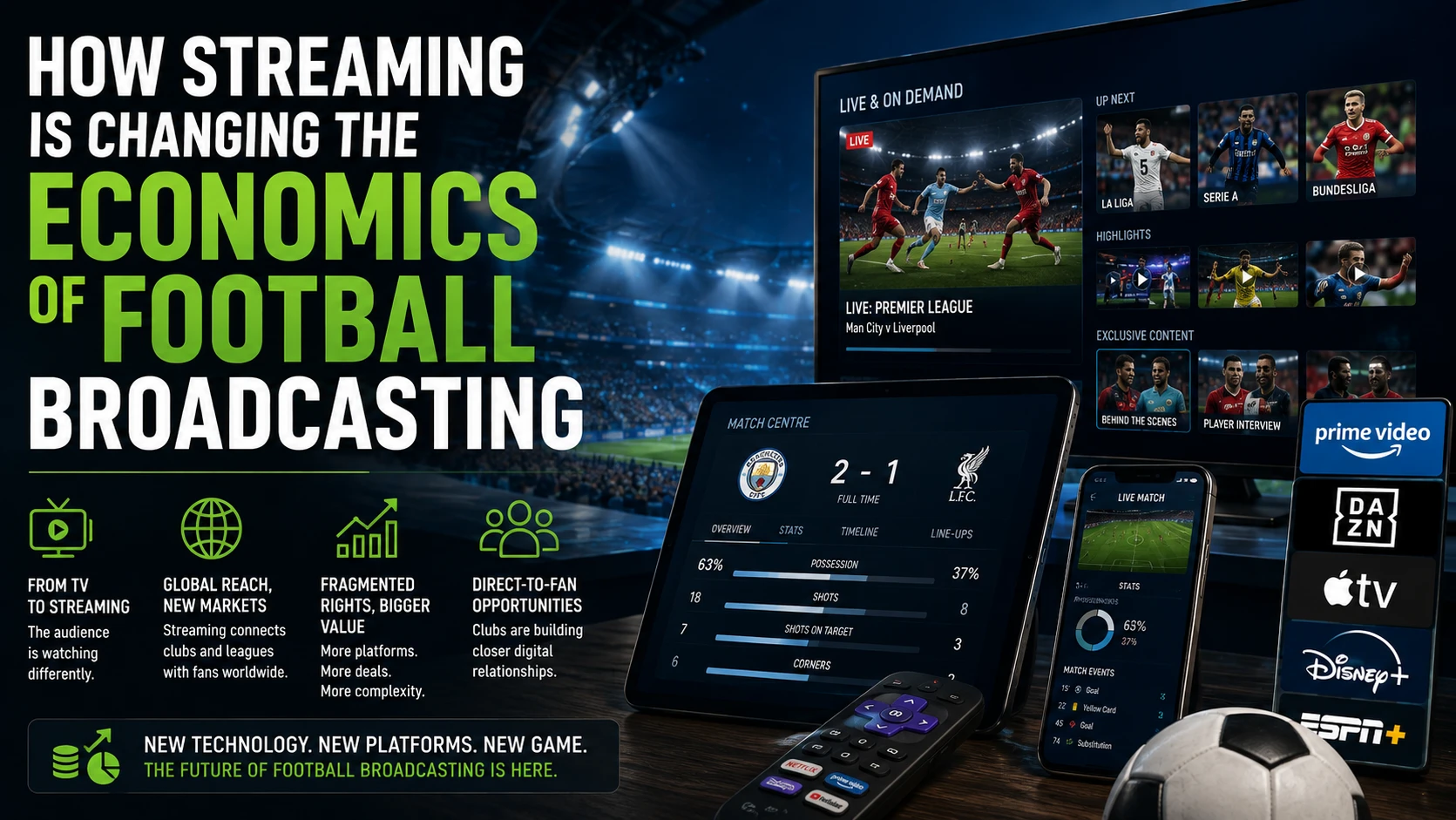
For decades, television broadcasting has been one of the financial engines of professional football. But the way supporters watch the game is changing. Streaming platforms, direct-to-consumer services and increasingly fragmented media rights are challenging the traditional relationship between football and television.
The change is about much more than whether a supporter watches a match on a television or a mobile phone. It could ultimately influence how competitions sell their rights, how clubs reach international audiences and where football’s future media revenue comes from.
How Television Transformed Football
Broadcasting money helped transform professional football from a predominantly matchday business into a global entertainment industry.
For major competitions, the ability to sell live television rights created revenue streams far larger than clubs could generate through ticket sales alone.
That money flowed through the game, influencing transfer fees, player salaries, stadium development and the commercial value of competitions themselves.
Television also changed football’s audience. Supporters no longer needed to live near a club or attend matches to follow a team every week.
Football became global.
The Audience Is Moving Online
The traditional television model is now competing with a very different media environment.
Supporters increasingly consume entertainment through internet-connected televisions, mobile devices, streaming services and social platforms. Younger audiences in particular have grown up expecting content to be available whenever and wherever they want it.
Football cannot ignore that shift.
Broadcasters have responded by developing their own streaming services, while technology companies and digital platforms have become increasingly important participants in the sports-media market.
The distinction between a broadcaster and a technology company is becoming less obvious.
Football Rights Are Becoming More Fragmented
For supporters, one consequence has been fragmentation.
A single competition may have different broadcasting arrangements across dozens of countries. Within individual markets, rights can also be divided between multiple broadcasters and streaming services.
That can maximise the value of media packages, but it can also make following football more complicated and expensive.
A supporter who once needed one television subscription may now require several services to watch every competition involving their club.
The commercial logic for rights holders is understandable. The long-term question is how much fragmentation supporters will tolerate.
Why Live Football Remains So Valuable
Football possesses something increasingly rare in modern media: an audience that still wants to watch content at a specific time.
A drama series can be watched tomorrow. A film can be paused and continued later. A major football match loses much of its value once the result is known.
That makes live sport particularly attractive to broadcasters and streaming platforms trying to retain subscribers and create appointment viewing.
It also explains why premium football rights can remain valuable even as traditional television audiences change.
Could Clubs Eventually Go Direct to Supporters?
Streaming technology creates an intriguing possibility: football organisations developing stronger direct relationships with their audiences.
Clubs already operate websites, applications, video channels, membership platforms and subscription services. Competitions increasingly have their own digital ecosystems as well.
In theory, technology makes it possible for rights holders to distribute more content directly to supporters rather than relying entirely on traditional broadcasters.
In practice, the economics are more complicated.
Broadcasters provide enormous guaranteed payments, production expertise, distribution and marketing. Replacing that infrastructure with a direct subscription model would transfer considerable commercial risk to leagues and clubs.
The future may therefore involve hybrid models rather than the disappearance of broadcasters altogether.
The Global Supporter Changes the Equation
Streaming also removes many of the geographical limitations associated with traditional broadcasting.
A supporter in Asia, Africa or the Americas can follow a European club almost as closely as somebody living near the stadium.
For football organisations, that international audience represents far more than television viewers.
Global supporters can become subscribers, merchandise customers, social-media followers, fantasy football players and members of digital communities.
The value of broadcasting is therefore increasingly connected to the wider digital relationship between a club and its audience.
Highlights Are Part of the Battle Too
Not every supporter consumes football through complete 90-minute matches.
Highlights, short-form video, statistics, commentary and social-media clips have become important parts of the modern football experience.
For younger supporters especially, discovering a goal or incident through a mobile device may be just as natural as seeing it during a traditional television broadcast.
This creates another challenge for rights holders: protecting the value of premium live coverage while making enough content available to keep football visible across digital platforms.
What Does This Mean for Supporters?
The technological transition offers obvious benefits.
Streaming can provide greater flexibility, more devices, additional statistics, alternative commentary and access to competitions that traditional broadcasters might never have shown.
But there are disadvantages too.
Subscription fatigue, fragmented rights and geographical restrictions can make it surprisingly difficult for supporters to determine where a particular match is available.
The best technological solution is not necessarily the one generating the largest number of separate subscriptions.
Football Still Needs Reach
There is another economic consideration beyond immediate broadcasting revenue.
Football competitions need audiences.
Putting every match behind increasingly expensive subscription barriers may maximise short-term income while reducing exposure among younger or more casual supporters.
Free-to-air television historically introduced millions of people to major sporting events. Digital football will need to find its own balance between exclusivity and accessibility.
The Next Broadcasting Era
Traditional television is unlikely to disappear from football overnight. Nor will streaming automatically replace the existing broadcasting model.
Instead, the two are increasingly becoming part of the same ecosystem.
Broadcasters are becoming streaming platforms. Technology companies are becoming sports broadcasters. Clubs and competitions are becoming publishers.
For football, the fundamental commercial question remains unchanged: how much is access to the world’s most popular sport worth?
What is changing is who delivers it, how supporters watch it and how that value is ultimately distributed throughout the game.

